
Catalogue Search | MBRL


Are you sure you want to remove the book from the shelf?

{{itemTitle}}
772
result(s) for
"Catton, Bruce"
Sort by:

America Goes to War
The Pulitzer Prize–winning historian \"ranges informally but authoritatively\" across Civil War-related topics in a thought-provoking essay collection ( The New York Times).
Based on a lecture series delivered at Wesleyan University, these essays come from Bruce Catton, a New York Times–bestselling and National Book Award–winning author acclaimed as \"one of America's foremost Civil War authorities\" ( Kirkus Reviews). In them, he delves more deeply into the subject of the war and its meaning for America—addressing such issues as the psychology of the citizen soldier; the presidential career of Ulysses S. Grant; and what happens to civil liberties in wartime. He explores how the war compelled the nation to confront questions about race and democracy, and places the conflict in a wider context, identifying it as the world's first truly modern war.
\"Nothing in our time makes the Civil War as alive as the writings of Bruce Catton.\" — The Baltimore Sun
eBook


America Goes to War
A fascinating study of the first modern war and its effect on American Culture.
eBook

America goes to war : the civil war and its meaning in American culture
A fascinating study of the first modern war and its effect on American Culture.
eBook
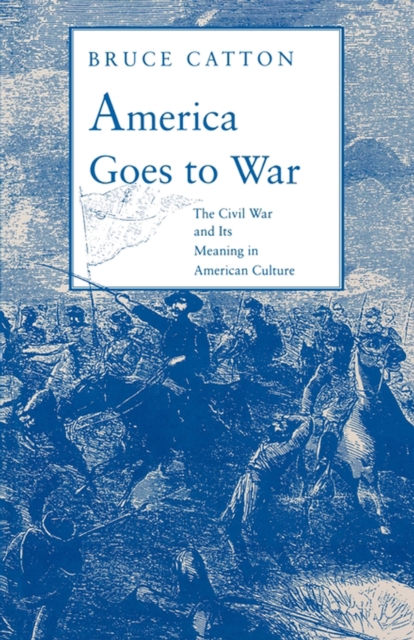
America goes to war
A fascinating study of the first modern war and its effect on American Culture.
eBook

Great Authors of Nonfiction
Of the many millions of books written over the course of history, only a relatively small percentage have been deemed classics. Authors of classic literature are those who have penned works definitive of a style, movement, era, or ethos. Their works are timeless in message and scope. This essential volume chronicles the lives of many literary luminaries--including Jane Austen, Charles Dickens, Ernest Hemingway, and Virginia Woolf--examining their early histories, journeys to success, and greatest tomes.
eBook
A Formula for Enjoying the War
Like Robert Penn Warren, Bruce Catton “soaked up Civil War history” in his youth at the turn of the twentieth century. For the man who would become the most prolific and popular historian of the war, that soaking occurred way up north in Michigan, in the “cut-over lumber country” almost three hundred miles northwest of Detroit. Into this “friendly, changeless world,” the boy named Charles Bruce Catton was born in 1899, in the little town of Petoskey. Soon afterward, the family moved a bit farther south to Benzonia, near beautiful Crystal Lake. His father, George R. Catton, was the devoutly
Book Chapter

Small mammal response to group selection silvicultural systems in Engelmann spruce-subalpine fir forests
We measured small mammal response to several different group selection silvicultural systems that varied by opening size (0.03, 0.13, and 1.0 ha) but maintained a consistent 30% area removal. The southern redbacked vole (Clethrionomys gapperi), followed by the common shrew (Sorex cinereus) and dusky shrew (S. monticolus), were the most abundant species pre- and post-harvest. There was no evidence that the minimum number alive estimates for red-backed voles differed significantly (α = 0.05) among treatments pre-harvest (ρ = 0.67) or post-harvest (1993, ρ = 0.98; 1994, ρ = 0.84). However, red-backed voles used harvested openings less than the surrounding forest within each treatment. Common shrews showed some preference for the unlogged controls and the treatment units containing 1.0-ha openings. Dusky shrews showed no treatment preference. Overall, we conclude that the group selection silvicultural systems did not substantially change the relatively rich, abundant small mammal community present before harvesting.
Journal Article