
Catalogue Search | MBRL


Are you sure you want to remove the book from the shelf?

{{itemTitle}}
4
result(s) for
"Centre for European Policy Studies (Brussels, Belgium)"
Sort by:

ECB banking supervision and beyond : report of a CEPS Task Force
With publication of the results of its Comprehensive Assessment at the end of October 2014, the European Central Bank has set the standard for its new mandate as supervisor. But this was only the beginning. The heavy work started in early November, with the day-to-day supervision of the 120 most significant banks in the eurozone under the Single Supervisory Mechanism. The centralisation of the supervision in the eurozone will pose a number of challenges for the ECB in the coming months and years ahead. This report analyses these challenges in detail, drawing on the discussions and presentations in the CEPS Task Force on ECB Banking Supervision, and reinforced by extensive research undertaken by the rapporteur.
Book
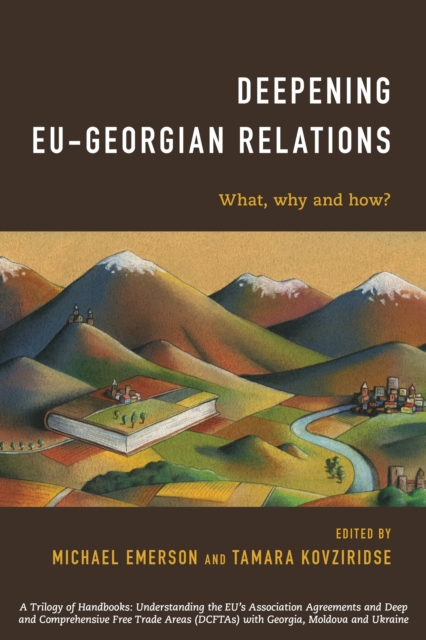
Deepening EU-Georgian relations
This handbook explains in readily comprehensible language what the new Association Agreement between the European Union and Georgia means in legal, political and economic terms. This treaty is a milestone in the history of Georgia's place in Europe, and definitively marks the country's post-Soviet independence. It is also a new model treaty for the EU's relations with its closest neighbours.
eBook


Deepening EU-Ukrainian Relations
The signing of the Association Agreement and DCFTA between Ukraine and the European Union in 2014 was an act of strategic, geopolitical significance in the history of Ukraine and Europe itself. Emblematic of a struggle to replace a corrupt, oligarch-controlled regime at home and to resist attempts by Russia to deny Ukraine its 'European choice', the Association Agreement is a defiant statement of the country's determination to become a democratic, independent state. The purpose of the Handbook is to make the content of this complex treaty clearly comprehensible. The first edition of this book has become an acknowledged 'bible' for all practitioners and scholars engaged in east European affairs.This second edition carries the story forward, with a systematic assessment of the achievements and problems that implementation of the treaty has been witnessing over the subsequent years.
eBook