
Catalogue Search | MBRL


Are you sure you want to remove the book from the shelf?

{{itemTitle}}
8
result(s) for
"Champagne, Marie Therese"
Sort by:

Both Text and Subtext: The Circulation and Preservation of Two Manuscripts of Nicolaus Maniacutius in Twelfth-Century Europe
Within European manuscript culture in the twelfth-century, a vast network of monastic and cathedral scholars circulated texts between their institutions, copying them, incorporating them into other manuscripts, and, in turn, preserving them. This study of the early circulation of two texts by Nicolaus Maniacutius (††† ca. 1145), a Cistercian scholar in Rome, reveals that they were incorporated into other codices in Rome, London, and northern England through different types of scholarly networks, and suggests some of the modes of transmission. How these texts were circulated clearly indicates how each text was valued, and demonstrates how \"““intellectual property\"”” was valued in twelfth-century Europe.
Journal Article


Christian Hebraism in Twelfth-Century Rome: A Philologist's Correction of the Latin Bible through Dialogue with Jewish Scholars and their Hebrew Texts
In mid-twelfth-century Rome, one clerical scholar, Nicolaus Maniacutius, honed his philological skills as he endeavoured to return the text of the Psalter to the original. Maniacutius met the challenge of editing Scripture in an unusual manner as a Christian Hebraist, consulting with Jewish scholars to compare the Vulgate Book of Psalms with the Jews’ Hebrew text. In doing so, he followed the example set by his scholarly predecessor, St Jerome, centuries earlier, as well as his contemporary, Hugh of St Victor. While scholars have acknowledged that Maniacutius consulted with Jews and learned Hebrew, the identity of the one or more Jewish scholar(s) remains obscure. The Sephardic scholar Abraham ibn Ezra lived in Rome c. 1140–1143, and while there wrote a commentary on the Psalms. Nicolaus also revised the Psalter and wrote of a ‘learned Spanish Jew’. This article explores the phenomenon of Christian Hebraism in mid-twelfth-century Rome through the life and work of Maniacutius, and presents evidence that supports Cornelia Linde's suggestion that Abraham ibn Ezra was the ‘learned Spanish Jew’ with whom Maniacutius worked. In addition, textual evidence supports Maniacutius's work within an informal, cross-confessional discourse community of Jewish and Christian scholars.
Journal Article
Popes and Jews: 1095-1291
Rebecca Rist has produced a valuable addition to current research on the relationship between the papacy and the Jews in the High Middle Ages (Popes and Jews: 1095-1291).
Book Review

The relationship between the papacy and the Jews in twelfth-century Rome: Papal attitudes toward biblical Judaism and contemporary European Jewry
The relationship of the papacy to the Jews in the Middle Ages, which had developed under the influences of Patristic writers, Roman law, and papal precedent, was marked in the twelfth century by toleration and increasing restriction, but also by papal protection. Between the First Crusade massacres of Jews and the restrictions and persecutions of the thirteenth century, the twelfth century is set apart as a unique era in the lives of European Jews. As Eugenius III (1145–1153) and Alexander III (1159–1181) extended their protection to the Jews of Rome and perhaps all of Christendom through the papal document Sicut Judaeis, and simultaneously proclaimed Christianity's doctrinal superiority over Judaism, the Roman Jews also acknowledged the pope as their temporal lord and ruler in Rome through their presentation of the Torah. Other motivations for that contractual relationship perhaps existed, including the popes' need for financial backing. Eugenius III and Alexander III lived in exile through much of their reigns and struggled to maintain control of the Patrimony, a major source of papal revenues. During the same era, Eugenius III and Alexander III publicly promoted the Church's inheritance of biblical Judaism in the claim that the Treasures of the Temple of Herod existed in the Lateran basilica. Lateran texts, special liturgical rituals, and papal processions through Rome reinforced that claim. At the same time, the attitudinal influences of the Cistercians Nicolaus Maniacutius and Bernard of Clairvaux on Eugenius, and the Jewish steward Jechiel in the papal household on Alexander, cannot be measured definitively but suggest a paradoxical relationship with the Jews. The history of continuing papal conflicts with the Roman Commune and the Holy Roman Emperor Frederick I Barbarossa confirms that Eugenius and Alexander unceasingly sought to establish their authority and power over Rome, the Patrimony, and Christendom throughout their papacies, and used popular perceptions that the Church possessed the Temple Treasures to buttress that authority. The popes' emphasis on biblical Judaism and actions toward the Roman and European Jews reflects a multi-faceted mosaic of papal attitudes toward the Jews and biblical Judaism between 1145 and 1181.
Dissertation
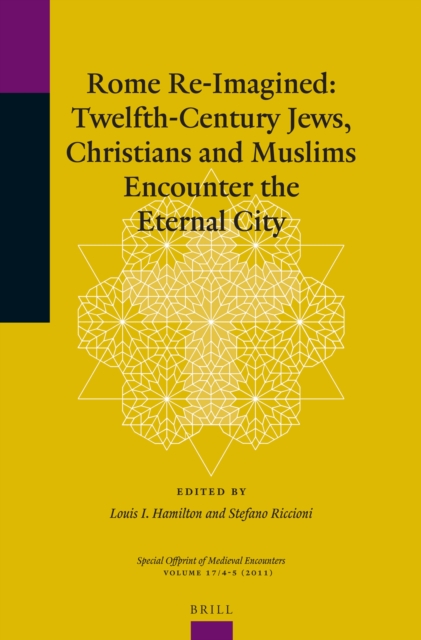
Rome re-imagined : twelfth-century Jews, Christians and Muslims encounter the Eternal City
This collection examines the image of Rome through Arabic, Greek, Hebrew, Latin, and Persian descriptions of the eternal city. Placing the twelfth-century renaissance into a Mediterranean context. The city of Rome is revealed as a multi-vocal object of desire and a contested ideal.
eBook

Three-dimensional structure of the single domain cupredoxin AcoP
Cupredoxins are widely occurring copper-binding proteins with a typical Greek-key beta barrel fold. They are generally described as electron carriers that rely on a T1 copper center coordinated by four ligands provided by the folded polypeptide. The discovery of novel cupredoxins demonstrates the high diversity of this family, with variations in term of copper-binding ligands, copper center geometry, redox potential, as well as biological function. AcoP is a periplasmic protein belonging to the iron respiratory chain of the acidophilic bacterium Acidithiobacillus ferrooxidans. AcoP presents original features: highly resistant to acidic pH, it possesses a constrained green-type copper center of high redox potential. To understand the unique properties of AcoP, we undertook structural and biophysical characterization of wild-type AcoP and of two Cu-ligand mutants (H166A and M171A). The crystallographic structure of AcoP at 1.65 A resolution unveils a typical cupredoxin fold with extended loops, never observed in previously characterized cupredoxins, that might be involved in the interaction of AcoP with its physiological partners. Moreover, the structure shows that the green color of AcoP cannot be attributed to nonclassical copper ligands, its green-colored copper center raising from a long Cu-S (Cys) bond, determined by both X-ray diffraction and EXAFS. The crystal structures of two AcoP mutants confirm that the active center of AcoP is highly constrained. Comparative analysis with other cupredoxins of known structures, suggests that in AcoP the second coordination sphere might be an important determinant of active center rigidity due to the presence of an extensive hydrogen bond network. Competing Interest Statement The authors have declared no competing interest.
Paper