
Catalogue Search | MBRL


Are you sure you want to remove the book from the shelf?

{{itemTitle}}
109
result(s) for
"Chander, Anupam"
Sort by:


Privacy and/or Trade
International privacy and trade law developed together but are now engaged in significant conflict. Current efforts to reconcile the two are likely to fail, and the result for globalization favors the largest international companies able to navigate the regulatory thicket. In a landmark finding, this Article shows that more than sixty countries outside the European Union are now evaluating whether foreign countries have privacy laws that are adequate to receive personal data. This core test for deciding on the permissibility of global data exchanges is currently applied in a nonuniform fashion with ominous results for the data flows that power trade today.
The promise of a global internet, with access for all, including companies from the Global South, is increasingly remote. This Article uncovers the forgotten and fateful history of the international regulation of privacy and trade that led to our current crisis and evaluates possible solutions to the current conflict. It proposes a Global Agreement on Privacy that would be enforced within the trade order, but with external data-privacy experts developing the treaty's substantive norms.
Journal Article

The Internet of Things: Both Goods and Services
International trade law, organized around the goods-services dichotomy, is about to meet the Internet of Things (IoT). How will rules written for the world of 1994 fare in a world of talking teapots and connected cars? IoT will especially raise governmental concerns with respect to privacy, security, and standards. Indeed, governments have already begun taking adverse measures against foreign IoT suppliers based not on the hardware, but on the digital features of the products. This paper argues that IoT devices comprise both goods and services, therefore calling into application multiple WTO disciplines, with the specific agreements that are applicable dependent on the particular governmental measure subject to challenge.
Journal Article

What Are Digital Trade and Digital Trade Law?
Digitization has greatly expanded the scope of trade, and with it the scope of trade law. But the regulatory framework, although growing in bilateral and regional fora, is highly dynamic and remains fragmented, increasing the challenges facing digital trade law.
Journal Article

The Electronic Silk Road
On the ancient Silk Road, treasure-laden caravans made their arduous way through deserts and mountain passes, establishing trade between Asia and the civilizations of Europe and the Mediterranean. Today's electronic Silk Roads ferry information across continents, enabling individuals and corporations anywhere to provide or receive services without obtaining a visa. But the legal infrastructure for such trade is yet rudimentary and uncertain. If an event in cyberspace occurs at once everywhere and nowhere, what law applies? How can consumers be protected when engaging with companies across the world?
In this accessible book, cyber-law expert Anupam Chander provides the first thorough discussion of the law that relates to global Internet commerce. Addressing up-to-the-minute examples, such as Google's struggles with China, the Pirate Bay's skirmishes with Hollywood, and the outsourcing of services to India, the author insightfully analyzes the difficulties of regulating Internet trade. Chander then lays out a framework for future policies, showing how countries can dismantle barriers while still protecting consumer interests.
eBook

Unshackling Foreign Corporations: Kiobel’s Unexpected Legacy
The Supreme Court’s ruling in Kiobel v. Royal Dutch Petroleum Co. disfavors American corporations. While largely unshackling foreign corporations from the risk of being haled before an American court to answer for human rights abuses abroad, the decision keeps American corporations constrained by human rights law. This inconsistency exists because application of the Alien Tort Statute (ATS), as announced in Kiobel, turns on whether a corporation’s actions “touch and concern” the United States. American corporations are simply far more likely to satisfy that standard than foreign corporations.
Journal Article
Unshackling foreign corporations: 'Kiobel 's' unexpected legacy
The Supreme Court's ruling in 'Kiobel v. Royal Dutch Petroleum Co'. disfavors American corporations. While largely unshackling foreign corporations from the risk of being haled before an American court to answer for human rights abuses abroad, the decision keeps American corporations constrained by human rights law. This inconsistency exists because application of the Alien Tort Statute (ATS), as announced in 'Kiobel', turns on whether a corporation's actions \"touch and concern\" the United States. American corporations are simply far more likely to satisfy that standard than foreign corporations.
Journal Article

Googling Freedom
While GM and GE rushed into China, why did so many Americans cheer the possibility of Google pulling out? The answer to this puzzle lies in Google's special role as new media. Television once moved the free speech paradigm from the local street corner to the national platform of CBS; the Internet has shifted it further to the global stage offered by Google and its peers. Free speech theory— and Western media corporations—must now grapple with the reach of this media into unfree societies. While a growing chorus has denounced Western new media enterprises for betraying their obligations to the people of China and other authoritarian regimes, no one has yet explained what those obligations are or why these companies might have them. Corporate social responsibility theory has focused largely on the risks of a global supply chain in goods, neglecting the questions raised by the rise of global information services. The notion of corporate obligations to people around the world seems especially perplexing in juxtaposition with the familiar mandate to maximize shareholder wealth at home. Drawing from theories of Foucault and Habermas and the history of the underground press, I argue that information service providers bear a special responsibility to unfree people. What might have been mutually beneficial transactions in a free society can become, in an unfree society, predicate offenses leading to years of hard labor. New media can either help give voice to dissidents or help perfect totalitarianism.
Journal Article
Everyone's a Superhero: A Cultural Theory of \Mary Sue\ Fan Fiction as Fair Use
Lieutenant Mary Sue took the helm of the Starship Enterprise, saving the ship while parrying Kirk's advances. At least she did so in the unofficial short story by Trekkie Paula Smith. \"Mary Sue\" has since come to stand for the insertion of an idealized authorial representative in a popular work. Derided as an exercise in narcissism, Mary Sue is in fact a figure of subaltern critique, challenging the stereotypes of the original. The stereotypes of popular culture insinuate themselves deeply into our lives, coloring our views on occupations and roles. From Hermione Granger-led stories, to Harry Potter in Kolkata, to Star Trek same-sex romances, Mary Sues re-imagine our cultural landscape, granting agency to those denied it in the popular mythology. Lacking the global distribution channels of traditional media, Mary Sue authors now find an alternative in the World Wide Web, which brings their work to the world. Despite copyright law's grant of rights in derivative works to the original's owners, we argue that Mary Sues that challenge the orthodoxy of the original likely constitute fair use. The Mary Sue serves as a metonym for all derivative uses that challenge the hegemony of the original. Scholars raise three principal critiques to such fair use: (1) why not write your own story rather than borrowing another's? (2) even if you must borrow, why not license it? and (3 won't \"recoding\" popular icons dstabilize culture? Relying on a cultural theory that prizes voice, not just exit, as a response to hegemony, we reply to these objections here. \"Gee, golly, gosh gloriosky,\" thought Mary Sue as she stepped on the bridge of the Enterprise. \"Here I am, the youngest Lieutenant in the fleet-only fifteen and half years old.\" Captain Kirk came up to her. \"Oh, Lieutenant, I love you madly. Will you come to bed with me?\" \"Captain! I am not that kind of girl!\" \"You're right, and I respect you for it. Here, take over the ship for a minute while I go for some coffee for us.\" Mr. Spock came onto the bridge. \"What are you doing in the command seat, Lieutenant?\" \"The Captain told me to.\" \"Flawlessly logical. I admire your mind.\"
Journal Article
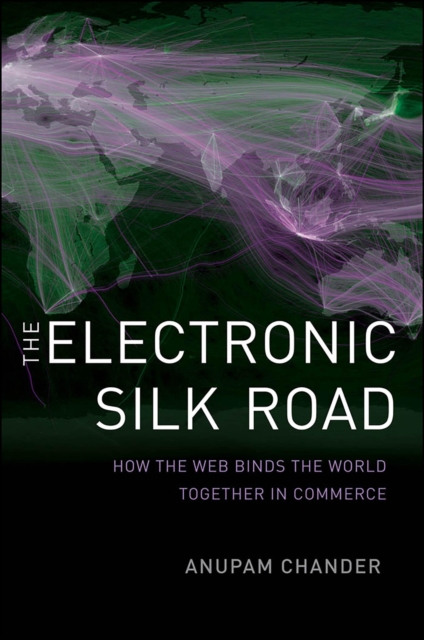
The electronic silk road : how the web binds the world in commerce
On the ancient Silk Road, treasure-laden caravans made their arduous way through deserts and mountain passes, establishing trade between Asia and the civilizations of Europe and the Mediterranean. Today's electronic Silk Roads ferry information across continents, enabling individuals and corporations anywhere to provide or receive services without obtaining a visa. But the legal infrastructure for such trade is yet rudimentary and uncertain. If an event in cyberspace occurs at once everywhere and nowhere, what law applies? How can consumers be protected when engaging with companies across the world? In this accessible book, cyber-law expert Anupam Chander provides the first thorough discussion of the law that relates to global Internet commerce. Addressing up-to-the-minute examples, such as Google's struggles with China, the Pirate Bay's skirmishes with Hollywood, and the outsourcing of services to India, the author insightfully analyzes the difficulties of regulating Internet trade. Chander then lays out a framework for future policies, showing how countries can dismantle barriers while still protecting consumer interests.
eBook