
Catalogue Search | MBRL


Are you sure you want to remove the book from the shelf?

{{itemTitle}}
463
result(s) for
"Chandler, David P"
Sort by:

Facing the Khmer Rouge
As a child growing up in Cambodia, Ronnie Yimsut played among the ruins of the Angkor Wat temples, surrounded by a close-knit community. As the Khmer Rouge gained power and began its genocidal reign of terror, his life became a nightmare. In this stunning memoir, Yimsut describes how, in the wake of death and destruction, he decides to live.
Escaping the turmoil of Cambodia, he makes a perilous journey through the jungle into Thailand, only to be sent to a notorious Thai prison. Fortunately, he is able to reach a refugee camp and ultimately migrate to the United States, where he attended the University of Oregon and became an influential leader in the community of Cambodian immigrants.Facing the Khmer Rougeshows Ronnie Yimsut's personal quest to rehabilitate himself, make a new life in America, and then return to Cambodia to help rebuild the land of his birth.
eBook

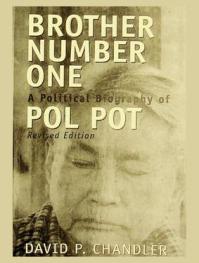
Brother Number One : a political biography of Pol Pot
In the tragic recent history of Cambodia—a past scarred by a long occupation by Vietnamese forces and by the preceding three-year reign of terror by the brutal Khmer Rouge—no figure looms larger or more ominously than that of Pol Pot. As secretary of the Central Committee of the Communist Party of Kampuchea (CPK) since 1962 and as prime minister of Democratic Kampuchea (DK), he has been widely blamed for trying to destroy Cambodian society. By implementing policies whose effects were genocidal, he oversaw the deaths of more than one million of his nation’s people.The political career of Saloth Sar, better known by his nom de guerre Pol Pot, forms a critical but largely inaccessible portion of twentieth-century Cambodian history. What we know about his life is sketchy: a comfortable childhood, three years of study in France, and a short career as a schoolteacher preceded several years—spent mostly in hiding—as a guerrilla and the commander of the victorious army in Cambodia’s civil war. His career reached a climax when he and his associates, coming to power, attempted to transform their country along lines more radical than any attempted by a modern regime. Driven into hiding in 1979 by invading Vietnamese forces, Pol Pot maintained his leadership of a Khmer Rouge guerrilla army in exile, remaining a power and a threat.In this political biography, David P. Chandler throws light on the shadowy figure of Pol Pot. Basing his study on interviews and on a wide range of sources in English, Cambodian, and French, the author illuminates the ideas and behavior of this enigmatic man and his entourage against the background of post–World War II events, providing a key to understanding this horrific, pivotal period of Cambodian history. In this revised edition, Chandler provides new information on the state of Cambodia and the Khmer Rouge following the death of Pol Pot in 1997.
eBook

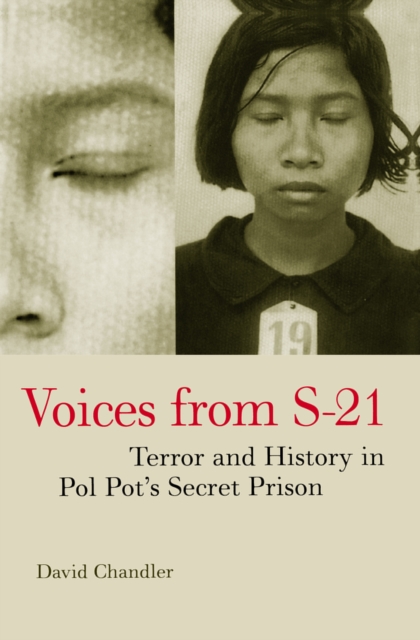
Voices from S-21 : terror and history in Pol Pot's secret prison
The horrific torture and execution of hundreds of thousands of Cambodians by Pol Pot's Khmer Rouge during the 1970s is one of the century's major human disasters. David Chandler, a world-renowned historian of Cambodia, examines the Khmer Rouge phenomenon by focusing on one of its key institutions, the secret prison outside Phnom Penh known by the code name \"S-21.\" The facility was an interrogation center where more than 14,000 \"enemies\" were questioned, tortured, and made to confess to counterrevolutionary crimes. Fewer than a dozen prisoners left S-21 alive. During the Democratic Kampuchea (DK) era, the existence of S-21 was known only to those inside it and a few high-ranking Khmer Rouge officials. When invading Vietnamese troops discovered the prison in 1979, murdered bodies lay strewn about and instruments of torture were still in place. An extensive archive containing photographs of victims, cadre notebooks, and DK publications was also found. Chandler utilizes evidence from the S-21 archive as well as materials that have surfaced elsewhere in Phnom Penh. He also interviews survivors of S-21 and former workers from the prison.Documenting the violence and terror that took place within S-21 is only part of Chandler's story. Equally important is his attempt to understand what happened there in terms that might be useful to survivors, historians, and the rest of us. Chandler discusses the \"culture of obedience\" and its attendant dehumanization, citing parallels between the Khmer Rouge executions and the Moscow Show Trails of the 1930s, Nazi genocide, Indonesian massacres in 1965-66, the Argentine military's use of torture in the 1970s, and the recent mass killings in Bosnia and Rwanda. In each of these instances, Chandler shows how turning victims into \"others\" in a manner that was systematically devaluing and racialist made it easier to mistreat and kill them. More than a chronicle of Khmer Rouge barbarism, Voices from S-21 is also a judicious examination of the psychological dimensions of state-sponsored terrorism that conditions human beings to commit acts of unspeakable brutality.
eBook


The Kingdom of Kampuchea, March–October 1945: Japanese–sponsored Independence in Cambodia in World War II
On 12 March 1945, three days after Japanese forces had swept the French from power in Indo-China, Cambodia's young king, Norodom Sihanouk, declared his country's independence, noting as he did so that it would now be known in French as “Kampuchea” rather than as “Cambodge”. The proclamation, made on Japanese advice, ushered in a seven–month interregnum between periods of French control.
Journal Article
Normative Poems (Chbap) and Pre-Colonial Cambodian Society
Using the chbap to analyze pre-cotonial Cambodian society is difficult because these gnomic, normative poems are only incidentally concerned with the ways in which that society was put together. Moreover, it is hard to determine how firmly they are anchored in the times when they were written: how useful is a seventeenth century chbap, after all, in helping us to understand eighteenth-century society? Another problem with using them is that they often provide an idealized picture, suggesting norms of behaviour rather than describing or analyzing the ways in which people behave. Because of this, the poems belong to more than one century at a time. Finally, like anything written down in a largely illiterate society, the chbap encapsulate and pass on the ideology of a minority élite. It can be argued that this ideology, in pre-colonial Cambodia at least, was rarely at odds with the ideology of the rural, illiterate poor; but this may be a circular argument, brought on by the widespread popularity, imposed by the elite over several centuries, of the chbap themselves.
Journal Article