
Catalogue Search | MBRL


Are you sure you want to remove the book from the shelf?

{{itemTitle}}
44
result(s) for
"Charlton, Sue Ellen M"
Sort by:

Comparing Asian politics : India, China, and Japan
\"Comparing Asian Politics presents an invaluable comparative examination of politics and government in three Asian nations: India, China, and Japan. The author elucidates the links between politics and each nation's distinctive cultural and historical contexts and demonstrates the intermingling and grafting of Asian traditions with the influence of Western values and institutions. National identity, political cohesion, and socioeconomic change emerge as central to how politics has developed in each nation-state. Also included are focus boxes on political and social issues in other important countries in Asia. The book provides insight into topics such as the significance of constitutions in the political process; the parliamentary system in Asia; the regionalization of politics and the importance of levels of government; the decay of one-party rule; the links between development and democratization; and the impact of globalization. This essential text not only illuminates the politics of India, China, and Japan in relation to one another, it also suggests to readers how their own experience of politics can be informed by understanding the politics and government of these three Asian nations. In this new edition, the author includes a discussion on the recent political changes in China and the election of Xi Jinping in early 2013, the devastating earthquake and tsunami that hit Japan in 2011, and the recent elections in India\"-- Provided by publisher.
Book
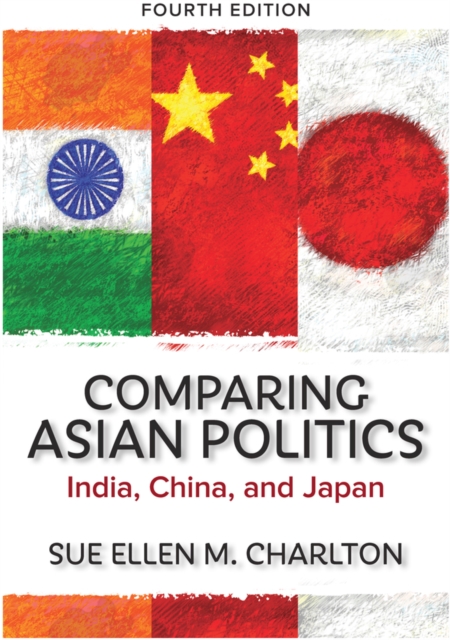
Comparing Asian Politics
Comparing Asian Politics examines politics and government in three Asian nations: India, China, and Japan. Sue Ellen M. Charlton explains the links between politics and each nation’s distinctive cultural and historical contexts, and demonstrates the intermingling and grafting of Asian traditions with the influence of Western values and institutions. National identity, political cohesion, and socioeconomic change emerge as central to the way politics has developed in each nation-state. The book provides insight into topics such as the significance of constitutions in the political process; the parliamentary system in Asia; the regionalization of politics and the importance of levels of government; the links between development and democratization; and the impact of globalization. The new edition includes background to the 2014 elections in India, details on recent political changes in China and the selection of Xi Jinping in 2012–2013, and the impact of the devastating earthquake and tsunami that hit Japan in 2011.
eBook
China: The Party-State System
This chapter explains the distinctive features of China's government and party structures to provide background on the problems associated with Bo Xilai's fall and more broadly about the country's future. The implosion of most party-state systems has turned many scholars away from a comparative framework when examining China, but Chinese researchers have concentrated on understanding the dynamics that had so quickly led to the demise of the former Communist governments. Throughout the revolutionary process, the Communist Party thus maintains its \"leading role,\" both in theory and in practice, so it is not surprising that one of the Four Cardinal Principles in the General Program of the party constitution is upholding the people's democratic dictatorship. The early 1950s were also a period of close relations with the Soviet Union, with Russian textbooks used in the schools and Soviet advisers helping to build the new institutions of the state.
Book Chapter
Elusive Democracy: The Decay of One-Party Rule
Numerous factors account for the decay in one-party rule, including organization and leadership weakness and the rise of competing social or political forces. In democracies, political parties are central to civic life: in principle, they reflect the voters' preferences, provide alternative policy visions, and hold governments accountable. The predecessors of the contemporary Congress and Liberal Democratic Parties date to the 1880s; the Chinese Communist Party, in contrast, was established shortly after World War I, as were other communist parties in Asia and Europe. An obvious difference is Congress's commitment to electoral competition and other elements of political democracy during all but two of the years that it formed national governments. In contrast, the Chinese Communist Parties (CCP) operated under the Leninist norms of single-party monopoly of revolutionary momentum. The history of the Liberal Democratic Party is very different from that of either the Congress or the CCP.
Book Chapter
Indian National Identity: Secular or Hindu?
The term \"communalism\" is used in the Indian sense to mean loyalties to and tensions among the communities of faith that characterize the various religious groups, especially Hindus and Muslims. The Mughal and British Empires were superimposed on a Hindu society that had been evolving for more than two thousand years when the first Muslim invasions in the tenth century began to undermine Hindu rule. The Mughal and British architectural, linguistic, and cultural imprint is found across the Asian subcontinent, but the heritage of these two empires is continually contested in debates about the Indian national identity. The years from 1946 to 1948 were years of political promise and tragedy for the new Indian nation-state. The chapter closes with a question that, though nearly buried for the first decades of the new republic, re-emerged in the 1980s: whether India is, and should be, a secular republic.
Book Chapter
Development Strategies and Policies
This chapter discusses the broad picture of the development experience in Asia. Understanding the idioms of development requires some knowledge of a country's political history and state-society relations. The Indian commitment to national development emerged from opposition to British colonialism, even as postcolonial planners adapted some idioms of the colonial state, such as a centralized bureaucracy, for their economic development strategies after 1947. However, one common feature of the policies has been the desire to build a strong state and a national identity—not surprising, given the anticolonial sentiments that swept Asia in the twentieth century. A survey of the history of both development and democracy in Europe, Asia, and elsewhere makes it clear that the meanings of both terms vary through time and across geographic regions. Political activity takes many forms throughout Asia, but in focusing on environmental politics, one can see more closely the relationship between development and democracy and the challenges to governance that countries confront.
Book Chapter
Asian Politics and Global Transformation
This chapter proposes to stimulate additional thinking about political change in Asia with attention to two questions important to the study of comparative politics. The first question is how the processes of globalization have affected domestic and transnational politics in the Asian region, and the second is how political thought or institutions in Asian countries have influenced—or might influence—issues in comparative politics. The tensions in India are but one example of the transformation of our rights consciousness that began with colonialism, was bolstered by European and American economic prowess in the twentieth century, and has accelerated with contemporary political and economic globalization. In 1994, the annual report of the United Nations Development Program emphasized the theme of human security, as meaning \"freedom from fear and freedom from want.\" One of the most provocative ways Asian traditions expand the boundaries of the social is in the relationship between nature and humans.
Book Chapter
Constitutions
Constitutions provide a useful starting point for understanding government structures and procedures, and the evolution of constitutions over time tells us much about political values and behavior. The drafting of the Indian Constitution was heavily influenced by the experience of British colonialism and by the nationalist movement, particularly the Indian National Congress, as well as by the interests and backgrounds of the delegates to the Constituent Assembly. The rebirth of Japan's political parties, in turn, brought a surge of debate about reform, particularly among those on the left whose voices had been silenced by political repression in the 1930s and early 1940s. China's history of constitutionalism is both checkered and disjointed. The essence of European and American constitutions—that the power of the state is defined and restrained by basic law—is absent from the Chinese political tradition.
Book Chapter
Japan: People and Politics
Japan has a long history of urban centers, but migration to the cities during the twentieth century permanently transformed the nation. In contrast to India and China, where a large proportion of people still live in rural areas, Japan is overwhelmingly urban. The size and distribution of the Japanese population raise several issues central to this book's discussions of demographic changes, development policies, and the linkage between domestic and foreign policies. Japan is not the only Asian country concerned about its aging population, but it is a special case. The combination of adopting from abroad and adapting to indigenous conditions has influenced gender patterns, as it has many other areas of Japanese society. In contrast to the plight of the Ainu, issues pertaining to Japan's largest minority populations, the Burakumin and the Koreans, generate more political concern. Western religions, notably Christianity, have been introduced to Japan as well, but with much less impact on the overall social fabric and, therefore, politics.
Book Chapter
Recreating the Chinese Nation-State
The overarching political challenge of modern Chinese history has been to establish national unity and, with it, government legitimacy. One of most interesting dimensions of the historical effort to recreate and redefine the Chinese nation-state is the contemporary renaissance of Confucian thought and policies. Confucianism, the social and political philosophy that later came to dominate the Chinese government, emerged during this early period. The Opium War between China and Britain is central to our story of national identity for two reasons. First, it inaugurated the pattern of foreign imperialism and Chinese weakness that lasted until the twentieth century. Second, because of this pattern, the Opium War became the symbol of Chinese humiliation and prompted a century-long struggle to free China from foreign control and influence. The extent of the Communist revolution as developed at Yan'an can be seen in its policy toward women.
Book Chapter