
Catalogue Search | MBRL


Are you sure you want to remove the book from the shelf?

{{itemTitle}}
20
result(s) for
"Cheeseman, Nicholas"
Sort by:


How to rig an election
An engrossing analysis of the pseudo-democratic methods employed by despots around the world to retain control Contrary to what is commonly believed, authoritarian leaders who agree to hold elections are generally able to remain in power longer than autocrats who refuse to allow the populace to vote. In this engaging and provocative book, Nic Cheeseman and Brian Klaas expose the limitations of national elections as a means of promoting democratization, and reveal the six essential strategies that dictators use to undermine the electoral process in order to guarantee victory for themselves. Based on their firsthand experiences as election watchers and their hundreds of interviews with presidents, prime ministers, diplomats, election officials, and conspirators, Cheeseman and Klaas document instances of election rigging from Argentina to Zimbabwe, including notable examples from Brazil, India, Nigeria, Russia, and the United States-touching on the 2016 election. This eye-opening study offers a sobering overview of corrupted professional politics, while providing fertile intellectual ground for the development of new solutions for protecting democracy from authoritarian subversion.
eBook


The politics of control in Kenya: Understanding the bureaucratic-executive state, 1952-78
Colonial rule in Kenya witnessed the emergence of a profoundly unbalanced institutional landscape. With all capacity resided in a strong prefectural provincial administration, political parties remained underdeveloped. The co-option of sympathetic African elites during the colonial twilight into the bureaucracy, the legislature and the private property-based economy meant that the allies of colonialism and representatives of transnational capital were able to reap the benefits of independence. In the late colonial period these elites not only attained the means of production, they also assumed the political and institutional capacity to reproduce their dominance. The post-colonial state must therefore be seen as a representation of the interests protected and promoted during the latter years of colonial rule. Under Jomo Kenyatta, the post-colonial state represented a 'pact-of-domination' between transnational capital, the elite and the executive. The ability of this coalition to reproduce itself over time lay in its capacity to demobilise popular forces, especially those elements of the nationalist movement that questioned both the social and economic cleavages of the post-colonial state. Whilst Kenya may have experienced changes to both the executive and legislature, the structure of the state itself has demonstrated remarkable continuity.
Journal Article


Introduction: Political Linkage and Political Space in the Era of Decolonization
The continuing importance of Kenya's institutional colonial inheritance has been underestimated because the impact of decolonization on Kenya's formal political institutions has rarely been systematically addressed. Consequently, there is a pressing need to reevaluate the structure of government in the colonial and postcolonial periods in a manner that takes a critical perspective on the domestic relationship between government and opposition. In addition to introducing the papers that follow, this essay examines the factors that underpin the continued supremacy of the executive-administrative axis in the Kenya postcolony. It develops the twin concepts of political linkage and political space as tools to describe the political landscape of the colonial and postcolonial eras. Institutional factors, it is argued, must be central to any attempt to explain the longevity and eventual breakdown of KANU rule.
Journal Article

How to rig an election
\"In this book, Nic Cheeseman and Brian Klaas expose the limitations of national elections as a means of promoting democratization, and reveal the six essential strategies that dictators use to undermine the electoral process in order to guarantee victory for themselves.\"--Publisher's description.
Book

Turning Points in African Democracy
Radical changes have taken place in Africa since 1990. What are the realities of these changes? What significant differences have emerged between African countries? What is the future for democracy in the continent? The editors have chosen eleven key countries to provide enlightening comparisons and contrasts to stimulate discussion among students. They have brought together a team of scholars who are actively working in the changing Africa of today. Each chapter is structured around a framing event which defines the experience of democratisation. The editors have provided an overview of the turning points in African politics. They engage with debates on how to study and evaluate democracy in Africa, such as the limits of elections. They identify four major themes with which to examine similarities and divergences as well as to explain change and continuity in what happened in the past. ABDUL RAUFU MUSTAPHA is University Lecturer in African Politics at Queen Elizabeth House and Kirk-Greene Fellow at St Antony's College, University of Oxford; LINDSAY WHITFIELD is a Research Fellow at the Danish Institute of International Studies, Copenhagen.
eBook
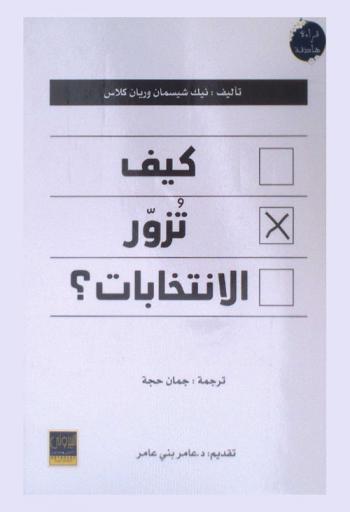
كيف تزور الانتخابات ؟
يتحدث الكتاب عن سبب تزوير الانتخابات وكيفية حدوثه وفوز عدد قليل من الحكومات المتسلطة بها باستعمال الوسائل المشروعة حيث تبني الأغلبية منها مجموعة من الاستراتيجيات لضمان عدم خسارتها، ولسوء الحظ في حين أن بعض الدروس في هذا الكتاب قد تكون جديدة بالنسبة إليك، فهي ليست جديدة على الديكتاتوريين والديمقراطيين المزيفين في العالم طوال عقود ضبطوا استراتيجياتهم من أجل إجراء انتخابات لا يمكن لأحد سواهم أن يفوز بها.
BOOK

Democracy and Elections in Africa
The two most striking findings presented in the book are that elections have a more significant impact on the level of civil liberties than international influence, GDP, ethnicity and popular mobilization, and that regimes tend to be significantly more democratic and less likely to break down after three elections have been held.
Book Review