
Catalogue Search | MBRL


Are you sure you want to remove the book from the shelf?

{{itemTitle}}
6
result(s) for
"Chernow, Ron author"
Sort by:

Why the Boom Went Bust
In \"Within Our Means,\" [Alfred L. Malabre Jr.] surveys the economic sins of the 1980's and outlines the stations of atonement. Breast-beating has arrived with a vengeance. \"If self-indulgence marked the 1980s,\" he writes, \"increased concern about the future seemed the watchword of the new decade.\" He sees the United States attempting to \"regain competitive stature through the neglected avenues of hard work and sacrifice.\" Time for sackcloth and ashes, folks. Though I share his bearish forecast and much of his indignation, I found myself increasingly displeased with his approach. I am partial to nice paragraphs of English prose and balk at airless compendiums of facts. Many of Mr. Malabre's pages offer one numbing statistic per sentence. I wish he had framed his abundant facts with an interesting narrative or arresting argument. I don't find the notion of living \"within our means\" a powerful or original theme, however merited. Ditto for his exhortation that \"the situation cries out for bold leadership in the White House and Congress.\" And his jeremiad about the budget deficit isn't so much wrong as painfully familiar. In \"Within Our Means,\" Ronald Reagan and his brand of economics become a shorthand explanation for every ill. George Bush comes off as little more than a weaselly Reagan clone, deaf to the arguments that speak to Mr. Malabre with thunderous conviction. (A characteristic device of the book is to cite a problem, then conclude, more or less, with the finger-wagging refrain \"Still, Bush seemed unconcerned.\") Mr. Malabre simply rides his hobbyhorse too hard. Many problems that upset him -- from drugs to crime to illiteracy -- didn't originate with Mr. Reagan or Mr. Bush, even if they didn't help matters. Greater fairness would have strengthened the polemic.
Book Review

Grant
Ulysses S. Grant's life has typically been misunderstood. He is often caricatured as a chronic loser and an inept businessman, or as the triumphant but brutal Union general of the Civil War. But these stereotypes don't capture the general and president whose fortunes rose and fell with dizzying speed and frequency. Before the Civil War, Grant was flailing. His business ventures had ended dismally, and despite distinguished service in the Mexican War he ended up resigning from the army in disgrace amid recurring accusations of drunkenness. But in war, Grant began to realize his remarkable potential, soaring through the ranks of the Union army, prevailing at the battle of Shiloh and in the Vicksburg campaign, and ultimately defeating the legendary Confederate general Robert E. Lee. Along the way, Grant endeared himself to President Lincoln and became his most trusted general and the strategic genius of the war effort. Grant's military fame translated into a two-term presidency, but one plagued by corruption scandals involving his closest staff members. But during his administration he sought freedom and justice for black Americans, working to crush the Ku Klux Klan and earning the admiration of Frederick Douglass, who called him \"the vigilant, firm, impartial, and wise protector of my race.\" After his presidency, he brought low by a dashing young swindler on Wall Street, only to resuscitate his image by working with Mark Twain to publish his memoirs, which are recognized as a masterpiece of the genre. Ron Chernow finds the threads that bind these disparate stories together, shedding new light on the man whom Walt Whitman described as \"nothing heroic ... and yet the greatest hero.\"
Book

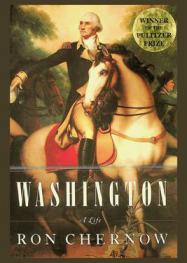
Washington : a life
In \"Washington : a Life\" celebrated biographer Ron Chernow provides a richly nuanced portrait of the father of our nation, dashing forever the stereotype of a stolid, unemotional man, and revealing an astute and surprising portrait of a canny political genius who knew how to inspire people.
Book

Mark Twain
\"Born Samuel Langhorne Clemens in 1835, under Halley's Comet, the rambunctious Twain was an early teller of tall tales. He left his home in Missouri at an early age, piloted steamboats on the Mississippi, and arrived in the Nevada Territory during the silver-mining boom. Before long, he had accepted a job at the local newspaper, where he barged into vigorous discourse and debate, hoaxes and hijinks. After moving to San Francisco, he published stories that attracted national attention for their brashness and humor, writing under a pen name soon to be immortalized. Chernow draws a richly nuanced portrait of the man who shamelessly sought fame and fortune and crafted his celebrity persona with meticulous care. Twain eventually settled with his wife and three daughters in Hartford, where he wrote some of his most well-known works, The Adventures of Tom Sawyer, Life on the Mississippi, and Adventures of Huckleberry Finn, earning him further acclaim. He threw himself into American politics, emerging as the nation's most notable pundit. While his talents as a writer and speaker flourished, his madcap business ventures eventually forced him into bankruptcy; to economize, Twain and his family spent nine eventful years in exile in Europe. He suffered the death of his wife and two daughters, and the last stage of his life was marked by heartache, political crusades, and eccentric behavior that sometimes obscured darker forces at play. Drawing on Twain's bountiful archives, including his fifty notebooks, thousands of letters, and hundreds of unpublished manuscripts, Chernow masterfully captures a man whose career reflected the country's westward expansion, industrialization, and foreign wars. No other white author of his generation grappled so fully with the legacy of slavery after the Civil War or showed such keen interest in African American culture. Today, more than one hundred years after his death, Twain's writing continues to be read, debated, and quoted.\"-- Provided by publisher.
BOOK