
Catalogue Search | MBRL


Are you sure you want to remove the book from the shelf?

{{itemTitle}}
119
result(s) for
"Cherry, Kevin M"
Sort by:

Plato, Aristotle, and the purpose of politics
\"In this book, Kevin M. Cherry compares the views of Aristotle and Plato about the practice, study, and above all, the purpose of politics\"-- Provided by publisher.
BOOK

Scaling up molecular pattern recognition with DNA-based winner-take-all neural networks
From bacteria following simple chemical gradients
1
to the brain distinguishing complex odour information
2
, the ability to recognize molecular patterns is essential for biological organisms. This type of information-processing function has been implemented using DNA-based neural networks
3
, but has been limited to the recognition of a set of no more than four patterns, each composed of four distinct DNA molecules. Winner-take-all computation
4
has been suggested
5
,
6
as a potential strategy for enhancing the capability of DNA-based neural networks. Compared to the linear-threshold circuits
7
and Hopfield networks
8
used previously
3
, winner-take-all circuits are computationally more powerful
4
, allow simpler molecular implementation and are not constrained by the number of patterns and their complexity, so both a large number of simple patterns and a small number of complex patterns can be recognized. Here we report a systematic implementation of winner-take-all neural networks based on DNA-strand-displacement
9
,
10
reactions. We use a previously developed seesaw DNA gate motif
3
,
11
,
12
, extended to include a simple and robust component that facilitates the cooperative hybridization
13
that is involved in the process of selecting a ‘winner’. We show that with this extended seesaw motif DNA-based neural networks can classify patterns into up to nine categories. Each of these patterns consists of 20 distinct DNA molecules chosen from the set of 100 that represents the 100 bits in 10 × 10 patterns, with the 20 DNA molecules selected tracing one of the handwritten digits ‘1’ to ‘9’. The network successfully classified test patterns with up to 30 of the 100 bits flipped relative to the digit patterns ‘remembered’ during training, suggesting that molecular circuits can robustly accomplish the sophisticated task of classifying highly complex and noisy information on the basis of similarity to a memory.
DNA-strand-displacement reactions are used to implement a neural network that can distinguish complex and noisy molecular patterns from a set of nine possibilities—an improvement on previous demonstrations that distinguished only four simple patterns.
Journal Article

Compiler-aided systematic construction of large-scale DNA strand displacement circuits using unpurified components
Biochemical circuits made of rationally designed DNA molecules are proofs of concept for embedding control within complex molecular environments. They hold promise for transforming the current technologies in chemistry, biology, medicine and material science by introducing programmable and responsive behaviour to diverse molecular systems. As the transformative power of a technology depends on its accessibility, two main challenges are an automated design process and simple experimental procedures. Here we demonstrate the use of circuit design software, combined with the use of unpurified strands and simplified experimental procedures, for creating a complex DNA strand displacement circuit that consists of 78 distinct species. We develop a systematic procedure for overcoming the challenges involved in using unpurified DNA strands. We also develop a model that takes synthesis errors into consideration and semi-quantitatively reproduces the experimental data. Our methods now enable even novice researchers to successfully design and construct complex DNA strand displacement circuits.
DNA circuits hold promise for advancing information-based molecular technologies, yet it is challenging to design and construct them in practice. Thubagere
et al
. build DNA strand displacement circuits using unpurified strands whose sequences are automatically generated from a user-friendly compiler.
Journal Article
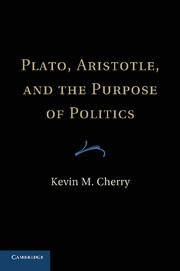
Plato, Aristotle, and the Purpose of Politics
In this book, Kevin M. Cherry compares the views of Plato and Aristotle about the practice, study and, above all, the purpose of politics. The first scholar to place Aristotle's Politics in sustained dialogue with Plato's Statesman, Cherry argues that Aristotle rejects the view of politics advanced by Plato's Eleatic Stranger, contrasting them on topics such as the proper categorization of regimes, the usefulness and limitations of the rule of law, and the proper understanding of phronēsis. The various differences between their respective political philosophies, however, reflect a more fundamental difference in how they view the relationship of human beings to the natural world around them. Reading the Politics in light of the Statesman sheds new light on Aristotle's political theory and provides a better understanding of Aristotle's criticism of Socrates. Most importantly, it highlights an enduring and important question: should politics have as its primary purpose the preservation of life, or should it pursue the higher good of living well?
eBook


Aristotle's \Certain Kind of Multitude\
Political theorists have recently emphasized the popular dimension of Aristotle's political thought, and many have called attention to Aristotle's assertion that certain multitudes should share in the city's deliberations. In this article, I explore the \"part of virtue and prudence\" Aristotle believes necessary for a multitude to participate in political life. I argue, first, that military service helps citizens develop the \"part of virtue\" necessary for political participation and, second, that the \"part of prudence\" Aristotle has in mind is suneis. I argue, moreover, that military virtue helps citizens acquire sunesis and guides its exercise. Aristotle recognizes the limitations and potential dangers of military virtue and attempts to avoid these, in part by offering a new understanding of military virtue to offset the Spartan. Understanding the \"part of virtue and prudence\" citizens have helps understand their role in a polity but also points to how those citizens, and their regime, can be improved.
Journal Article

A Series of Footnotes to Plato's Philosophers
In her magisterial Plato's Philosophers, Catherine Zuckert presents a radically new interpretation of Plato's dialogues. In doing so, she insists we must overcome reading them through the lens of Aristotle, whose influence has obscured the true nature of Plato's philosophy. However, in her works dealing with Aristotle's political science, Zuckert indicates several advantages of his approach to understanding politics. In this article, I explore the reasons why Zuckert finds Aristotle a problematic guide to Plato's philosophy as well as what she sees as the character and benefits of Aristotle's political theory. I conclude by suggesting a possible reconciliation between Zuckert's Aristotle and her Plato, insofar as both the Socrates whom Plato made his hero and Aristotle agree that political communities will rarely direct citizens toward virtue by means of law and that we must instead look to informal means of doing so.
Journal Article

The Problem of Polity: Political Participation and Aristotle's Best Regime
Aristotle uses the same word—politeia—to describe both the genus of “regimes” and a particular species within that genus. I argue that this usage is a common practice in Aristotle's practical works and identifies the most developed species within its genus. Aristotle thus sees the regime of polity as more appropriate for developed communities than the regimes often taken to represent his ideals, i.e., kingship and aristocracy. Aristotle's understanding of the capacities, and limitations, of the multitude leads him to propose the mixed regime of polity as the best regime generally possible. While polity differs from the best regime simply discussed in Book VII, it still offers rich possibilities for both political and theoretical activity.
Journal Article

Does Aristotle Believe Greeks Should Rule Barbarians?
Some scholars argue Aristotle reflects the prejudices of his Athenian audience, pointing to his repetition of the poetic claim that it is fitting for Greeks to rule barbarians. What many of these critics--as well as many of Aristotle's defenders-- fail to note is that the source
of Aristotle's quotation (Euripides' Iphigenia in Aulis) itself undermines the claim. Aristotle's citation, therefore, is less proof of his racial bias or an esoteric subversion of Greek attitudes of superiority than an explicit call to consider more carefully what the basis
of true excellence is and what its attainment requires.
Journal Article

Aristotle and the Eleatic Stranger on the Nature and Purpose of Political Life
This article argues that Book I of the Politics represents Aristotle's critique of Plato's Eleatic Stranger on the specific character of political rule and the knowledge required for political rule, and that this critique produces a different understanding of the proper division of regimes and the relationship between political theory and practice. These differences can be traced to a more fundamental disagreement about nature: Aristotle sees nature as generally hospitable to human life and argues that the natural end or goal of political association is not mere life but the good life, while the Eleatic perceives nature as hostile and proposes a minimalist politics, aimed primarily at preserving life. Although the Eleatic's view of nature might appear to be closer to and more compatible with modern political thought, the conception of nature Aristotle presents in his Politics offers richer possibilities for political theory and political life.
Journal Article