
Catalogue Search | MBRL


Are you sure you want to remove the book from the shelf?

{{itemTitle}}
59
result(s) for
"Chiu, Frances A."
Sort by:
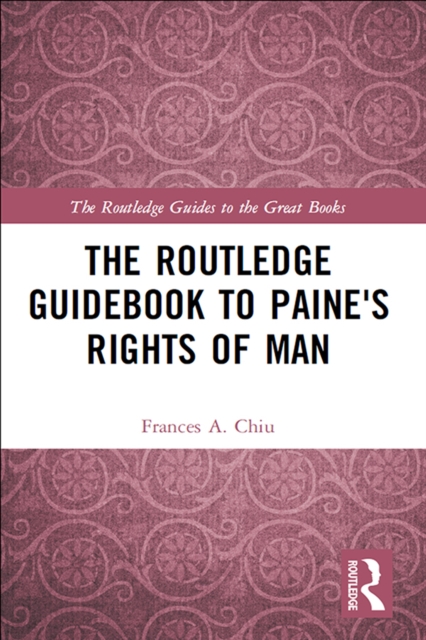
The Routledge Guidebook to Paine's Rights of Man
Upon publication in 1791-92, the two parts of Thomas Paine's Rights of Man proved to be both immensely popular and highly controversial. An immediate bestseller, it not only defended the French revolution but also challenged current laws, customs, and government.
The Routledge Guidebook to Paine's Rights of Man provides the first comprehensive and fully contextualized introduction to this foundational text in the history of modern political thought, addressing its central themes, reception, and influence. The Guidebook examines:
the history of rights, populism, representative governments, and challenges to monarchy from the 12th through 18th century;
Paine's arguments against monarchies, mixed governments, war, and state-church establishments;
Paine's views on constitutions;
Paine's proposals regarding suffrage, inequality, poverty, and public welfare;
Paine's revolution in rhetoric and style;
the critical reception upon publication and influence through the centuries, as well as Paine's relevance today.
The Routledge Guidebook to Paine's Rights of Man is essential reading for students of eighteenth-century American and British history, politics and philosophy, and anyone approaching Paine's work for the first time.
eBook

Introduction
The introduction is divided into five sections. It opens with a brief history of the ideas and rhetoric of rights from the 12th through 18th century in the West, before proceeding to explore the emergence of some of the central themes in Paine's Rights of Man such as hereditary government, inequality, representation, and economic justice: here, the ideas of such activists and thinkers as Gratian, George Buchanan, the Levellers, Diggers, James Harrington, Algernon Sidney, John Locke, James Murray, James Burgh, and Granville Sharp will be analyzed and compared. How did these writers address the idea of a \"commonwealth?\" Republican government? Universal male suffrage? Slavery? The final section examines Paine's life and work from 1772 to 1790, particularly his editorship for The Pennsylvania Magazine, as well as his writing of Common Sense and the American Crisis papers, showing how he engaged with the writings of contemporary English reformers when he criticized hereditary government and imperialism while cultivating a new populist style. In what respects was Paine radical? Conservative?
Book Chapter
Conclusion
The Conclusion opens with a summary of the main themes of Rights of Man, Parts 1 and 2, as well as responses to both parts, before delving into the legacy of the work from the 19th through 21st century. Here, we consider how Rights of Man has continued to inspire generations of labor rights activists and Chartists on both sides of the Atlantic despite the general proscription of his writings. Finally, the third section will show how Paine's ideas have become more relevant than ever around the world-including, ironically enough, to the nation that Paine thought would never fall prey to oligarchy and lack of democratic representation: the U.S. This section will demonstrate how the stimulation of commerce (or capitalism), as commended by Paine, has managed to foment extreme inequality and frequent wars, while producing a government unresponsive to the needs of the vast majority of its citizens according to such cultural historians and economists as Thomas Frank, Peter Joseph, Thomas Piketty, and Joseph Stiglitz.
Book Chapter
Rights of Man Part 2, Chapter 4
This chapter delves into Paine's views on the writing of constitutions, starting with his admiration for the state constitutions of the thirteen colonies and the creation of the American constitution in 1787. But was Paine altogether accurate in his high assessment of the latter? A closer look reveals that anti-Federalists (e.g., George Mason, Melancton Smith, Mercy Otis Warren) found fault with the new constitution and its creation in much the same way as Paine criticized the British constitution: a document that privileged the few wealthy at the expense of the poor and middling orders. It was not until a decade later as Paine wrote his scorching letter to George Washington that he censured the American constitution as a \"base imitation\" of the British constitution. This chapter also examines Paine's assessments of the Magna Charta and the Bill of Rights of 1689.
Book Chapter
Rights of Man, Part 2, Chapter 5
This chapter examines Rights of Man, Part 2, Chapter 5, arguably the boldest chapter in the work. Paine was not only the first to redefine civilization-positing that a civilized government must provide for the weakest and most vulnerable beings-but also to propose an overhaul of the aims of government. Here, I will show how Paine pushed for an end to wasteful wars, high taxes, and bloated compensation of royal courts while proposing a scheme for the alleviation of poverty among the poor and the elderly. Although other earlier and contemporary writers (e.g., James Burgh, Robert Potter, John Scott, Sir John Sinclair, Adam Smith) had pointed out the challenges for the indigent, Paine was not only one of the first to present a comprehensive scheme, but also among one of the most generous. In addition, he would advocate progressive taxation and the earliest prototype of Social Security.
Book Chapter
Rights of Man, Part 2, Preface-Chapter 3
This chapter delves into the ways in which Rights of Man, Part 2 became more radical than Part 1. How did Paine shift from a reluctant acceptance of monarchy in Part 1 to an emphatic rejection of it in Part 2? The chapter starts by examining the events and publications that led to Paine's change of mind, beginning with the aborted escape of Louis XVI and his family from France and writings critical of republicanism published by Burke (Letter to a Member of the National Assembly and Appeal from the New to the Old Whigs) and the Abbé Sieyès. How did Paine compare the New and Old World-and to what extent was he correct? Also considered here is Paine's views of war and its shaping of government as well as his criticisms of hereditary government. How did Paine's arguments diverge from Harrington's and Sidney's? From those of his own contemporaries such as John Adams and Sieyès?
Book Chapter
Thomas Paine's Rights of Man Part 1, Sections I-VIII
The discussion of Rights of Man, Part 1 begins with a brief sketch of the events in France leading up to the fall of the Bastille and the ensuing debate over the French revolution in Britain when the erstwhile Whig reformer Edmund Burke wrote his Reflections on the Revolution in France in reaction to Richard Price's celebration of the French revolution in his Discourse on the Love of Our Country. From here, the chapter examines Paine's defense of progress, his attempts to defend the early stages of the Revolution, his explanation of rights as a divine gift, his arguments against city charters and game laws, his criticisms of the relationship between the monarch and Parliament, hereditary government, primogeniture, state-church establishments, and praise for the French Declaration of Rights: all of which were intended to convince readers that Britain was in need of a more modernized government. Paine's ideas will be analyzed not only in the context of earlier writers and contemporary reformers as discussed in the Introduction but also in the context of other respondents to Burke's Reflections such as John Belsham, Sir Brooke Boothby, Capel Lofft, Catharine Macaulay, and Mary Wollstonecraft.
Book Chapter

Reflections in a Glass Darkly: Essays on J. Sheridan Le Fanu
[...]Hughes' contention that 'Dragon Volant' is a 'rudimentary metafiction' that 'toys consistently with the problem of false and mistaken perception' where 'many things that appear as realities are merely distorted reflections' is a shrewd one that could be said to apply to much of Le Fanu's fiction which continually toy with reader expectations: it's a striking feature that not only figures in his earlier comic fiction - for instance, 'Jim Sullivan's adventures in the Great Snow' where preternatural-seeming incidents are revealed to have ludicrously mundane causes - but also in A Lost Name, The Wyvern Mystery (capably addressed by Sally Harris), and The Rose and the Key. [...]there is Victor Sage's essay on Le Fanu's last novel, Willing to Die. There is considerable overlap between the subject matter of several essays in the various sections (e.g., General Studies, Special Topics, Individual Works) such that one wishes that the editors had either arranged the selections by author or chronological order.
Book Review

Omeprazole before Endoscopy in Patients with Gastrointestinal Bleeding
In this randomized study of patients with upper gastrointestinal bleeding, infusion of omeprazole, as compared with placebo, before endoscopy reduced the incidence of endoscopic treatment (19.1% vs. 28.4%, P=0.007) and, among patients with peptic ulcers, resulted in fewer actively bleeding ulcers and more ulcers with clean bases. These findings suggest that infused omeprazole is beneficial for patients with upper gastrointestinal bleeding who are awaiting endoscopy.
In patients with upper gastrointestinal bleeding, infusion of omeprazole before endoscopy reduced the incidence of endoscopic treatment (19.1% vs. 28.4%) and, among patients with peptic ulcers, resulted in fewer actively bleeding ulcers and more ulcers with clean bases.
In patients with bleeding peptic ulcers, we previously showed that infusion of a high-dose proton-pump inhibitor after hemostasis had been achieved during endoscopy reduced recurrent bleeding and improved clinical outcomes.
1
The adjuvant use of high-dose proton-pump inhibitors in endoscopic therapy has also been endorsed in two consensus statements
2
,
3
and confirmed in two meta-analyses.
4
,
5
Clot formation over arteries is pH dependent; a gastric pH above 6 is thought to be critical for platelet aggregation.
6
When given intravenously and at a high dose, proton-pump inhibitors can be used to maintain a neutral gastric pH.
7
In clinical practice, treatment with proton-pump . . .
Journal Article
