
Catalogue Search | MBRL


Are you sure you want to remove the book from the shelf?

{{itemTitle}}
20
result(s) for
"Chu, Cindy Yik-yi"
Sort by:

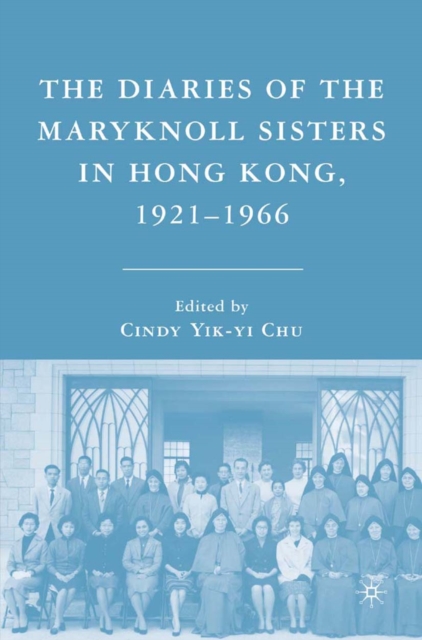
The diaries of the Maryknoll Sisters in Hong Kong, 1921-1966
This book is a documentary survey of Hong Kong history, from the 1920s to the mid-1960s, from the perspective of the Maryknoll Sisters, as recorded in their diaries written during that period. It is a priceless collection of first-hand materials on the social history of Hong Kong.
eBook

From the Pursuit of Converts to the Relief of Refugees: The Maryknoll Sisters in Twentieth-Century Hong Kong
Through an examination of the work of the Maryknoll sisters in Hong Kong, Yik-yi Chu explores the changing nature of missionary work over the course of the twentieth century. She asserts that the Sisters assumed the role of a \"third force\" in Hong Kong as they shifted from searching for pagans to be baptized to offering relief to refugees.
Journal Article
Foreign communities in Hong Kong, 1840s-1950s
This collection of essays describes adaptations of minority ethnic groups to cross-cultural situations in Hong Kong from the 1840s through the 1950s. It aims to portray Hong Kong history through the perspectives of foreign communities - the British, Germans, Americans, Indians and Japanese - and to understand how they perceived the economic situation, political administration and culture of the colony.
eBook
Catholic Church between Two World Wars
The Catholic Church established itself in Hong Kong in 1841, in response to the religious needs of Irish troops in the recently occupied territory. At that time, the Church had not developed any plans for Hong Kong as a mission field, not to mention that personnel were deployed in Hong Kong only on a short-term basis and that the Catholics had not yet formed a stable community. However, in the ensuing few years, the population of the colony grew by leaps and bounds, and thus opportunities for evangelization increased. Evangelization was the ultimate motive of foreign missions, and Hong Kong was no exception. Very soon, the Church moved from taking care of Irish troops to working for the consolidation and expansion of a local Catholic community. The latter objective entailed the proclamation of the Christian religion, the erection of church buildings, and the appointment of a responsible institute in Hong Kong.
Book Chapter
Stanley Civilian Internment Camp during Japanese Occupation
Hong Kong experienced three years and eight months of Japanese occupation, from December 1941 to August 1945, a long ordeal that inflicted suffering on Chinese and foreign residents alike. Before the Japanese invaded the colony, there had been fear that the ongoing Sino-Japanese War (1937–1945) would spread across the border to Hong Kong. That Hong Kong was under British rule was not proof against impending hostilities. Following the attack on Pearl Harbor on December 7, 1941, the United States entered the Second World War (1939–1945). War finally broke out in the Pacific, and the Allied Powers truly faced a war on two fronts, one in Europe and one in Asia. From then on, the Japanese moved to realize their so-called Greater East Asia Co-prosperity Sphere, aiming at the control of other countries in Southeast Asia. Seeing how events were unfolding elsewhere, the British knew they could not forestall Japanese expansion, and very quickly Hong Kong fell victim to Japanese aggression.
Book Chapter

Imperial to International: A History of St. John's Cathedral, Hong Kong
Review(s) of: Imperial to international: A history of St. John's Cathedral, Hong Kong, by Stuart Wolfendale, Hong Kong, Hong Kong University Press, 2013, 376 pages with illustrations, ISBN 978-988-8139-87-3, HK$380.
Book Review

Back to the Masses: The Historiography of Hong Kong's Recent Political Developments and the Prospects of Future Scholarship
This paper examines the historiography of Hong Kong's recent political developments. It addresses the different schools of thought, represented by some important English-language works. It highlights the respective roles of the Chinese, the British and the Hong Kong side in the 1980s and 1990s. Several important questions are raised: Does the existing literature provide us with a better understanding of the Hong Kong situation after 1997? What factors affected the assessment of the Hong Kong problem, with particular reference to the concept of \"one country, two systems\"? And, how should the scholarship of Hong Kong politics develop?
Journal Article

Postwar Years, the 1950s, the Early 1960s, and Refugees
The last Maryknoll Sisters left Japanese-occupied Hong Kong in January 1943; these women, unlike their counterparts who had sailed on the Asama Maru off the Stanley Civilian Internment Camp and returned home, had not been part of the repatriation program. They had stayed in Hong Kong after they had been released from the camp; in January 1943 the ten remaining Maryknoll Sisters embarked on their journey to China (Luoding in Guangdong Province, Wuzhou and Guilin in Guangxi Province) and to Macau, to escape from the Japanese.1 It would be almost three years before the Maryknoll Sisters returned to Hong Kong, from Macau and interior mainland. They traveled by all possible means, by boat, by train, and by plane.2 By the end of 1945, their convent in the Maryknoll Convent School (M.C.S.) building, at the corner of Boundary Street and Waterloo Road, had a total of thirteen Sisters, the superior Mary Paul McKenna was one of them.3 Initially, the Maryknoll Sisters occupied only part of the M.C.S. building and thus had to stay with 600 Japanese soldiers who were also in the building until May 1946, when the nuns recovered the whole compound.
Book Chapter