
Catalogue Search | MBRL


Are you sure you want to remove the book from the shelf?

{{itemTitle}}
8
result(s) for
"Clotfelter, Charles T., author"
Sort by:

Unequal colleges in the age of disparity
It is commonly supposed that colleges help to reduce inequality by providing paths for individuals to rise beyond modest origins. Reviewing evidence from more than 1,000 colleges, elite and not, the author argues that baccalaureate education's power to reduce inequality has actually declined, because the colleges themselves have become more unequal. Unequal Colleges in the Age of Disparity describes the market for baccalaureate education over the last four decades, paying attention to both the demand side and supply side of the market. It is an historical analysis of a large and variegated industry, described in terms - such as \"firm,\" \"consumer,\" and \"market power\" - rarely applied to it, that explain this increasing inequality.-- Provided by publisher
Book

After Brown
The United States Supreme Court's 1954 landmark decision,Brown v. Board of Education, set into motion a process of desegregation that would eventually transform American public schools. This book provides a comprehensive and up-to-date assessment of howBrown's most visible effect--contact between students of different racial groups--has changed over the fifty years since the decision.
Using both published and unpublished data on school enrollments from across the country, Charles Clotfelter uses measures of interracial contact, racial isolation, and segregation to chronicle the changes. He goes beyond previous studies by drawing on heretofore unanalyzed enrollment data covering the first decade afterBrown, calculating segregation for metropolitan areas rather than just school districts, accounting for private schools, presenting recent information on segregation within schools, and measuring segregation in college enrollment.
Two main conclusions emerge. First, interracial contact in American schools and colleges increased markedly over the period, with the most dramatic changes occurring in the previously segregated South. Second, despite this change, four main factors prevented even larger increases: white reluctance to accept racially mixed schools, the multiplicity of options for avoiding such schools, the willingness of local officials to accommodate the wishes of reluctant whites, and the eventual loss of will on the part of those who had been the strongest protagonists in the push for desegregation. Thus decreases in segregation within districts were partially offset by growing disparities between districts and by selected increases in private school enrollment.
eBook

Federal tax policy and charitable giving
The United States is distinctive among Western countries in its reliance on nonprofit institutions to perform major social functions. This reliance is rooted in American history and is fostered by federal tax provisions for charitable giving. In this study, Charles T. Clotfelter demonstrates that changes in tax policy—effected through legislation or inflation—can have a significant impact on the level and composition of giving. Clotfelter focuses on empirical analysis of the effects of tax policy on charitable giving in four major areas: individual contributions, volunteering, corporate giving, and charitable bequests. For each area, discussions of economic theory and relevant tax law precede a review of the data and methodology used in econometric studies of charitable giving. In addition, new econometric analyses are presented, as well as empirical data on the effect of taxes on foundations. While taxes are not the most important determinant of contributions, the results of the analyses presented here suggest that charitable deductions, as well as tax rates and other aspects of the tax system, are significant factors in determining the size and distribution of charitable giving. This work is a model for policy-oriented research efforts, but it also supplies a major (and very timely) addition to the evidence that must inform future proposals for tax reform.
eBook
Studies of supply and demand in higher education
In the United States today, there are some 3,400 separately governed colleges and universities, amounting to a higher education industry with expenditures that constitute 2.8% of the gross national product. Yet, the economic issues affecting this industry have been paid relatively little attention. In this collection of eight essays, experts in economics and education bring economic analysis to bear on such underexamined topics as the nature of competition in higher education, higher education's use of resources, and who chooses to purchase what kind of education and why. In higher education, supply refers to such issues as government support for public colleges and universities, the means by which graduate programs allocate financial support to students, and the criteria that universities use for investing endowments. Demand pertains to patterns of student enrollment and to the government, business, and individual market for the service and research activities of higher education. Why are tuitions nearly the same among schools despite differences in prestige? How are institutions with small endowments able to compete successfully with institutions that have huge endowments? How are race and ethnicity reflected in enrollment trends? Where do the best students go? What choices among colleges do young people from low-income backgrounds face? This volume addresses these questions and suggests subjects for further study of the economics of higher education.
eBook
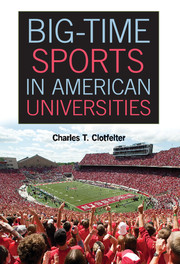
Big-Time Sports in American Universities
For almost a century, big-time college sport has been a wildly popular but consistently problematic part of American higher education. The challenges it poses to traditional academic values have been recognized from the start, but they have grown more ominous in recent decades, as cable television has become ubiquitous, commercial opportunities have proliferated and athletic budgets have ballooned. Drawing on new research findings, this book takes a fresh look at the role of commercial sports in American universities. It shows that, rather than being the inconsequential student activity that universities often imply that it is, big-time sport has become a core function of the universities that engage in it. For this reason, the book takes this function seriously and presents evidence necessary for a constructive perspective about its value. Although big-time sport surely creates worrying conflicts in values, it also brings with it some surprising positive consequences.
eBook
Economic challenges in higher education
The last two decades have been a turbulent period for American higher education, with profound demographic shifts, gyrating salaries, and marked changes in the economy. While enrollments rose about 50% in that period, sharp increases in tuition and fees at colleges and universities provoke accusations of inefficiency, even outright institutional greed and irresponsibility. As the 1990s progress, surpluses in the academic labor supply may give way to shortages in many fields, but will there be enough new Ph.D.'s to go around? Drawing on the authors' experience as economists and educators, this book offers an accessible analysis of three crucial economic issues: the growth and composition of undergraduate enrollments, the supply of faculty in the academic labor market, and the cost of operating colleges and universities. The study provides valuable insights for administrators and scholars of education.
eBook

Death and Dollars
Despite the recent downturn in the stock market, the 1990s boom and the shift to defined contribution plans mean that more individuals will have significant wealth upon retirement. How they use that wealth will determine not only their own well-being, but also the living standards of their children, the resources available to philanthropies, and the level of investment capital in the economy. This volume explores the reasons why people save, how they decide to allocate their wealth once they retire, and how givers select their beneficiaries. It also assesses the extent to which the estate tax and annuitization of retirement wealth affects the amount and nature of wealth transfers. Finally, it looks at the impact of wealth transfers--first on the amount of aggregate saving and capital accumulation, and then on the distribution of wealth among households. Several conclusions emerge. First, gifts and bequests are important; they may account for about half of total wealth in America. Second, rich people make most of the wealth transfers. They are thoughtful about how much they pay in taxes and how they dispose of their wealth. They care about philanthropic causes and view their charitable contributions as more than a way to avoid paying estate taxes. Third, most nonrich people probably have some lexicographic preferences about the disposition of their wealth; they want to ensure they have adequate resources to take care of their own needs, and if money is left over, they would like it to go to their children. Fourth, little support has emerged for the pure altruistic model of bequests. Fifth, institutions matter. In the case of the rich, the estate tax probably reduces saving and increases bequests to charity. In the case of the nonrich, the shift to defined contribution plans will at a minimum mean that they have more wealth in their hands when they die, and therefore they will leave larger accidental bequests. It might also increase their interest in leaving an estate for their heirs. Saving and bequest behavior remains a fertile ground for future research. Major differences of opinion remain on such important issues as the effect of bequests on the distribution of wealth. The contributors to this volume provide a summary of existing knowledge, push the debate forward, and link topics in a unique and comprehensive way. At the same time, they make clear that many questions remain unresolved about the motives for and effects of wealth transfers.
eBook