
Catalogue Search | MBRL


Are you sure you want to remove the book from the shelf?

{{itemTitle}}
360
result(s) for
"Cohen, Benjamin R."
Sort by:
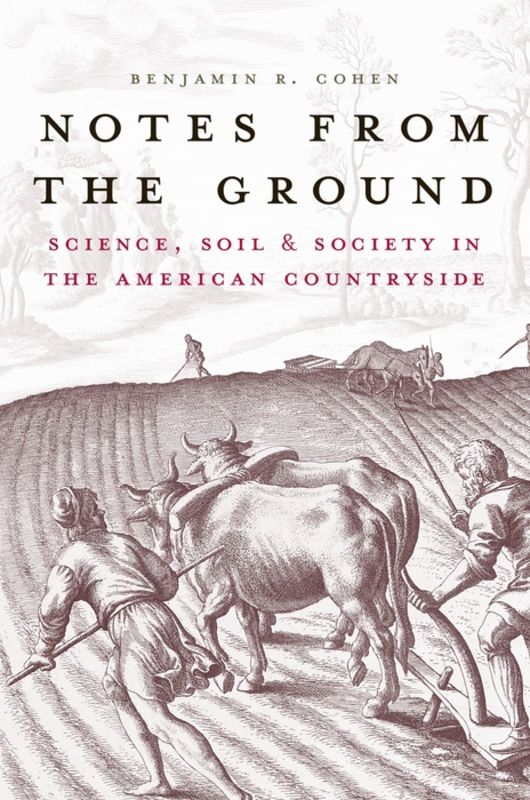
Notes from the ground
Notes from the Groundexamines the cultural conditions that brought agriculture and science together in nineteenth-century America. Integrating the history of science, environmental history, and science studies, the book shows how and why agrarian Americans-yeoman farmers, gentleman planters, politicians, and policy makers alike-accepted, resisted, and shaped scientific ways of knowing the land. By detailing the changing perceptions of soil treatment, Benjamin Cohen shows that the credibility of new soil practices grew not from the arrival of professional chemists, but out of an existing ideology of work, knowledge, and citizenship.
eBook

once and future georgic: agricultural practice, environmental knowledge, and the place for an ethic of experience
This paper re-introduces the georgic ethic and the role it has historically played in debates about new agricultural practices. Public engagement, participatory research, and greater local involvement in crafting new means to work the land flood the literature of agrarian studies. Putting the experience- and place-based georgic into that discourse can help deepen its character and future possibilities. The paper draws from recent sociological research into the acceptance and resistance to new practices to show the georgic's explanatory, descriptive utility in studies of those controversies. It also highlights how agricultural and environmental ethicists can draw from the georgic tradition for its prescriptive and normative possibilities to put practitioners back into the agricultural policy process and to draw more firmly from the notion that knowledge of the environment is constituted in practices of living in it. Placing the language and terms of the georgic ethic more centrally into public conversations about agricultural ethics and policy can enrich those conversations by structuring them with attention to experience, place-based values, and the moral space of interaction between humans and the land.
Journal Article

Surveying Nature: Environmental Dimensions of Virginia's First Scientific Survey, 1835–1842
State scientific surveys are underexplored territory in environmental history, an oversight made more glaring since these projects were rich in their assumptions, methods, and legacies. This article examines Virginia's 1830s Geological Survey, asking why the state sought its benefits, how the project was organized, and what specific social and technical activities it comprised. The survey, all told, is indicative of a budding interest in and acceptance of science as a valid means to describe the environment.
Journal Article

Technoscience and Environmental Justice
Over the course of nearly thirty years, the environmental justice movement has changed the politics of environmental activism and influenced environmental policy. In the process, it has turned the attention of environmental activists and regulatory agencies to issues of pollution, toxics, and human health as they affect ordinary people, especially people of color. This book argues that the environmental justice movement has also begun to transform science and engineering. The chapters present case studies of technical experts' encounters with environmental justice activists and issues, exploring the transformative potential of these interactions. Technoscience and Environmental Justice first examines the scientific practices and identities of technical experts who work with environmental justice organizations, whether by becoming activists themselves or by sharing scientific information with communities. It then explore scientists' and engineers' activities in such mainstream scientific institutions as regulatory agencies and universities, where environmental justice concerns have been (partially) institutionalized as a response to environmental justice activism. All of the chapters grapple with the difficulty of transformation that experts face, but the studies also show how environmental justice activism has created opportunities for changing technical practices and, in a few cases, has even accomplished significant transformations.The hardcover edition does not include a dust jacket.
eBook

ESCAPING THE FALSE BINARY OF NATURE AND CULTURE THROUGH CONNECTION: Richard White's \The Organic Machine: The Remaking of the Columbia River\
In The Organic Machine, Richard White fruitfully undermined the ease of separating nature from culture by emphasizing their relationship rather than their distinct identity. Now a staple of university curricula, White's text has become the standard bearer for a methodology that befits environmental history as well as all manner of environmental studies. With his nuanced presentation of the political, ethical, social, and technological dynamics of land and water management, White has offered students and scholars the framework and model with which to move beyond binary approaches to nature and culture issues. The work is particularly well-regarded for its philosophical clarity and subtle consideration of environmental and technological ethics, standing as one of the few treatments of the postmodern era to argue against simplistic dichotomies while remaining outside the fray of constructivist counter-critiques. This article treats The Organic Machine for its deepening relevance to environmental scholarship by revisiting its themes and structure.
Journal Article

The Element of the Table: Visual Discourse and the Preperiodic Representation of Chemical Classification
Cohen delves into the visual representation of chemical classification. He discusses the active function of tables in the history of chemistry, arguing that the dynamic roles have in fact been enabled and fostered by their visually representative characteristics.
Journal Article

Notes from the ground : science, soil, and society in the American countryside / Benjamin R. Cohen
This text examines the cultural conditions that brought agriculture and science together in 19th-century America. Integrating the history of science, environmental history and science studies, this text shows how and why agrarian Americans accepted, resisted and shaped scientific ways of knowing the land.
eBook

The Arid Lands
Deserts are commonly imagined as barren, defiled, worthless places, wastelands in need of development. This understanding has fueled extensive anti-desertification efforts -- a multimillion-dollar global campaign driven by perceptions of a looming crisis. In this book, Diana Davis argues that estimates of desertification have been significantly exaggerated and that deserts and drylands -- which constitute about 41% of the earth's landmass -- are actually resilient and biodiverse environments in which a great many indigenous people have long lived sustainably. Meanwhile, contemporary arid lands development programs and anti-desertification efforts have met with little success. As Davis explains, these environments are not governed by the equilibrium ecological dynamics that apply in most other regions. Davis shows that our notion of the arid lands as wastelands derives largely from politically motivated Anglo-European colonial assumptions that these regions had been laid waste by \"traditional\" uses of the land. Unfortunately, such assumptions still frequently inform policy. Drawing on political ecology and environmental history, Davis traces changes in our understanding of deserts, from the benign views of the classical era to Christian associations of the desert with sinful activities to later (neo)colonial assumptions of destruction. She further explains how our thinking about deserts is problematically related to our conceptions of forests and desiccation. Davis concludes that a new understanding of the arid lands as healthy, natural, but variable ecosystems that do not necessarily need improvement or development will facilitate a more sustainable future for the world's magnificent drylands.
eBook

Mr. Jefferson's Lost Cause: Land, Farmers, Slavery, and the Louisiana Purchase
Cohen reviews Mr. Jefferson's Lost Cause: Land, Farmers, Slavery, and the Louisiana Purchase by Roger G. Kennedy.
Book Review