
Catalogue Search | MBRL


Are you sure you want to remove the book from the shelf?

{{itemTitle}}
6
result(s) for
"Cohen, Jeffrey Jerome, editor"
Sort by:


Prismatic Ecology
Emphasizing sustainability, balance, and the natural, green dominates our thinking about ecology like no other color. What about the catastrophic, the disruptive, the inaccessible, and the excessive? What of the ocean's turbulence, the fecundity of excrement, the solitude of an iceberg, multihued contaminations?Prismatic Ecologymoves beyond the accustomed green readings of ecotheory and maps a colorful world of ecological possibility.
In a series of linked essays that span place, time, and discipline, Jeffrey Jerome Cohen brings together writers who illustrate the vibrant worlds formed by colors. Organized by the structure of a prism, each chapter explores the coming into existence of nonanthropocentric ecologies. \"Red\" engages sites of animal violence, apocalyptic emergence, and activism; \"Maroon\" follows the aurora borealis to the far North and beholds in its shimmering alternative modes of world composition; \"Chartreuse\" is a meditation on postsustainability and possibility within sublime excess; \"Grey\" is the color of the undead; \"Ultraviolet\" is a potentially lethal force that opens vistas beyond humanly known nature.
Featuring established and emerging scholars from varying disciplines, this volume presents a collaborative imagining of what a more-than-green ecology offers. While highlighting critical approaches not yet common within ecotheory, the contributions remain diverse and cover a range of topics including materiality, the inhuman, and the agency of objects. By way of color, Cohen guides readers through a reflection of an essentially complex and disordered universe and demonstrates the spectrum as an unfinishable totality, always in excess of what a human perceives.
Contributors: Stacy Alaimo, U of Texas at Arlington; Levi R. Bryant, Collin College; Lowell Duckert, West Virginia U; Graham Harman, American U in Cairo; Bernd Herzogenrath, Goethe U of Frankfurt; Serenella Iovino, U of Turin, Italy; Eileen Joy; Robert McRuer, George Washington U; Tobias Menely, Miami U; Steve Mentz, St. John's U, New York City; Timothy Morton, Rice U; Vin Nardizzi, U of British Columbia; Serpil Opperman, Hacettepe U, Ankara; Margaret Ronda, Rutgers U; Will Stockton, Clemson U; Allan Stoekl, Penn State U; Ben Woodard; Julian Yates, U of Delaware.
eBook


Veer Ecology
The words most commonly associated with the environmental movement-save, recycle, reuse, protect, regulate, restore-describe what we can do to help the environment, but few suggest how we might transform ourselves to better navigate the sudden turns of the late Anthropocene. Which words can help us to veer conceptually along with drastic environmental flux? Jeffrey Jerome Cohen and Lowell Duckert asked thirty brilliant thinkers to each propose one verb that stresses the forceful potential of inquiry, weather, biomes, apprehensions, and desires to swerve and sheer. Each term is accompanied by a concise essay contextualizing its meaning in times of resource depletion, environmental degradation, and global climate change.
Some verbs are closely tied to natural processes: compost, saturate, seep, rain, shade, sediment, vegetate, environ. Many are vaguely unsettling: drown, unmoor, obsolesce, power down, haunt. Others are enigmatic or counterintuitive: curl, globalize, commodify, ape, whirl. And while several verbs pertain to human affect and action-love, represent, behold, wait, try, attune, play, remember, decorate, tend, hope-a primary goal ofVeer Ecologyis to decenter the human. Indeed, each of the essays speaks to a heightened sense of possibility, awakening our imaginations and inviting us to think the world anew from radically different perspectives. A groundbreaking guide for the twenty-first century,Veer Ecologyforegrounds the risks and potentialities of living on-and with-an alarmingly dynamic planet.
Contributors: Stacy Alaimo, U of Texas at Arlington; Joseph Campana, Rice U; Holly Dugan, George Washington U; Lara Farina, West Virginia U; Cheryll Glotfelty, U of Nevada, Reno; Anne F. Harris, DePauw U; Tim Ingold, U of Aberdeen; Serenella Iovino, U of Turin; Stephanie LeMenager, U of Oregon; Scott Maisano, U of Massachusetts, Boston; Tobias Menely, U of California, Davis; Steve Mentz, St. John's U; J. Allan Mitchell, U of Victoria; Timothy Morton, Rice U; Vin Nardizzi, U of British Columbia; Laura Ogden, Dartmouth College; Serpil Opperman, Hacettepe U, Ankara; Daniel C. Remein, U of Massachusetts, Boston; Margaret Ronda, U of California, Davis; Nicholas Royle, U of Sussex; Catriona Sandilands, York U; Christopher Schaberg, Loyola U; Rebecca R. Scott, U of Missouri; Theresa Shewry, U of California, Santa Barbara; Mick Smith, Queen's U; Jesse Oak Taylor, U of Washington; Brian Thill, Golden West College; Coll Thrush, U of British Columbia, Vancouver; Cord J. Whitaker, Wellesley College; Julian Yates, U of Delaware.
eBook

Anthropocene Reading
Few terms have garnered more attention recently in the sciences,
humanities, and public sphere than the Anthropocene, the proposed
epoch in which a human \"signature\" appears in the
lithostratigraphic record. Anthropocene Reading considers
the implications of this concept for literary history and critical
method.
Entering into conversation with geologists and geographers, this
volume reinterprets the cultural past in relation to the
anthropogenic transformation of the Earth system while showcasing
how literary analysis may help us conceptualize this geohistorical
event. The contributors examine how a range of literary texts, from
The Tempest to contemporary dystopian novels to the poetry
of Emily Dickinson, mediate the convergence of the social
institutions, energy regimes, and planetary systems that support
the reproduction of life. They explore the long-standing dialogue
between imaginative literature and the earth sciences and show how
scientists, novelists, and poets represent intersections of
geological and human timescales, the deep past and a posthuman
future, political exigency and the carbon cycle.
Accessibly written and representing a range of methodological
perspectives, the essays in this volume consider what it means to
read literary history in the Anthropocene.
Contributors include Juliana Chow, Jeffrey Jerome Cohen, Thomas
H. Ford, Anne-Lise François, Noah Heringman, Matt Hooley, Stephanie
LeMenager, Dana Luciano, Steve Mentz, Benjamin Morgan, Justin
Neuman, Jennifer Wenzel, and Derek Woods.
eBook
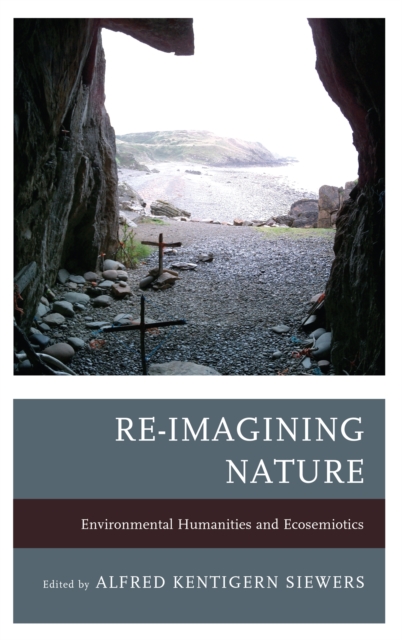
Re-imagining nature
Re-Imagining Nature: Environmental Humanities and Ecosemiotics explores new horizons in environmental studies, which consider communication and meaning as core definitions of ecological life, essential to deep sustainability. It considers landscape as narrative, and applies theoretical frameworks in eco-phenomenology and ecosemiotics to literary, historical, and philosophical study of the relationship between text and landscape. It considers in particular examples and lessons to be drawn from case studies of medieval and Native American cultures, to illustrate in an applied way the promise of environmental humanities today. In doing so, it highlights an environmental future for the humanities, on the cutting edge of cultural endeavor today.
eBook