
Catalogue Search | MBRL


Are you sure you want to remove the book from the shelf?

{{itemTitle}}
27
result(s) for
"Cohen, Stephen S., author"
Sort by:

Concrete economics : the Hamilton approach to economic growth and policy
\"Brilliantly written and argued, Concrete Economics shows exactly how the US government has shaped and directed the economy since the very inception of the country. This book does not rehash the sturdy and well-known arguments that to thrive, an entrepreneurial economy needs a social and policy environment characterized by a broad range of freedoms. Nor does it buy into the myth of the absolutely free market. Instead, Cohen and DeLong focus on the forgotten role played by the US government in initiating and enabling a redesign of the US economy. The government not only sets the ground rules for entrepreneurial activity but directs the surges of energy that mark a vibrant economy. It is as true for present-day Silicon Valley as it was for New England manufacturing at the dawn of the nineteenth century. This is not an argument based on abstract truths, complex correlations, or arcane discoveries, but rather on the facts of how the US economy succeeded so brilliantly. And that provides a blueprint for how the government, established companies, and new ventures can partner to yet again successfully reshape the economy. \"-- Provided by publisher.
Book

Arming without Aiming: India's Military Modernization
India, a leading importer of advance conventional weaponry, has not planned strategically for its military needs, although the haphazard approach, due to competing elements within the military and a restraint policy in place since the Nehru era, may be the right one in seeking accommodation with others in the region.
eBook
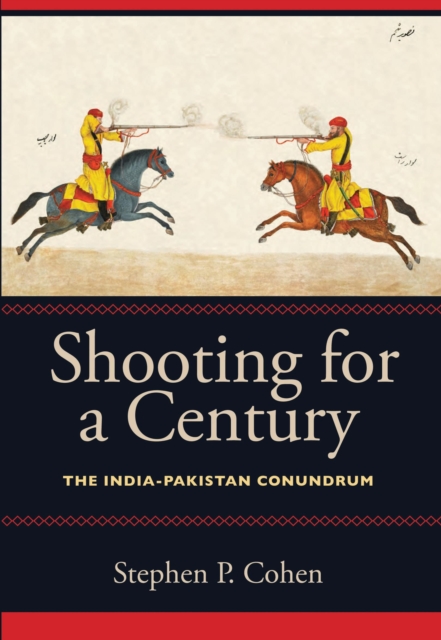
Shooting for a century
The rivalry between India and Pakistan has proven to be one of the world's most intractable international conflicts, ever since 1947 when the British botched their departure from the South Asian subcontinent. And the enmity is likely to continue for another thirty-five years, reaching the century mark. This has critical implications for both countries and the rest of the world. Renowned South Asia expert Stephen P. Cohen explains why he expects this rivalry to continue in this first comprehensive survey of the deep historical, cultural, and strategic differences that underpin the hostility.
In recent years the stakes have increased as India and Pakistan have each acquired a hundred or more nuclear weapons, blundered into several serious crises, and become victims of terrorism, some of it from across their borders. America is puzzled by the problem of dealing with a rising India and a struggling Pakistan, and Cohen offers a fresh approach for U.S. policy in dealing with these two powers.
Drawing on his rich experience in South Asia to explore the character, depth, and origin of Indian and Pakistani attitudes toward each other, Cohen develops a comprehensive theory of why the dispute between New Delhi and Islamabad is likely to persist. He also describes the terrible cost of this animosity for the citizens of India and Pakistan, including the region's high levels of violence and low level of economic integration. On a more hopeful note, however, he goes on to suggest developments that could ameliorate the tension, including a more active role for the UnitedStates in addressing a range of issues that divide the nations. Kashmir is one of these issues, but as much a consequence as a cause of the rivalry.
Can India and Pakistan resolve their many territorial and identity issues? Perhaps the best they can expect in the near term is a limited degree of normalization, including bottom-up ideas generated by the peace and business communities, as well as a realistic assessment by strategic elites of the two states' shared common interests.
\"Right now, full normalization seems unlikely,\" Cohen writes in the preface, \"so this book is suffused with conditional pessimism: normalization would be desirable, but there are worse futures than a projection of the present rivalry for another thirty years or more.\"
eBook
Perception, Politics and Security in South Asia
This book provides a detailed examination of the compound crisis between India and Pakistan that brought the region to the brink of a nuclear war in 1990. Placing the crisis in the context of concurrent international events such as the fall of the Soviet Union, the authors draw out the lesson for present-day South Asian affairs. The book also makes a significant contribution to the debates on the role of nuclear weapons, confidence and security building strategies and the place of ethnicity in contemporary international relations.
eBook
Outlines in Orthopaedic Surgery
Pocket-size, user-friendly roadmap to learning the basic skills of orthopaedic surgery!
Surgery requires a combination of knowledge and skill acquired through years of direct observation, mentorship, and practice. The learning curve can be steep, frustrating, and intimidating for many medical students and junior residents. Too often, books and texts that attempt to translate the art of surgery are far too comprehensive for this audience and counterproductive to learning important basic skills to succeed. Outlines in Orthopaedic Surgery by Valentin Antoci and Adam Eltorai is the orthopaedic volume in a series of textbooks that offer a simplified roadmap to surgery. The text serves as starting point for learning orthopaedic surgery techniques, with room for adding notes, details, and pearls collected during the journey.
This unique resource outlines key steps for common orthopaedic procedures, laying a solid foundation of basic knowledge from which trainees can easily build and expand. Thirty-five chapters are systematically organized and formatted by subspecialty, starting with an introduction, followed by sections covering surgery of the hand, shoulder and elbow, joint arthroplasty, sports orthopaedics, spine surgery, orthopaedic trauma, foot and ankle, and pediatrics. Each chapter includes symptoms and signs, surgical pathology, diagnostic modalities, differential diagnosis, treatment options, indications for surgical intervention, step-by-step procedures, pitfalls, and prognosis.
Key Features
* Concise text and bullets provide quick procedural outlines essential for understanding procedural steps
* The generously illustrated text encompasses a full spectrum of musculoskeletal disorders related to degenerative changes, injuries, and congenital conditions
* Treatment of a variety of fractures including both bones of the forearm, Monteggia and olecranon, lateral malleolus/bimalleolar ankle, and supracondylar humeral and intramedullary fixation of forearm fractures in pediatric patients
This is an ideal, easy-to-read resource for medical students and junior residents to utilize during orthopaedic surgery rotations and for quick consultation during the early years of practice. It will also benefit allied health professionals who need a quick guide on core orthopaedic surgery procedures.
eBook

Four Crises and a Peace Process: American Engagement in South Asia
Explains the underlying causes of four contained conflicts on the subcontinent, their consequences, the lessons learned, and the American role in each. Considers these as cases of attempted conflict resolution, as instances of limited war by nuclear-armed nations, and as examples of intervention and engagement by the U.S. and China
eBook

Cotton and Williams' practical gastrointestinal endoscopy
Translated into seven languages, Cotton and Williams' Practical Gastrointestinal Endoscopy has for the last 25 years been the basic primer for endoscopy around the world, providing clear, clinical and practical guidance on the fundamentals of endoscopy practice, from patient positioning and safety, how to perform different endoscopic procedures, and the latest in therapeutic techniques and advances in technology.
It's key strength and reason for its popularity is its step-by-step, practical approach, especially with the use of outstanding colour artwork to illustrate the right and wrong ways to perform endoscopy. Add to this the weight and expertise of its author team, led by Peter Cotton and Christopher Williams, and the final result is an essential tool for all gastroenterologists and endoscopists, particularly trainees looking to improve their endoscopic technique.
Joining Peter Cotton, Christopher Williams and Brian Saunders in the seventh edition are two exciting stars in UK and US endoscopy, Adam Haycock and Jonathan Cohen. New to this edition are:
* Approximately 35 high-quality videos illustrating optimum endoscopy practice, all referenced via \"video eyes\" in the text
* Self-assessment MCQs to test main learning points
* An online clinical photo imagebank to complement the line illustrations, perfect for downloading into scientific presentations
* Key learning points in every chapter
* Much more information on mucosal resection techniques and small bowel endoscopy—for capsule and \"deep\" enteroscopy
* The latest recommendations and guidelines from the ASGE, ASG, UEGW and BSG.
Cotton and Williams' Practical Gastrointestinal Endoscopy, seventh edition is fully modernised, masterful as ever, and once again, the number one endoscopy manual for a whole new generation of gastroenterologists and endoscopists.
eBook
South Asia After The Cold War
South Asia is a region of one billion people, divided into seven states and numerous religious, caste, ethnic, and linguistic groups. It is the site of ethnic and religious violence that is transnational in its implications; the region has been host to four major wars and several war scares, most recently the India-Pakistan crisis over Kashmir in 1990. South Asia may also be on the edge of nuclearization. Even so, the region has an unheralded history of cooperative efforts and a strong record of democracy-since 1988, all the major states of South Asia have elected governments.
In this volume, a cast of Western and regional leading scholars, military analysts, and politicians assess the current security landscape in the South Asia region. Offering a balanced mix of perspectives, the contributors provide background information on long-standing conflicts, the impact that the Cold War had upon those conflicts, and thoughtful analysis of the future strategic dilemmas, as well as speculation on possible opportunities for peace for different countries in the region.
eBook

Folk City
From Washington Square Park and Café Society to WNYC Radio and Folkways Records, New York City's cultural, artistic, and commercial assets helped to shape a distinctively urban breeding ground for the famous folk music revival of the 1950s and '60s. Folk City, by Stephen Petrus and Ronald Cohen, explores New York's central role in fueling the nationwide craze for folk music in postwar America.
eBook

India
For years, Americans have seen India as a giant but inept state. That negative image is now obsolete. After a decade of drift and uncertainty, India is taking its expected place as one of the three major states of Asia. Its pluralist, secular democracy has allowed the rise of hitherto deprived castes and ethnic communities. Economic liberalization is gathering steam, with six percent annual growth and annual exports in excess of $30 billion. India also has a modest capacity to project military power. The country will soon have a two-carrier navy and it is developing a nuclear-armed missile capable of reaching all of Asia. This landmark book provides the first comprehensive assessment of India as a political and strategic power since India's nuclear tests, its 1999 war with Pakistan, and its breakthrough economic achievements. Stephen P. Cohen examines the domestic and international causes of India's \"emergence,\" he discusses the way social structure and tradition shape Delhi's perceptions of the world, and he explores India's relations with neighboring Pakistan and China, as well as the United States. Cohen argues that American policy needs to be adjusted to cope with a rising India-and that a relationship well short of alliance, but far more intimate than in the past, is appropriate for both countries.
eBook