
Catalogue Search | MBRL


Are you sure you want to remove the book from the shelf?

{{itemTitle}}
22
result(s) for
"Cohn, Samuel Kline"
Sort by:

Popular protest in late medieval English towns
\"Contrary to received opinion, revolts and popular protests in medieval English towns were as frequent and as sophisticated, if not more so, as those in the countryside. This groundbreaking study refocuses attention on the varied nature of popular movements in towns from Carlisle to Dover and from the London tax revolt of Longbeard in 1196 to Jack Cade's Rebellion in 1450, exploring the leadership, social composition, organisation and motives of popular protest. The book charts patterns of urban revolt in times of strong and weak kingship, contrasting them with the broad sweep of ecological and economic change that inspired revolts on the continent. Samuel Cohn demonstrates that the timing and character of popular revolt in England differed radically from revolts in Italy, France and Flanders. In addition, he analyses repression and waves of hate against Jews, foreigners and heretics, opening new vistas in the comparative history of late medieval Europe\"-- Provided by publisher.
Book

Cholera revolts: a class struggle we may not like
Few have studied cholera revolts comparatively, and certainly not over the vast terrain from Asiatic Russia to Quebec or across time from the first European cholera wave of the 1830s to the twentieth century. Scholars have instead concentrated on the first European cholera wave in the 1830s and have tended to explain cholera's social violence within the political contexts of individual nations, despite these riots raging across vast differences in political landscapes from Czarist Russia to New York City but with similar fears and conspiracy theories of elites inventing cholera to cull populations of the poor. Moreover, the history of cholera's social toxins runs against present generalizations on why epidemics spawn blame and violence against others. Cholera riots continued, and in Italy and Russia became geographically more widespread, vicious, and destructive long after the disease had lost its mystery. The article then poses the question of why historians on the left have not studied the class struggles provoked by cholera, with riots of 10,000, murdering state officials and doctors, destroying hospitals, town halls, and in the case of Donetsk, an entire city. Finally, the article draws parallels between Europe's cholera experiences and those in West Africa with Ebola in 2014.
Journal Article
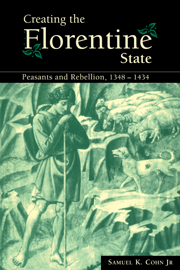
Creating the Florentine State
This book offers a comprehensive approach to the study of the political history of the Renaissance: its analysis of government is embedded in the context of geography and social conflict. Instead of the usual institutional history, it examines the Florentine state from the mountainous periphery - a periphery both of geography and class - where Florence met its most strenuous opposition to territorial incorporation. Yet, far from being acted upon, Florence's highlanders were instrumental in changing the attitudes of the Florentine ruling class: the city began to see its own self-interest as intertwined with that of its region and the welfare of its rural subjects at the beginning of the fifteenth century. Contemporaries either remained silent or purposely obscured the reasons for this change, which rested on widespread and successful peasant uprisings across the mountainous periphery of the Florentine state, hitherto unrecorded by historians.
eBook
The topography of medieval popular protest
Assumptions about the topography of popular revolt have been essential in constructing sociological and historical models that demarcate a 'pre-modern' from the 'modern' period. In Charles Tilly's words, the 'repertoires of collective action' before the mid-nineteenth century were 'parochial, particular, and bifurcated', while afterwards, they became 'cosmopolitan, autonomous, and modular' (2008). By relying on primary sources across the Italian peninsula, France, Flanders and Britain and for the early modern period across German-speaking regions into Russia, this article shows that the plethora of late medieval revolts were rarely, if ever, confined to a neighbourhood or bounded by local religious congregations or family ties. Instead, they were citywide and north of the Alps fused alliances with the peasantry and other cities. With popular protest pushing eastward in the early modern period, these long-distant dimensions became more extensive, crossing linguistic boundaries and thousands of kilometres. In addition, this article raises new questions, such as why peasants and urban rebels in Italy, in contrast to northern Europe, resisted cross-mural alliances, and to what extent late medieval popular insurrection differed from those of the early modern period. The article ends with a call for new models to understand these differences.
Journal Article

Social and institutional Reactions to the Influenza Pandemic of 1918-20
This essay challenges generalizations since the late enlightenment about the effects of epidemics and pandemics on collective mentalities: that from antiquity to the present, epidemics, regardless of the disease, have sparked distrust, social violence, and the blaming of others. By contrast, the pandemic that killed the greatest numbers in world history–the Influenza of 1918-20 – was a pandemic of compassion. No one has yet to uncover this pandemic sparking collective violence or blaming any minorities for spreading the disease anywhere in the globe. The essay then explores the variety of charitable reactions and abnegation that cut across social divisions in communities from theatres of war in Europe to nations thousands of miles from the direct military encounters. Most remarkable, however, was the overflowing volunteerism of women, especially in the US, Canada, and Australia. To explain this widespread charitable reaction, the essay investigates the milieu of the First World War, showing how that context in domestic war settings was not conducive to risking life to aid total strangers, especially when those strangers came from different foreign countries classes, races, or religious faiths. I end with a reflection on the unfolding socio-psychological reactions to Covid-19 from the perspective of 1918–20.
Journal Article

The Black Death and the Burning of Jews
Cohn investigates the sources of the 1348-51 persecution in the context of popular rebellion in Europe during the later Middle Ages and compares the Black Death massacres with those later in the century, arguing that the two differed in the social composition of perpetrators and victims and in their underlying psychological causes. Such comparisons show that transhistorical explanations of violence towards Jews--even ones that argue for fundamental changes in anti-Semitism with the birth of Christianity, the later Christianization of Europe in the fourth century, or the rise of a more aggressive Church and states in the twelfth century--fail to do justice to the sources or account for the vagaries of history. External events such as the unprecedented mortalities of the Black Death could rapidly transform the face of hatred, and afterwards, within a generation or less, the perpetuators and motives for violence could shift fundamentally yet again.
Journal Article

Households and Plague in Early Modern Italy
The remarkable \"Books of the Dead\" from early modern Milan and the parish and tax records of Nonantola during the plague of 1630 allow historians to reconstitute the patterns of family and household deaths caused by pestilence. Not only did deaths caused by this highly contagious disease cluster tightly within households; the intervals between household deaths were also extremely short. As much as one-quarter of all plague deaths were multiple household deaths that occurred on the same day. Similar to a deadly influenza, the speed and efficiency with which the late medieval and early modern plagues spread depended on unusually short periods of incubation and infectivity.
Journal Article

Piété et commande d'œuvres d'art après la Peste noire
From over 500 artistic commissions found scattered through thousands of last wills and testaments in Tuscany and Umbria, this paper draws new conclusions about art production after the Black Death of 1348. The \"notable disturbances\" in painting magisterially discussed by Millard Meiss and other art historians, I argue, were not the results of new waves of pessimism spawned by the plague's unprecedented mortalities. Rather, the opposite was the case. With the recurrence of plague in the late Trecento patricians and plebeians alike broke from the grip of mendicant piety and sought out new ways to memorialize themselves and, more importantly, their male lineages. This flood of new patrons to the art market conditioned new workshop practices, leading to that \"strict uniformity and regimentation of figures\" that Meiss and others have interpreted as \"a return to the Dugento.\"
Journal Article
