
Catalogue Search | MBRL


Are you sure you want to remove the book from the shelf?

{{itemTitle}}
159
result(s) for
"Colangelo, Francesco"
Sort by:

Recycling of Pre-Washed Municipal Solid Waste Incinerator Fly Ash in the Manufacturing of Low Temperature Setting Geopolymer Materials
In this work, three samples of municipal solid waste incinerators fly ash (MSWI-FA) have been stabilized in systems containing coal fly ash to create geopolymers through a polycondensation reaction. Monolithic products have been obtained with both MSWI fly ash as received and after the partial removal of chloride and sulfate by water washing. The polycondensation products have been characterized qualitatively by means of Fourier transform infrared spectroscopy, X-ray diffraction and scanning electron microscopy and quantitatively, through the determination of the volume of reacted water and silicate. Furthermore, the heavy metals and chloride releases together with the physico-mechanical properties have been evaluated on the hardened products. In conclusion, considering the technological and environmental performances of the obtained geopolymers, they could be suitable for many non-structural applications, such as backfilling of abandoned quarries, decorative materials or brick fireplaces, hearths, patios, etc.
Journal Article

Fast vortex dynamics and relaxation times in NbRe-based heterostructures
An in-depth analysis of Abrikosov vortex dynamics and flux-flow instabilities was performed in NbRe/Au and NbRe/Py bilayers to compare superconducting/normal metal (S/N) and superconducting/ferromagnetic (S/F) heterostructures based on the same superconducting layer. The heterostructures, fabricated by sputtering, were characterized through electrical transport measurements. The I – V characteristics show that, in the NbRe/Py bilayer, vortices reach higher critical velocities than those observed in the NbRe/Au structure. The analysis of the flux-flow instability within the Larkin–Ovchinnikov framework allows one to extract the quasiparticle energy relaxation time. For external magnetic field values for which edge barrier pinning is dominant and thermal effects are negligible, the relaxation times are about 150 ps and 24 ps for NbRe/Au and NbRe/Py bilayers, respectively. These results indicate that NbRe/Py bilayers, having a relaxation time one order of magnitude smaller than values reported in NbRe microbridges, have great potential for the realization of devices where fast relaxation processes are required.
Journal Article
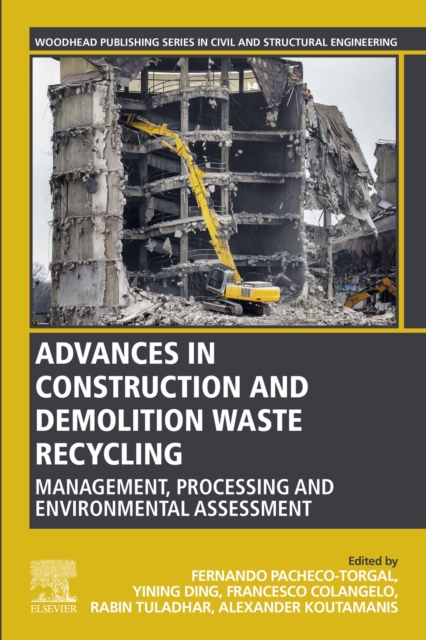
Advances in Construction and Demolition Waste Recycling
Advances in Construction and Demolition Waste Recycling: Management, Processing and Environmental Assessment is divided over three parts.Part One focuses on the management of construction and demolition waste, including estimation of quantities and the use of BIM and GIS tools.
eBook

Innovative Solidification and Stabilization Techniques Using Industrial By-Products for Soil Remediation
In recent decades, heavy industrial discharges have caused severe soil and groundwater pollution. Many areas previously occupied by industries are now represented by lands contaminated by the accumulation of toxic metals, which pose serious risks to human health, plants, animals, and surrounding ecosystems. Among the various potential solutions, the solidification and stabilization (S/S) technique represents one of the most effective technologies for treating and disposing of a wide range of contaminated wastes. This study focuses on the theoretical definition of a green material mix, which will subsequently be used in the solidification process of contaminated industrial soils, optimizing the mix to ensure treatment effectiveness. The mix design was developed through a literature analysis, representing a preliminary theoretical study. This paper explores the application of the S/S process using various additives, including Portland cement, fly ash (FA), ground granulated blast furnace slag (GGBFS), and other industrial waste materials, to create an innovative mix design for the treatment of contaminated soils. The main objective is to reduce the permeability and solubility of contaminants while simultaneously improving the mechanical properties of the treated materials. The properties of the studied soils are described along with those of the green materials used, providing a comprehensive overview of the optimization of the resulting mixtures.
Journal Article
Correction: Petrillo et al. Innovative Solidification and Stabilization Techniques Using Industrial By-Products for Soil Remediation. Appl. Sci. 2025, 15, 4002
In the original publication [...]
Journal Article
Use of Unbound Materials for Sustainable Road Infrastructures
The growing environmental sensitivity and the reduction of natural resources create, in Italy and other developed countries, an increasing interest in the search for alternative materials to be used in road construction works. In recent years, the problems related to environmental sustainability have made it increasingly difficult to remove natural aggregates from quarries and, at the same time, the regulations for the management of waste dumps are more and more restrictive. For this reason, the use of recycled aggregates is experiencing a continuous increase in the civil construction sector. This paper deals with the study of construction and demolition waste (CDW) in the field of road construction, in particular for the construction of embankment, road subgrades, foundation layers and unbound bases for flexible superstructures. Three different particle size fractions were used to prepare the mixtures: the first having a coarse size and designation 0–63 mm, the second intermediate size with aggregates of 0–31.5 mm grain size and the third with the finest aggregates having a grain size of 0–4 mm. The study was carried out by analyzing three granulometric fractions, verifying the best application for each of them. Subsequently, the mix-design was investigated, operating in compliance with the requirements imposed by UNI 11531-1, EN ISO 14688, EN 13242 and EN 13285. For the unbound layers of subgrade, foundation and base, which require greater resistance to fragmentation, the use of CDW alone has shown some limitations. Therefore, in the experimentation, it was decided to mix the CDW with a granulated slag coming from the steel production in the electric arc furnaces (EAF) and with an additional CDW (0–31.5 mm) coming from the recovery of concrete with slag. EAF granulated slag was used in small quantities, due to its relatively high cost. Four eco-friendly and recycled mixtures were studied, with low economic impact and high environmental sustainability, suitable for the construction of unbound layers of road superstructures.
Journal Article

Synthesis and Characterizations of Melamine-Based Epoxy Resins
A new, easy and cost-effective synthetic procedure for the preparation of thermosetting melamine-based epoxy resins is reported. By this innovative synthetic method, different kinds of resins can be obtained just by mixing the reagents in the presence of a catalyst without solvent and with mild curing conditions. Two types of resins were synthesized using melamine and a glycidyl derivative (resins I) or by adding a silane derivative (resin II). The resins were characterized by means of chemical-physical and thermal techniques. Experimental results show that all the prepared resins have a good thermal stability, but differ for their mechanical properties: resin I exhibits remarkable stiffness with a storage modulus value up to 830 MPa at room temperature, while lower storage moduli were found for resin II, indicating that the presence of silane groups could enhance the flexibility of these materials. The resins show a pot life higher than 30 min, which makes these resins good candidates for practical applications. The functionalization with silane terminations can be exploited in the formulation of hybrid organic-inorganic composite materials.
Journal Article
Use of Cement Kiln Dust, Blast Furnace Slag and Marble Sludge in the Manufacture of Sustainable Artificial Aggregates by Means of Cold Bonding Pelletization
In this work, three different samples of solid industrial wastes cement kiln dust (CKD), granulated blast furnace slag and marble sludge were employed in a cold bonding pelletization process for the sustainable production of artificial aggregates. The activating action of CKD components on the hydraulic behavior of the slag was explored by evaluating the neo-formed phases present in several hydrated pastes. Particularly, the influence of free CaO and sulfates amount in the two CKD samples on slag reactivity was evaluated. Cold bonded artificial aggregates were characterized by determining physical and mechanical properties of two selected size fractions of the granules for each studied mixture. Eighteen types of granules were employed in C28/35 concrete manufacture where coarser natural aggregate were substituted with the artificial ones. Finally, lightweight concretes were obtained, proving the suitability of the cold bonding pelletization process in artificial aggregate sustainable production.
Journal Article

Sustainable Non-Conventional Concrete 3D Printing—A Review
In this review article, system materials for concrete 2D printing have been discussed, along with the various other aspects that are connected to sustainable construction. The article consists of an introduction giving the background of manufacturing that started almost two decades ago, including the non-conventional methods of building structures. It has been seen that there are various stainable materials in the field of 3D printing in construction, as the conversion of construction to 3D printing reduces waste generation. Further in this article, the cost comparison between conventional and non-conventional construction methods has been discussed, including the effectiveness of 3D printing; 3D printing is very effective in the sense that it requires the precise use of machinery and construction material. Full-scale 3D printing has also been seen in the building sector, but only to some extent. Some of the components of bridges, and even some of small bridges, have been constructed using 3D printing and ultra-high-performance concrete. Since there are various advantages to 3D building, there are also various disadvantages to 3D printing, such as how much it costs and finding the materials that are suitable for 3D printing, which might increase the cost. Polymers have also been used in 3D printing construction since polymers have a very long lifespan, and polymers may increase the strength of the final product by reinforcing the aggregate. Additionally, this technology gives us the opportunity to use various materials together for construction, such as recycled aggregates and geopolymers, along with concrete and cement, which might pose some challenges but are being used nowadays. A major concern with this technology is its impact on the labor market. Since in traditional construction huge amounts of man hours are required, concerns have been raised about the inclusion of this technology, as this might affect employment. Since most of the work will be done by machines, the need for labor will reduce. These are some of the issues that need attention. Finally, this article discusses the novelty and future scope of 3D printing in the construction sector, and concludes by outlining the scope of potential developments for 3D printing concrete by taking into account sustainability.
Journal Article

Experimental and Numerical Analysis of Thermal and Hygrometric Characteristics of Building Structures Employing Recycled Plastic Aggregates and Geopolymer Concrete
The correct estimation of building energy consumptions is assuming an always increasing importance, and a detailed reproduction of building structures, with all the single components involved, is necessary to achieve this aim. In addition, the current ecological development tries to limit the use of natural raw materials as building components, in favor of alternative (waste) materials, which ensure significant advantages from the economic, energetic and environmental point of views. In this work, dynamic heat and vapor transport in a typical three-dimensional (3D) building structure, involving different types of environmental-friendly concrete mixtures, have been simulated by using finite elements. In particular, the authors propose to substitute part of the aggregates with plastic waste and to use a fly ash based geopolymeric binder for the production of low conductivity concrete, to be employed in eco-efficient buildings. Concrete produced with natural limestone aggregates has been considered as the reference benchmark. The whole characterization of the different types of concrete tested in the present work has been obtained through laboratory experiments. The structure taken into account in the simulations is a 3D thermal bridge, typical of building envelopes. The thermal and hygrometric transient behavior of this structure, employing plastic waste in different percentages and geopolymer concrete, has been analyzed by the authors.
Journal Article