
Catalogue Search | MBRL


Are you sure you want to remove the book from the shelf?

{{itemTitle}}
128
result(s) for
"Colburn, Forrest D"
Sort by:

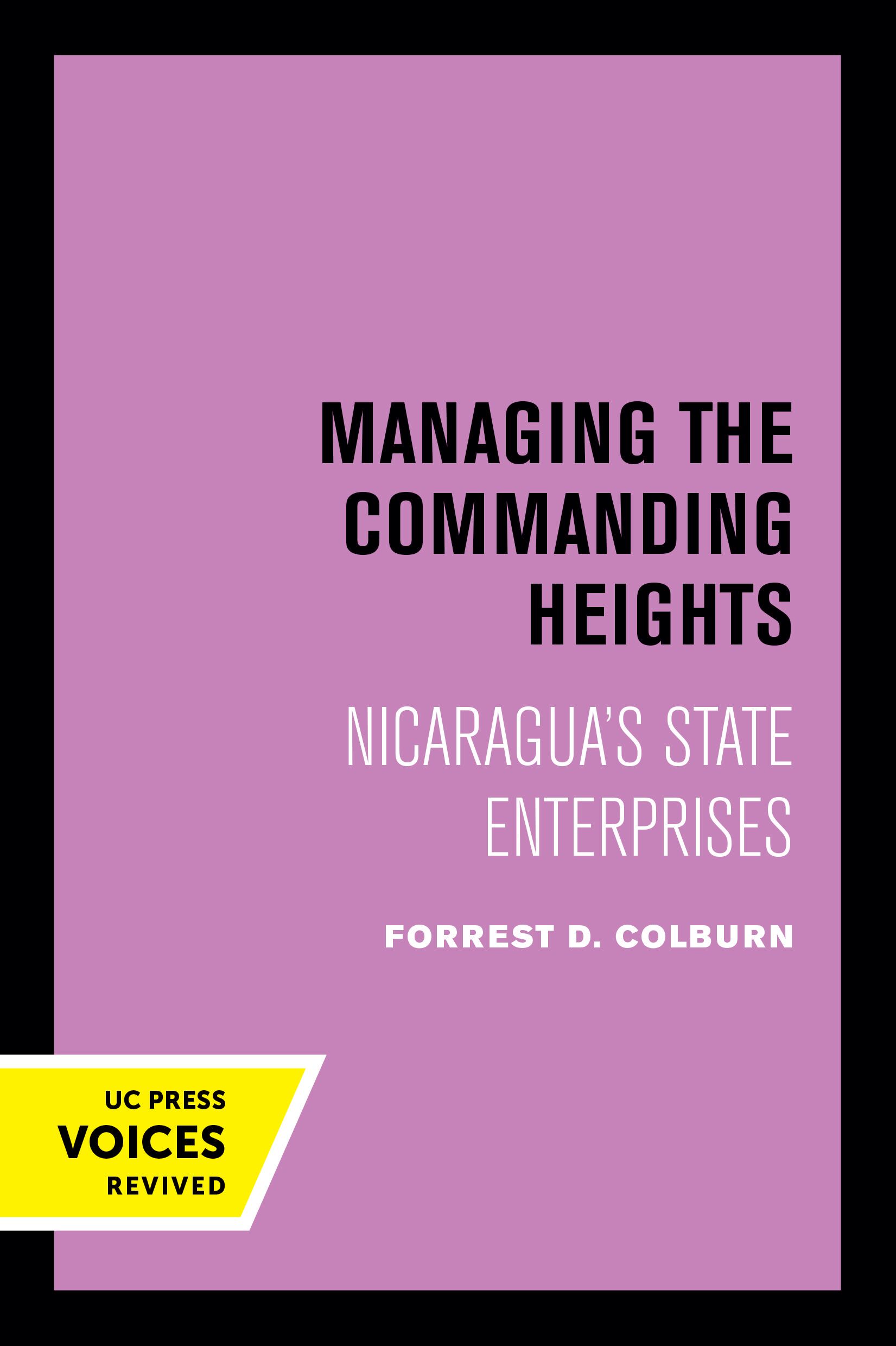
Managing the Commanding Heights
Revolutions have often occurred in poor countries. Although triumphant revolutionaries may lack the resources to assume complete responsibility for their country's economy, they do tend to nationalize what Lenin called the \"commanding heights\"--those enterprises that meet the strategic needs of the polity. How these enterprises are administered is consequential, and at times decisive, for the course of revolutionary change. In Managing the Commanding Heights, Forrest D. Colburn explores the Sandinistas' management of Nicaragua's state enterprises, with an emphasis on the critical agrarian sector. Central to the book are three lively and instructive case studies that provide a penetrating glimpse into life in post-revolutionary Nicaragua. In analyzing these cases, Colburn explains the intentions of the Sandinista elite and links them with choices made at individual enterprises. Colburn argues that state enterprises have been politically useful but economically unsuccessful. Even with the unseen political advantages of state enterprises, the pronounced financial losses of nationalized farms and factories exacerbate the economic--and ultimately political--vulnerability of a regime already weakened by counterrevolution. The evidence demonstrates trenchant limitations to a revolutionary state's capacity to improve popular welfare. State capacity is undermined by multiple factors: international constraints on the autonomy of post-revolutionary regimes, sheer poverty, the unintended but inevitable political manipulation of the economy, the lack of managerial ability among even well-intentioned elites, and a revolutionary mentalité that erodes rationality. These same difficulties have bedeviled other post-revolutionary regimes, notably those in Africa. Managing the Commanding Heights is essential reading for anyone interested in the dynamics of
revolutionary regimes and the possibilities for radical change in poor countries. This title is part of UC Press's Voices Revived program, which commemorates University of California Press's mission to seek out and cultivate the brightest minds and give them voice, reach, and impact. Drawing on a backlist dating to 1893, Voices Revived makes high-quality, peer-reviewed scholarship accessible once again using print-on-demand technology. This title was originally published in 1990. Many titles in the Voices Revived program are also newly available as ebooks, offered at a discounted price to support wider access to scholarly work.
eBook

The Decay of The Central American Left
Fervent and widespread protests that broke out in April 2018 against Daniel Ortega in Nicaragua exposed the lack of legitimacy of that country's personalistic regime. Longstanding members of the Sandinista Front for National Liberation have deserted the organization, long a pillar of the left in Central America. In neighboring El Salvador, the Farabundo Martí National Liberation Front came in a distant third in the presidential election of 3 February 2019. A leftist who was elected president in Guatemala, Álvaro Colom, proved disappointing. The left in Central America has collapsed, the victim of opportunism, a failure to rejuvenate political structures, and an inability to develop effective strategies for governing.
Journal Article
Personalism and Populism in Nicaragua
Scholarship on populism has focused on the ways in which charismatic leaders trade economic benefits for political support and their ability to smother political institutions. But the Nicaraguan case suggests that attention should also be given to the other end of the polity—namely, the absence in the general population of a democratic culture that offers needed support for political institutions. In Nicaragua, the scarcity of informed, engaged, and exacting citizens—participants in politics—is an important part of the explanation for the persistence of personalism and populism.
Journal Article


Varieties of liberalism in Central America : nation-states as works in progress
Why do some countries progress while others stagnate? Why does adversity strengthen some countries and weaken others? Indeed, in this era of unprecedented movement of people, goods, and ideas, just what constitutes a nation-state? Forrest Colburn and Arturo Cruz suggest how fundamental these questions are through an exploration of the evolution of Guatemala, El Salvador, Honduras, Nicaragua, and Costa Rica over the last quarter of a century, a period of intriguing, often confounding, paradoxes in Central America’s development. Offering an elegant defense of empiricism, Colburn and Cruz explore the roles of geography and political choice in constructing nations and states. Countries are shown to be unique: there are a daunting number of variables. There is causality, but not the kind that can be revealed in the laboratory or on the blackboard. Liberalism—today defined as democracy and unfettered markets—may be in vogue, but it has no inherent determinants. Democracy and market economies, when welded to the messy realities of individual countries, are compatible with many different outcomes. The world is more pluralistic in both causes and effects than either academic theories or political rhetoric suggest.
eBook
Nicaragua's surprising response to COVID-19
According to the 2019 Social Progress Index (based on multiple indicators showing several social metrics, such as health care and basic medical attention), Nicaragua ranked 103th among 149 countries, with a score of 58.97/100. According to the Ministry of Health’s epidemiological bulletin, acute respiratory infections and pneumonia cases for week 18 of 2020 decreased 15.6 percent and 20.7 percent, respectively, compared to the same week of 2019. [...]the Nicaraguan Medical Union stated that in the country, there are more than 40 cases of COVID-19 infections in medical personnel. [...]the government has restricted actions by nongovernmental and religious groups to provide health support to the population. According to the World Bank’s revised economic forecast for 2020 – including the COVID-19 effects – Nicaragua will face its third consecutive year of economic recession with a 4.3 percent decrease in its GDP, badly hurting an economy that is already significantly weak.
Journal Article
Latin America’s New Turbulence: Trouble in the “Northern Triangle”
Guatemala, Honduras, and El Salvador are weighed down by high crime, sluggish economies, and heavy reliance on remittances. And when significant political change has taken place, it has resulted in frightening political fragmentation.
Journal Article
The Turnover in El Salvador
On 15 March 2009, Mauricio Funes, the candidate of the Farabundo Martí National Liberation Front (FMLN)–a former guerrilla movement that laid down its arms in 1992 and reconstituted itself as a political party–won the presidential election in El Salvador, marking the country's first peaceful turnover of power since the nation-state became independent in 1821. But sweeping social and political change will probably be elusive; instead, political and economic constraints are apt to lead to a surprising continuity in public policy.
Journal Article
El Salvador’s Beleauguered Democracy
Salvadorans went to the polls on 2 February 2014 to select a new president. With current president Mauricio Funes of the Farabundo Martí National Liberation Front (FMLN) ineligible to run (El Salvador’s constitution prohibits consecutive presidential terms), voters were left to choose among Vice-President Salvador Sánchez Cerén of the FMLN and former San Salvador mayor Norman Quijano of the National Republican Alliance (known as Arena). In an extremely close runoff on March 9, Sánchez Cerén managed to eke out a win against Quijano with 50.1 percent of the vote. The runoff results suggest that El Salvador still remains deeply divided two decades after the end of its civil war. Now Sánchez Cerén must govern a country beset by a feeble economy and rampant violence.
Journal Article