
Catalogue Search | MBRL


Are you sure you want to remove the book from the shelf?

{{itemTitle}}
111
result(s) for
"Coller, Ian"
Sort by:


Arab France
Many think of Muslims in Europe as a twentieth century phenomenon, but this book brings to life a lost community of Arabs who lived through war, revolution, and empire in early nineteenth century France. Ian Coller uncovers the surprising story of the several hundred men, women, and children—Egyptians, Syrians, Greeks, and others—who followed the French army back home after Napoleon’s occupation of Egypt. Based on research in neglected archives, on the rediscovery of forgotten Franco-Arab authors, and on a diverse collection of visual materials, the book builds a rich picture of the first Arab France—its birth, rise, and sudden decline in the age of colonial expansion. As he excavates a community that was nearly erased from the historical record, Coller offers a new account of France itself in this pivotal period, one that transcends the binary framework through which we too often view history by revealing the deep roots of exchange between Europe and the Muslim world, and showing how Arab France was in fact integral to the dawn of modernity.
eBook

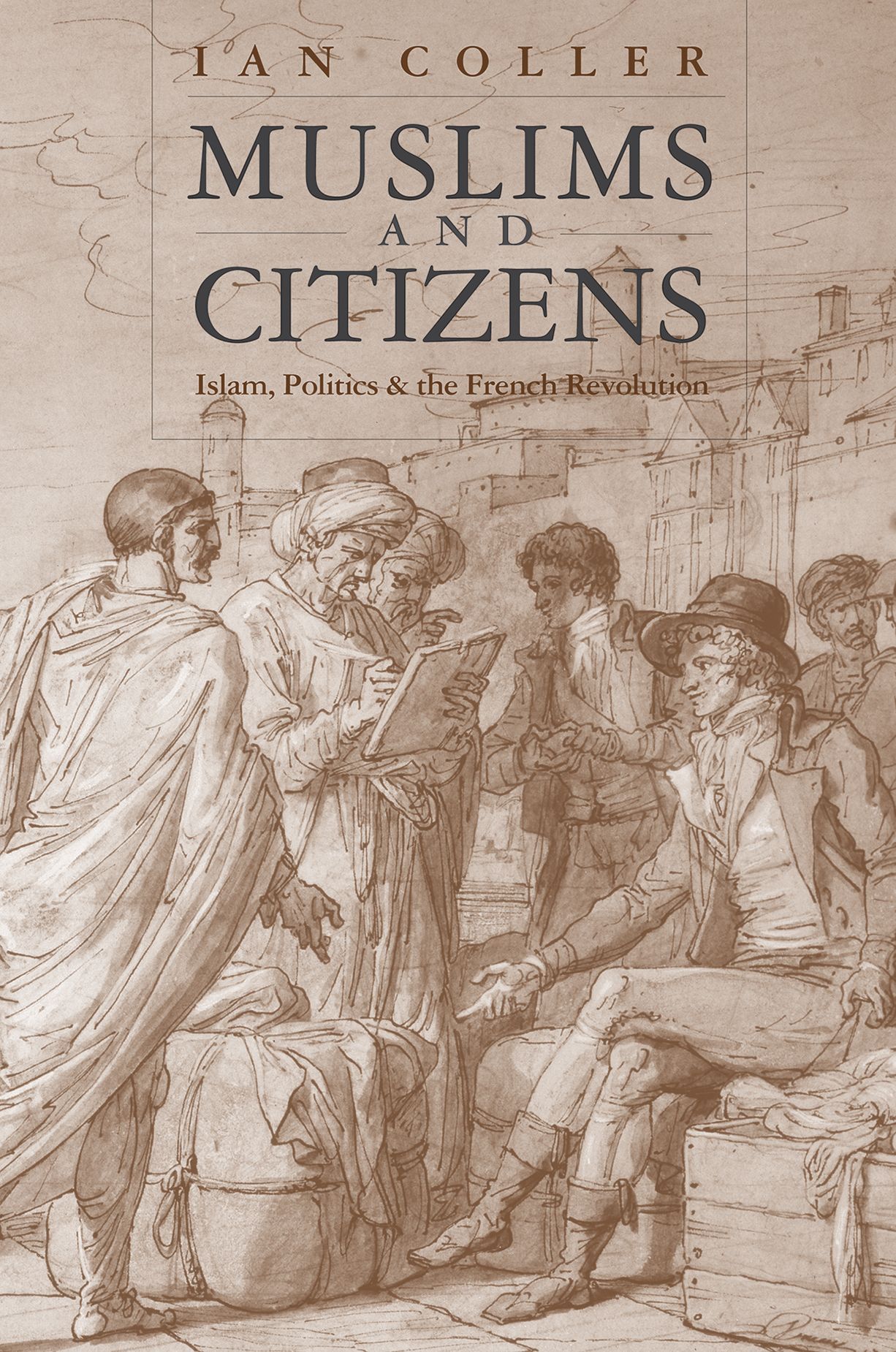
Muslims and Citizens
A groundbreaking study of the role of Muslims in eighteenth†'century France From the beginning, French revolutionaries imagined their transformation as a universal one that must include Muslims, Europe's most immediate neighbors. They believed in a world in which Muslims could and would be French citizens, but they disagreed violently about how to implement their visions of universalism and accommodate religious and social difference. Muslims, too, saw an opportunity, particularly as European powers turned against the new French Republic, leaving the Muslim polities of the Middle East and North Africa as France's only friends in the region. InMuslims and Citizens, Coller examines how Muslims came to participate in the political struggles of the revolution and how revolutionaries used Muslims in France and beyond as a test case for their ideals. In his final chapter, Coller reveals how the French Revolution's fascination with the Muslim world paved the way to Napoleon's disastrous invasion of Egypt in 1798.
eBook
Arab France
Many think of Muslims in Europe as a twentieth century phenomenon, but this book brings to life a lost community of Arabs who lived through war, revolution, and empire in early nineteenth century France. Ian Coller uncovers the surprising story of the several hundred men, women, and children—Egyptians, Syrians, Greeks, and others—who followed the French army back home after Napoleon's occupation of Egypt. Based on research in neglected archives, on the rediscovery of forgotten Franco-Arab authors, and on a diverse collection of visual materials, the book builds a rich picture of the first Arab France—its birth, rise, and sudden decline in the age of colonial expansion. As he excavates a community that was nearly erased from the historical record, Coller offers a new account of France itself in this pivotal period, one that transcends the binary framework through which we too often view history by revealing the deep roots of exchange between Europe and the Muslim world, and showing how Arab France was in fact integral to the dawn of modernity.
eBook


THE FRENCH REVOLUTION COMES TO THE INDIAN OCEAN
Anjouan, or Nzwani, is a small Indian Ocean island of not much more than four hundred square kilometers located in the Mozambique Channel, part of the Comoros archipelago, equidistant from the coast of Africa and the island of Madagascar. Its sheer and heavily forested volcanic mountains present a striking backdrop to the capital, Mutsumudu. Fresh water streaming down to the shore of a well-sheltered bay first attracted Arab and Persian seafarers and, later, European ships as they passed around the Cape of Good Hope. Buried somewhere among the verdant foothills on the outskirts of the former capital, Domoni, on the
Book Chapter

Bringing art and science together to address climate change
Art x Climate was the first-ever gallery of visual art to be included in the National Climate Assessment. This letter outlines the purpose and process of Art x Climate and highlights three Art x Climate artists and their work. The letter concludes with lessons learned from this project: the need for cross-disciplinary respect among the arts and sciences, the wide range of themes and artworks centered around climate change, and the ability of art to facilitate new collaborations and bring more people into the climate change conversation.
Journal Article

AFRICAN LIBERALISM IN THE AGE OF EMPIRE? HASSUNA D’GHIES AND LIBERAL CONSTITUTIONALISM IN NORTH AFRICA, 1822–1835
Although in most accounts of liberalism Africans appear only as passive victims or beneficiaries of European policies, in the early nineteenth century many Africans shared liberal aspirations for the “good society” based on free trade, constitutional government and individual property. However, African liberalism was articulated in the context of an existential crisis provoked by the new European world order. Hassuna D’Ghies, educated in Tripoli and Europe, articulated an overtly “African” liberal response to this crisis of adaptation through his writings and political activity in London in the 1820s. By the end of the decade, D’Ghies had abandoned this project and returned to North Africa to take up a more authoritarian model of reform that ultimately led to the reabsorption of Tripoli and its region into the Ottoman Empire. D’Ghies's turn toward an “imperial liberalism” underwritten by Islamic legitimacy suggests the impossibility of reconciling African autonomy with European liberal claims to universality, and the ways in which African political thought was fragmented by imperial globalization.
Journal Article