
Catalogue Search | MBRL


Are you sure you want to remove the book from the shelf?

{{itemTitle}}
8
result(s) for
"Collier, Paul, author"
Sort by:

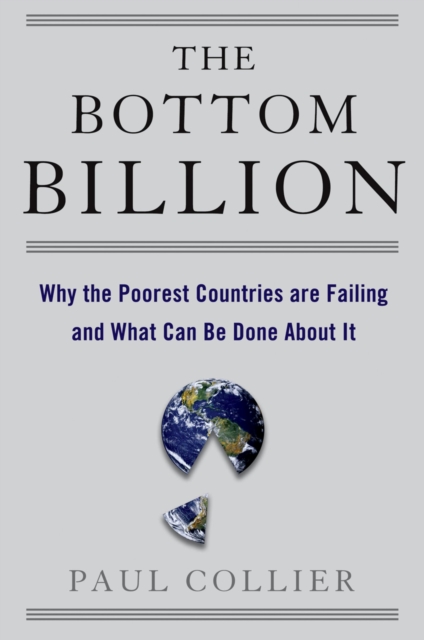
The Bottom Billion
In the award-winning The Bottom Billion, Paul Collier reveals that fifty failed states--home to the poorest one billion people on Earth--pose the central challenge of the developing world. The book shines much-needed light on this group of small nations that are dropping further and further behind the majority of the world's people. What the bottom billion need, Collier argues, is a bold new plan supported by the Group of Eight industrialized nations. The G8 will have to adopt preferential trade policies, new laws against corruption, new international charters, and even conduct carefully calibrated military interventions.
eBook

Refuge : rethinking refugee policy in a changing world
\"Immigration has become the great divisive issue of our times. In Refuge, Paul Collier and Alexander Betts set out a policy vision that can empower refugees to help themselves, contribute to their host societies, and ultimately rebuild their countries of origin\"-- Provided by publisher.
Book

Fragmenting fatherhood
Debates about the future of fatherhood have been central to a range of conversations about changing family forms, parenting and society. Law has served an important, yet often neglected, role in these discussions, serving as an important focal point for broader political frustrations, playing a central role in mediating disputes, and operating as a significant, symbolic, state-sanctioned account of the scope of paternal rights and responsibilities. Fragmenting Fatherhood provides the first sustained engagement with the way that fatherhood has been understood, constructed and regulated within English law. Drawing on a range of disparate legal provisions and material from diverse disciplines, it sketches the major contours of the figure of the father as drawn in law and social policy, tracing shifts in legal and broader understandings of what it means to be a 'father'and what rights and obligations should accrue to that status.
eBook
Mecca and Main Street
In Mecca and Main Street, noted author and journalist Geneive Abdo offers illuminating answers to these questions. Gaining unprecedented access to Muslim communities in America, she traveled across the country, visiting schools, mosques, Islamic centers, radio stations, and homes. She reveals a community tired of being judged by Americans perceptions of Muslims overseas and eager to tell their own stories. Abdo brings these stories vividly to life, allowing us to hear their own voices and inviting us to understand their hopes and their fears.
eBook

Freud and Nietzsche
Many of the leading Freudian analysts, including in the early days, Jung, Adler, Reich and Rank, attempted to link the writings of Nietzsche with the clinical work of Freud. But what was Nietzsche to Freud--an intuitive anticipation, a precursor, a rival psychologist? Assoun moves beyond the seduction of these attractive analogues to a deeper analysis of the relation between these two figures.
eBook
Resource financed infrastructure
This report, consisting of a study prepared by global project finance specialists Hunton and Williams LLP and comments from six internationally reputed economists and policy makers, provides an analytical discussion of resource financed infrastructure (RFI) contracting from a project finance perspective. The report is meant as a forum for in-depth discussion and as a basis for further research into RFI's role, risks, and potential, without any intention to present a World Bank, supported view on RFI contracting. It is motivated by the conviction that if countries are to continue to either seeks RFI or receive unsolicited RFI proposals, there is an onus on public officials to discern bad deals from good, to judge unavoidable trade-offs, and to act accordingly. The report aims to provide a basis for developing insights on how RFI deals can be made subject to the same degree of public policy scrutiny as any other instrument through which a government of a low or lower-middle-income country might seek to mobilize development finance. The report also feeds into the global mainstreaming of 'open contracting,' providing citizens with the means to engage with governments and other stakeholders on how nonrenewable resources are best managed for the public benefit. In the case of RFI, there is a very direct link made between the value of resources in the ground and the development of (infrastructure) benefits. It should not be a surprise, therefore, that the revised Extractive Industries Transparency Initiative (EITI) Standard, adopted in May 2013, addresses extractive transactions with an infrastructure component, including RFI.
eBook
Teaching banned books
Who hasn't read Blubber? And yet, published in 1974 and a New York Times 'Outstanding Book', it remains one of the 100 Most Frequently Challenged Books and is kept out of many school libraries. As a standard-bearer for intellectual freedom, the school librarian is in an ideal position to collaborate with teachers to not only protect the freedom to read but also ensure that valued books with valuable lessons are not quarantined from the readers for whom they were written. In this classroom- and library-ready book of discussion guides, award-winning champion of children's literature Pat Scales shows that there is a way to teach these books while respecting all views.
eBook