
Catalogue Search | MBRL


Are you sure you want to remove the book from the shelf?

{{itemTitle}}
9
result(s) for
"Collins, Christopher, author"
Sort by:


Global White Supremacy
Knowledge is more expansive than the boundaries of the Western university model and its claim to be the dominant-or only-rigorous house of knowledge. In the former colonies of Europe (e.g., South Africa, Brazil, and Oceania), the curriculum, statues, architectures, and other aspects of the university demonstrate the way in which it is a fixture in empire maintenance. The trajectory of global White supremacy is deeply historical and contemporary-it is a global, transnational, and imperial phenomenon. White supremacy is sustained through the construction of inferiority and anti-Blackness. The context, history, and perspective offered by Collins, Newman, and Jun should serve as an introduction to the disruption of the ways in which university and academic dispositions have and continue to serve as sites of colonial and White supremacist preservation-as well as sites of resistance.
eBook

Why moats matter
Incorporate economic moat analysis for profitable investing Why Moats Matter is a comprehensive guide to finding great companies with economic moats, or competitive advantages. This book explains the investment approach used by Morningstar, Inc., and includes a free trial to Morningstar's Research. Economic moats—or sustainable competitive advantages—protect companies from competitors. Legendary investor Warren Buffett devised the economic moat concept. Morningstar has made it the foundation of a successful stock-investing philosophy. Morningstar views investing in the most fundamental sense: For Morningstar, investing is about holding shares in great businesses for long periods of time. How can investors tell a great business from a poor one? A great business can fend off competition and earn high returns on capital for many years to come. The key to finding these great companies is identifying economic moats that stem from at least one of five sources of competitive advantage—cost advantage, intangible assets, switching costs, efficient scale, and network effect. Each source is explored in depth throughout this book. Even better than finding a great business is finding one at a great price. The stock market affords virtually unlimited opportunities to track prices and buy or sell securities at any hour of the day or night. But looking past that noise and understanding the value of a business's underlying cash flows is the key to successful long-term investing. When investors focus on a company's fundamental value relative to its stock price, and not where the stock price sits today versus a month ago, a day ago, or five minutes ago, investors start to think like owners, not traders. And thinking like an owner will makes readers better investors. The book provides a fundamental framework for successful long-term investing. The book helps investors answer two key questions: How can investors identify a great business, and when should investors buy that business to maximize return? Using fundamental moat and valuation analysis has led to superior risk-adjusted returns and made Morningstar analysts some of the industry's top stock-pickers. In this book, Morningstar shares the ins and outs of its moat-driven investment philosophy, which readers can use to identify great stock picks for their own portfolios.
eBook

Benedict XIV and the Enlightenment
Pope Benedict XIV Lambertini (r. 1740-58) was one of the driving forces behind the Italian Enlightenment of the eighteenth century. His campaign to reconcile faith and empirical science, re-launch a dialogue between the Church and the European intellectual community, and expand papal patronage of the arts and sciences helped restore Italy's position as a center of intellectual and artistic innovation.
Benedict XIV and the Enlightenmentoffers a broad and nuanced assessment of Benedict's engagement with Enlightenment art, science, spirituality, and culture. The collection's essays, written by international experts in the field, cover topics ranging from Benedict's revisions to the Church's procedures for beatification and sanctification to his patronage of women scientists and mathematicians at the university in Bologna, his birthplace.
eBook

Poetry & Geography
Poetry & Geography examines the rich diversity of geographical imaginations informing post-war and contemporary poetry in Britain and Ireland. Drawing impetus from the spatial turn in the humanities and social sciences, the fourteen essays collected here appraise the significance of ideas of space, place, and landscape for ‘mainstream’ and ‘experimental’ poets, post-romantics and neo-modernists alike. Cumulatively, the book’s varied articulations of poetry and geography sketch out a series of intersections between language and location, form and environment, sound and space. Poetry’s unique capacity to invigorate and expand our vocabularies of site and situation, of our manifold relations with the world outside us, is described and explored. Bringing together fresh, interdisciplinary readings of poets as diverse as Roy Fisher and R.S. Thomas, John Burnside and Thomas Kinsella, Jo Shapcott and Peter Riley, Alice Oswald and Ciaran Carson, Poetry & Geography sketches a topographical map of shared poetic terrains. It contributes to a fertile set of dialogues between literary studies and cultural geography in which the valences of space and place are open to processes of contestation and reimagining. This new collection of critical essays provides readers with a vital set of coordinates in a complex and evolving field. Key themes include: place and identity; literary cartographies; walking as trope and spatial practice; the poetics of edges, margins, and peripheries; landscape, language, and form.
eBook

Philosophic values and world citizenship
In Philosophic Values and World Citizenship: Locke to Obama and Beyond, Alain Locke—the central promoter of the Harlem Renaissance, America's most famous African American pragmatist, the cultural referent for Renaissance movements in the Caribbean and Africa—is placed in conversation with leading philosophers and cultural figures in the modern world. The contributors to this collection compare and contrast Locke's views on values, tolerance, cosmopolitanism, and American and world citizenship with philosophers and leading cultural figures ranging from Aristotle, Immanuel Kant, James Farmer, William James, John Dewey, José Vasconcelos, Hans G. Gadamer, Fredrick Nietzsche, Horace Kallen, Leroi Jones (Amiri Baraka) to the cultural and political figure of Barack Obama. This important collection of essays eruditely presents Locke's views on moral, emotional, and aesthetic values; the principle of tolerance in managing value conflict; and his rhetorical style, which conveyed his views of cultural reciprocity and tolerance in the service of the values of citizenship and cosmopolitanism. For teachers and students of contemporary debates in pragmatism, diversity, and value theory, these conversations define new and controversial terrain.
eBook

Catholic Revival in the Age of the Baroque
This book is a study of Catholic reform, popular Catholicism and the development of confessional identity in southwest Germany. Based on extensive archival study, it argues that Catholic confessional identity developed primarily from the identification of villagers and townspeople with the practices of Baroque Catholicism - particularly pilgrimages, processions, confraternities and the Mass. Thus the book is in part a critique of the confessionalization thesis which dominates scholarship in this field. The book is not however focused narrowly on the concerns of German historians. An analysis of popular religious practice and of the relationship between parishioners and the clergy in villages and small towns allows for a broader understanding of popular Catholicism, especially in the period after 1650. Local Baroque Catholicism was ultimately a successful convergence of popular and elite, lay and clerical elements, which led to an increasingly elaborate religious style.
eBook
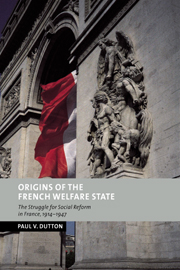
Origins of the French Welfare State
This is the first comprehensive analysis of public and private welfare in France available in English, or French, which offers a deeply-researched explanation of how France's welfare state came to be and why the French are so attached to it. The author argues that France simultaneously pursued two different paths toward universal social protection. Family welfare embraced an industrial model in which class distinctions and employer control predominated. By contrast, protection against the risks of illness, disability, maternity, and old age followed a mutual aid model of welfare. The book examines a remarkably broad cast of actors that includes workers' unions, employers, mutual leaders, the parliamentary elite, haut fonctionnaires, doctors, pronatalists, women's organizations - both social Catholic and feminist - and diverse peasant organisations. It also traces foreign influences on French social reform, particularly from Germany's former territories in Alsace-Lorraine and Britain's Beveridge Plan.
eBook

The French Second Empire
This book is about a major historical figure, Napoleon III, and a political regime. It examines how Louis-Napoleon Bonaparte (nephew of the first Napoleon) was able to secure election as President of the Republic and subsequently to launch a coup d'état to establish a Second Empire. It then considers the ways in which power was exercised by the new imperial regime. Later, apparent stability led Napoleon III to engage in a difficult process of transition towards a more liberal regime; but at the point of success the decision was taken to go to war against Prussia which resulted in a catastrophic defeat and the destruction of his regime. This is a most thoroughly researched book on the Second Empire, which makes a contribution to our knowledge of a vitally important period of French history following the 1848 revolution and the intense mid-century crisis.
eBook