
Catalogue Search | MBRL


Are you sure you want to remove the book from the shelf?

{{itemTitle}}
9
result(s) for
"Commons, Anne"
Sort by:

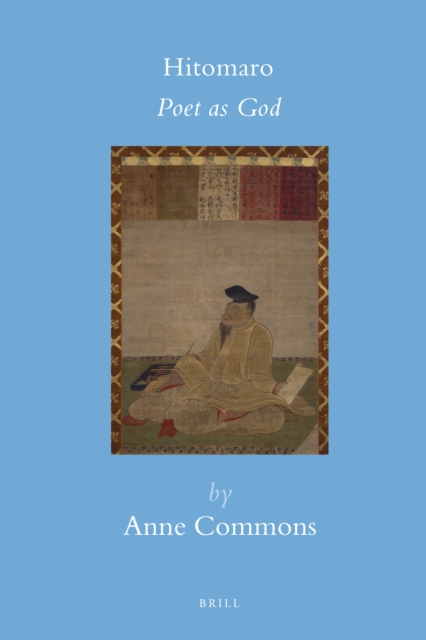
Hitomaro: Poet as God
Kakinomoto no Hitomaro (fl. ca. 690) is generally regarded as one of the pre-eminent poets of premodern Japan. While most existing scholarship on Hitomaro is concerned with his poetry, this study foregrounds the process of his reception and canonization as a deity of Japanese poetry. Building on new interest in issues of canon formation in premodern Japanese literature, this book traces the reception history of Hitomaro from its earliest beginnings to the early modern period, documenting and analysing the phases of the process through which Hitomaro was transformed from an admired poet to a poetic deity. The result is a new perspective on a familiar literary figure through his placement within the broader context of Japanese poetic culture.
eBook

Hitomaro
This book analyses the reception and eventual deification of the seventh-century poet Kakinomoto no Hitomaro. The result is a new perspective on a major literary figure through his placement within the broader context of Japanese poetic culture.
eBook


KOKINSHŪ
The Kokinwakashū (Collection of Old and New Japanese Poems), often known as Kokinshū, is an anthol. of Japanese court
Reference

The canonization of Hitomaro: Paradigm of the poet as God
This dissertation is a study of the reception, canonization, and ultimate deification of the seventh-century Japanese court poet Kakinomoto no Hitomaro. The dissertation examines the process of Hitomaro's canonization over a thousand-year span, from the eighth century to the eighteenth, analyzing his evolving image as a reflection of larger cultural patterns or tropes across that range of time. These images of Hitomaro are analyzed both in terms of his textual canonization and his extra-textual canonization, which took the form of worship ceremonies and enshrinement. The study examines Hitomaro's status as a symbolic embodiment of the Japanese court-poetic tradition, and illuminates the ways in which he was appropriated to fulfill a legitimizing and authorizing role within that tradition by later poetic practitioners. It demonstrates how the fluidity of Hitomaro's image was predicated on his power as a symbol, in some instances with almost no regard to his poetry. His textual canonization is based not only on the reception of his works, but on his valorization as a figure in later, highly-regarded canonical texts. His worship rituals and other aspects of his extra-textual canonization represent further developments from his treatment in major texts, and the dissertation elucidates the significance of Hitomaro's worship as a watershed in the increasing integration of religious and poetic discourse and praxis in medieval Japan.
Dissertation

Hitomaro: Poetry as God
Commons' translation here ignores the emotive force of the two particles shi and zo. [...] translating omou simply as 'think' is misleading.
Book Review


Archaeology and cognitive evolution
Archaeology can provide two bodies of information relevant to the understanding of the evolution of human cognition – the timing of developments, and the evolutionary context of these developments. The challenge is methodological. Archaeology must document attributes that have direct implications for underlying cognitive mechanisms. One example of such a cognitive archaeology is found in spatial cognition. The archaeological record documents an evolutionary sequence that begins with ape-equivalent spatial abilities 2.5 million years ago and ends with the appearance of modern abilities in the still remote past of 400,000 years ago. The timing of these developments reveals two major episodes in the evolution in spatial ability, one, 1.5 million years ago and the other, one million years later. The two episodes of development in spatial cognition had very different evolutionary contexts. The first was associated with the shift to an open country adaptive niche that occurred early in the time range of Homo erectus. The second was associated with no clear adaptive shift, though it does appear to have coincided with the invasion of more hostile environments and the appearance of systematic hunting of large mammals. Neither, however, occurred in a context of modern hunting and gathering.
Journal Article