
Catalogue Search | MBRL


Are you sure you want to remove the book from the shelf?

{{itemTitle}}
7,885
result(s) for
"Cook, David"
Sort by:


Histone modification dynamics at H3K27 are associated with altered transcription of in planta induced genes in Magnaporthe oryzae
Transcriptional dynamic in response to environmental and developmental cues are fundamental to biology, yet many mechanistic aspects are poorly understood. One such example is fungal plant pathogens, which use secreted proteins and small molecules, termed effectors, to suppress host immunity and promote colonization. Effectors are highly expressed in planta but remain transcriptionally repressed ex planta , but our mechanistic understanding of these transcriptional dynamics remains limited. We tested the hypothesis that repressive histone modification at H3-Lys27 underlies transcriptional silencing ex planta , and that exchange for an active chemical modification contributes to transcription of in planta induced genes. Using genetics, chromatin immunoprecipitation and sequencing and RNA-sequencing, we determined that H3K27me3 provides significant local transcriptional repression. We detail how regions that lose H3K27me3 gain H3K27ac, and these changes are associated with increased transcription. Importantly, we observed that many in planta induced genes were marked by H3K27me3 during axenic growth, and detail how altered H3K27 modification influences transcription. ChIP-qPCR during in planta growth suggests that H3K27 modifications are generally stable, but can undergo dynamics at specific genomic locations. Our results support the hypothesis that dynamic histone modifications at H3K27 contributes to fungal genome regulation and specifically contributes to regulation of genes important during host infection.
Journal Article


Context specificity of the EMT transcriptional response
Epithelial–mesenchymal plasticity contributes to many biological processes, including tumor progression. Various epithelial–mesenchymal transition (EMT) responses have been reported and no common, EMT-defining gene expression program has been identified. Here, we have performed a comparative analysis of the EMT response, leveraging highly multiplexed single-cell RNA sequencing (scRNA-seq) to measure expression profiles of 103,999 cells from 960 samples, comprising 12 EMT time course experiments and independent kinase inhibitor screens for each. We demonstrate that the EMT is vastly context specific, with an average of only 22% of response genes being shared between any two conditions, and over half of all response genes were restricted to 1–2 time course experiments. Further, kinase inhibitor screens revealed signaling dependencies and modularity of these responses. These findings suggest that the EMT is not simply a single, linear process, but is highly variable and modular, warranting quantitative frameworks for understanding nuances of the transition.
It is unclear if a common EMT expression program exists. Here, the authors perform multiplexed single-cell RNA sequencing across 12 EMT time courses and 16 kinase inhibitor screens, and find that EMT transcriptional responses are context specific and EMT is not a single, linear transition.
Journal Article


A Historical Review of Management Options Used against the Stable Fly (Diptera: Muscidae)
The stable fly, Stomoxys calcitrans (L.) (Diptera: Muscidae), remains a significant economic pest globally in situations where intensive animal production or horticultural production provide a suitable developmental medium. Stable flies have been recorded as pests of livestock and humans since the late 1800s to early 1900s. Over 100 years of research has seen numerous methodologies used to control this fly, in particular to protect cattle from flies to minimise production losses. Reduced milk production in dairy cows and decreased weight gain in beef cattle account for losses in the US alone of > $2000 million annually. Rural lifestyles and recreation are also seriously affected. Progress has been made on many control strategies against stable fly over a range of chemical, biological, physical and cultural options. This paper reviews management options from both a historical and a technical perspective for controlling this pest. These include the use of different classes of insecticides applied to affected animals as toxicants or repellents (livestock and humans), as well as to substrates where stable fly larvae develop. Arthropod predators of stable flies are listed, from which potential biological control agents (e.g., wasps, mites, and beetles) are identified. Biopesticides (e.g., fungi, bacteria and plant-derived products) are also discussed along with Integrated Pest Management (IPM) against stable flies for several animal industries. A review of cultural and physical management options including trapping, trap types and methodologies, farm hygiene, scheduled sanitation, physical barriers to fly emergence, livestock protection and amendments added to animal manures and bedding are covered. This paper presents a comprehensive review of all management options used against stable flies from both a historical and a technical perspective for use by any entomologist, livestock producer or horticulturalist with an interest in reducing the negative impact of this pest fly.
Journal Article


The contribution of DNA repair pathways to genome editing and evolution in filamentous pathogens
Abstract
DNA double-strand breaks require repair or risk corrupting the language of life. To ensure genome integrity and viability, multiple DNA double-strand break repair pathways function in eukaryotes. Two such repair pathways, canonical non-homologous end joining and homologous recombination, have been extensively studied, while other pathways such as microhomology-mediated end joint and single-strand annealing, once thought to serve as back-ups, now appear to play a fundamental role in DNA repair. Here, we review the molecular details and hierarchy of these four DNA repair pathways, and where possible, a comparison for what is known between animal and fungal models. We address the factors contributing to break repair pathway choice, and aim to explore our understanding and knowledge gaps regarding mechanisms and regulation in filamentous pathogens. We additionally discuss how DNA double-strand break repair pathways influence genome engineering results, including unexpected mutation outcomes. Finally, we review the concept of biased genome evolution in filamentous pathogens, and provide a model, termed Biased Variation, that links DNA double-strand break repair pathways with properties of genome evolution. Despite our extensive knowledge for this universal process, there remain many unanswered questions, for which the answers may improve genome engineering and our understanding of genome evolution.
This review summarizes and compares the molecular mechanism, hierarchy, and regulation of four DNA double-strand break repair pathways in animal and fungal models, with the aim to connect these DNA repair pathways to genome engineering outcomes and biased genome evolution in filamentous pathogens.
Journal Article
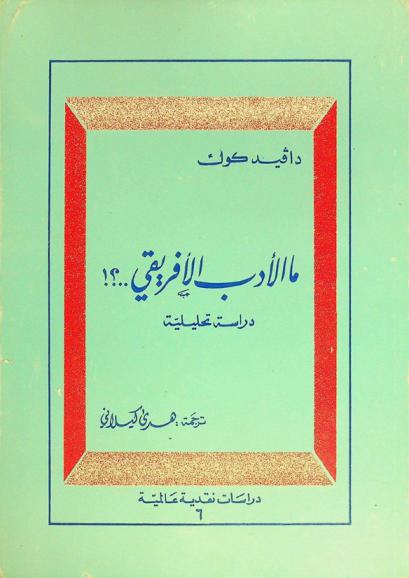
ما الأدب الإفريقي..؟! : دراسة تحليلية
يهدف الكتاب إلى تقديم دراسة تحليلية للأدب الإفريقي من خلال استعراض تاريخه، أنماطه، وخصائصه، بالإضافة إلى تأثير العوامل الثقافية والاجتماعية على تطوره، يبدأ الكتاب بتعريف الأدب الإفريقي كمفهوم، حيث يركز على الأدب المكتوب والشفهي الذي أنتجه الكتاب الأفارقة في مختلف المناطق، يناقش التنوع اللغوي والثقافي في القارة الإفريقية وكيف أثر ذلك على تطور الأدب، خاصة في ضوء الاستعمار وتفاعلاته مع الثقافات المحلية، يقدم الكتاب نبذة عن تطور الأدب الإفريقي منذ العصور القديمة، مرورا بفترة الاستعمار الأوروبي وحتى العصر الحديث، يناقش كيف أن الأدب الإفريقي في فترة الاستعمار كان وسيلة لمقاومة الاستعمار والتعبير عن الهوية الثقافية.
Book
A strong fracture-resistant high-entropy alloy with nano-bridged honeycomb microstructure intrinsically toughened by 3D-printing
Strengthening materials via conventional “top-down” processes generally involves restricting dislocation movement by precipitation or grain refinement, which invariably restricts the movement of dislocations away from, or towards, a crack tip, thereby severely compromising their fracture resistance. In the present study, a high-entropy alloy Al
0.5
CrCoFeNi is produced by the laser powder-bed fusion process, a “bottom-up” additive manufacturing process similar to how nature builds structures, with the microstructure resembling a nano-bridged honeycomb structure consisting of a face-centered cubic (
fcc
) matrix and an interwoven hexagonal net of an ordered body-centered cubic B2 phase. While the B2 phase, combined with high-dislocation density and solid-solution strengthening, provides strength to the material, the nano-bridges of dislocations connecting the
fcc
cells,
i.e
., the channels between the B2 phase on the cell boundaries, provide highways for dislocation movement away from the crack tip. Consequently, the nature-inspired microstructure imparts the material with an excellent combination of strength and toughness.
Developing superior structural materials has been challenging because of the inherent conflict between their strength and toughness. Here, the authors use 3D-printing to produce a high-entropy alloy with a microstructure resembling nano-bridged honeycomb structure with good strength and toughness.
Journal Article