
Catalogue Search | MBRL


Are you sure you want to remove the book from the shelf?

{{itemTitle}}
17,708
result(s) for
"Cook, L."
Sort by:


Metabolic flexibility allows bacterial habitat generalists to become dominant in a frequently disturbed ecosystem
Ecological theory suggests that habitat disturbance differentially influences distributions of habitat generalist and specialist species. While well-established for macroorganisms, this theory has rarely been explored for microorganisms. Here we tested these principles in permeable (sandy) sediments, ecosystems with much spatiotemporal variation in resource availability and physicochemical conditions. Microbial community composition and function were profiled in intertidal and subtidal sediments using 16S rRNA gene amplicon sequencing and metagenomics, yielding 135 metagenome-assembled genomes. Community composition and metabolic traits modestly varied with sediment depth and sampling date. Several taxa were highly abundant and prevalent in all samples, including within the orders Woeseiales and Flavobacteriales, and classified as habitat generalists; genome reconstructions indicate these taxa are highly metabolically flexible facultative anaerobes and adapt to resource variability by using different electron donors and acceptors. In contrast, obligately anaerobic taxa such as sulfate reducers and candidate lineage MBNT15 were less abundant overall and only thrived in more stable deeper sediments. We substantiated these findings by measuring three metabolic processes in these sediments; whereas the habitat generalist-associated processes of sulfide oxidation and fermentation occurred rapidly at all depths, the specialist-associated process of sulfate reduction was restricted to deeper sediments. A manipulative experiment also confirmed habitat generalists outcompete specialist taxa during simulated habitat disturbance. Together, these findings show metabolically flexible habitat generalists become dominant in highly dynamic environments, whereas metabolically constrained specialists are restricted to narrower niches. Thus, an ecological theory describing distribution patterns for macroorganisms likely extends to microorganisms. Such findings have broad ecological and biogeochemical ramifications.
Journal Article


A Life Cycle Explanation of Cooperative Longevity
A micro analytical, interdisciplinary informed framework is presented to postulate why and how some cooperatives endure for long periods of time. This five-phase framework was developed through an extended research process employing inductive and deductive approaches. The paper concludes that cooperative longevity is associated with multiple factors, primarily among them, ability to adapt and ameliorate frictions and subgroup factions. This adaptability leads to multi “life cycles”. Cooperative multi life cycle regeneration is facilitated by a learned and embedded process called “cooperative genius”.
Journal Article


Glacial lake outburst floods as drivers of fluvial erosion in the Himalaya
Glacial lake outburst floods (GLOFs) are exactly what they sound like. The sudden emptying of a glacial lake in high-topography regions like the Himalaya can quickly destroy everything in its path. Cook et al. intercepted a GLOF in the Bhotekoshi and Sunkoshi river valleys in central Nepal as they were monitoring the region in the aftermath of the 2015 Gorkha earthquake. They found that a massive amount of erosion occurred during the outburst flood, which suggests that GLOFs may be the primary factor in landscape evolution for these regions. Science , this issue p. 53 A very well monitored Himalayan glacial lake outburst flood shows the power of these large events to drive erosion. Himalayan rivers are frequently hit by catastrophic floods that are caused by the failure of glacial lake and landslide dams; however, the dynamics and long-term impacts of such floods remain poorly understood. We present a comprehensive set of observations that capture the July 2016 glacial lake outburst flood (GLOF) in the Bhotekoshi/Sunkoshi River of Nepal. Seismic records of the flood provide new insights into GLOF mechanics and their ability to mobilize large boulders that otherwise prevent channel erosion. Because of this boulder mobilization, GLOF impacts far exceed those of the annual summer monsoon, and GLOFs may dominate fluvial erosion and channel-hillslope coupling many tens of kilometers downstream of glaciated areas. Long-term valley evolution in these regions may therefore be driven by GLOF frequency and magnitude, rather than by precipitation.
Journal Article
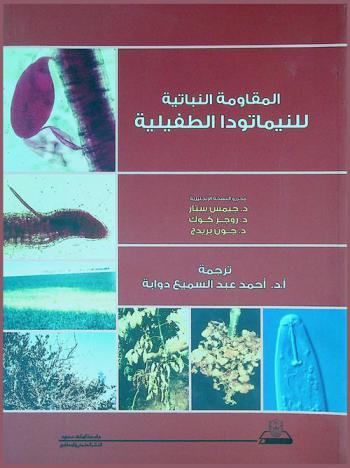
المقاومة النباتية للنيماتودا الطفيلية
يتناول هذا الكتاب في فصوله من الأول إلى الثاني عشر إعطاء فكرة جيدة عن المفاهيم والتاريخ والنظريات والتوارث لصفة المقاومة النباتية تجاه أهم أنواع النيماتودا المتطفلة على النباتات. كما يتطرق الكتاب أيضا إلى كيفية تقييم صفة المقاومة في الأصناف النباتية تجاه أنواع النيماتودا، وكذلك إلى كيفية نقل هذه الصفة من المصادر النباتية المقاومة إلى الأصناف النباتية الشائع زراعتها، والمرغوبة لدى المزارع، كما يتحدث عن موضوع الانتخاب المبني على الدلائل الجزيئية.
BOOK

Short Communication: A simple workflow for robust low-cost UAV-derived change detection without ground control points
High-quality 3-D point clouds generated from repeat camera-equipped unmanned aerial vehicle (UAV) surveys are increasingly being used to investigate landscape changes and geomorphic processes. Point cloud quality can be expressed as accuracy in a comparative (i.e., from survey to survey) and absolute (between survey and an external reference system) sense. Here we present a simple workflow for calculating pairs or sets of point clouds with a high comparative accuracy, without the need for ground control points or a differential GNSS (dGNSS)-equipped UAV. The method is based on the automated detection of common tie points in stable portions of the survey area. We demonstrate the efficacy of the new approach using a consumer-grade UAV in two contrasting landscapes: the coastal cliffs on the island of Rügen, Germany, and the tectonically active Daan River gorge in Taiwan. Compared to a standard approach using ground control points, our workflow results in a nearly identical distribution of measured changes. Compared to a standard approach without ground control, our workflow reduces the level of change detection from several meters to 10–15 cm. This approach enables robust change detection using UAVs in settings where ground control is not feasible.
Journal Article

البحث في التربية الخاصة : التصميمات والمناهج والتطبيقات
هذا الكتاب تم كتابته كمقرر مقدمة تمهيدية من أجل طلاب الدراسات العليا والممارسين في التربية الخاصة، يقوم بتركيز قدر كبير من المعلومات هنا على دور القارئ لا يقوم فقط بتوجيه الطالب أو الممارس إلى أساسيات تصميم البحث، ولكنه أيضا يعطيه مقدمة حول التراث التخصصي في هذا المجال الدينامي للبحث ومثله مثل الكتاب المصاحب الذي كتبه جيمس بليني وفيليب رزمريل، الأبحاث في أعاده التأهيل والإرشاد حيث يقدم هذا الكتاب الأسس التي سوف يحتاجها الفرد ليبدأ إجراء أي دراسة بحثية، ولكنه يشجع هذا الشخص أن يكمل هذا الكتاب بمقررات دراسية في الإحصاء وتصميم البحث المتقدم قبل البدء في أي دراسة تجريبية.
Book

Alcohol consumption patterns and HIV viral suppression among persons receiving HIV care in Florida: an observational study
Background
Alcohol consumption has been associated with poor antiretroviral therapy (ART) adherence but less is known about its relationship to HIV viral suppression, or whether certain drinking patterns have a stronger association than others. The objectives of this study were to determine the association of different patterns of alcohol consumption to HIV viral suppression and ART adherence, and to determine whether any associations of alcohol with HIV viral suppression were mediated by poor ART adherence.
Methods
This observational study used baseline data from 619 HIV+ participants, recruited across 8 clinical and community settings across Florida as part of the Florida Cohort from 2014 to 2016. Alcohol consumption was measured by self-report, and grouped into four categories: heavy drinking (>7/week for women or >14 drinks/week for men); binge, but not heavy drinking (≥4 or >5 drinks/occasion for women and men, respectively), low level drinking (neither heavy nor binge), and abstinence. Serum HIV RNA measurements were obtained from statewide HIV surveillance data, and durable viral suppression was defined as achieving HIV viral suppression (<200 copies/ml) at every assessment in the past 12 months.
Results
The majority of the 619 participants were male (63%) and aged 45 or greater (65%). The proportion of participants with heavy, binge, low-level drinking and abstinence was 9, 25, 37 and 30%, respectively. Optimal ART adherence (≥95%) was reported by 68%, and 60% achieved durable viral suppression. In multivariable analysis controlling for demographic factors, drug use, and homelessness, heavy drinking (compared to abstinence) was associated with increased odds of failing to achieve durable viral suppression (OR 2.16, 95% CI 1.08–4.32) whereas binge drinking alone was not significantly associated with this outcome (OR 1.04, 95% CI 0.64–1.70). Both heavy drinking and binge drinking were significantly associated with suboptimal ART adherence. Mediation analyses suggested that only a small proportion of the relationship between heavy drinking and suboptimal viral suppression was due to poor ART adherence.
Conclusions
Exceeding weekly recommended levels of alcohol consumption (heavy drinking) was significantly associated with poor HIV viral suppression and ART non-adherence, while binge drinking was associated with suboptimal ART adherence in this sample. Clinicians should attempt to address heavy drinking in their patients with HIV.
Journal Article