
Catalogue Search | MBRL


Are you sure you want to remove the book from the shelf?

{{itemTitle}}
5
result(s) for
"Cooper, John P. author"
Sort by:
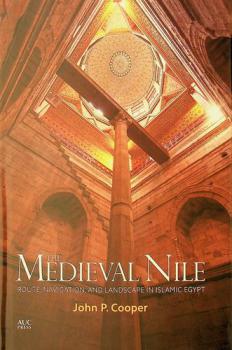
The medieval Nile : route, navigation, and landscape in Islamic Egypt
\"An interdisciplinary study that draws together geography, historical navigation data, and eyewitness accounts into a comprehensive picture of one of the world's great rivers. This ground-breaking view of the navigational landscape of the Nile in medieval Egypt draws on a broad range of sources: medieval Arabic geographies; traveler accounts; archaeology; and meteorological, hydrological, and geological studies. John Cooper first charts the changing geography of the Nile waterways, particularly in the Delta, from the eve of Islam to the early modern period, and logs the 'rise and fall' of these waterways for natural and/or anthropogenic reasons. He then presents a new perspective on the Nile, drawing on traveler accounts and environmental data to portray the river as a uniquely challenging and sometimes dangerous navigational environment requiring extensive local knowledge by skilled and hard-working Nile navigators. Finally, he looks at how the main Delta and Red Sea ports of medieval Egypt fitted into the navigational landscape described, explaining how these ports were affected by changes occurring to the navigational landscape, and how they reflected the navigational conditions of the Nile and surrounding seas\"--From the publisher.
Book
Atlas of Natural and Induced Fractures in Core
This book offers a reference for the interpretation of natural and induced fractures in cores. The natural and induced fracture data contained in cores provides a wealth of information once they are recognized and properly interpreted. Written by two experts in the field, this resource provides a much-needed tool to help with the accurate interpretation of these cores. The authors include the information needed to identify different fracture types as well as the criteria for distinguishing between the types of fractures. The atlas shows how to recognize non-fracture artefacts in a core since many of them provide other types of useful information. In addition, the text's illustrated structures combined with their basic interpretations are designed to be primary building blocks of a complete fracture assessment and analysis. The authors show how to recognize and correctly interpret these building blocks to ensure that subsequent analyses, interpretations, and modeling efforts regarding fracture-controlled reservoir permeability are valid.
eBook

The medieval Nile : route, navigation, and landscape in Islamic Egypt
\"An interdisciplinary study that draws together geography, historical navigation data, and eyewitness accounts into a comprehensive picture of one of the world's great rivers. This ground-breaking view of the navigational landscape of the Nile in medieval Egypt draws on a broad range of sources: medieval Arabic geographies; traveler accounts; archaeology; and meteorological, hydrological, and geological studies. John Cooper first charts the changing geography of the Nile waterways, particularly in the Delta, from the eve of Islam to the early modern period, and logs the \"rise and fall\" of these waterways for natural and/or anthropogenic reasons. He then presents a new perspective on the Nile, drawing on traveler accounts and environmental data to portray the river as a uniquely challenging and sometimes dangerous navigational environment requiring extensive local knowledge by skilled and hard-working Nile navigators. Finally, he looks at how the main Delta and Red Sea ports of medieval Egypt fitted into the navigational landscape described, explaining how these ports were affected by changes occurring to the navigational landscape, and how they reflected the navigational conditions of the Nile and surrounding seas.\"--From the publisher.
BOOK

Modelling High-Level Cognitive Processes
This book is a practical guide to building computational models of high-level cognitive processes and systems. High-level processes are those central cognitive processes involved in thinking, reasoning, planning, and so on. These processes appear to share representational and processing requirements, and it is for this reason that they are considered together in this text. The book is divided into three parts. Part I considers foundational and background issues. Part II provides a series of case studies spanning a range of cognitive domains. Part III reflects upon issues raised by the case studies. Teachers of cognitive modeling may use material from Part I to structure lectures and practical sessions, with chapters in Part II forming the basis of in-depth student projects. All models discussed in this book are developed within the COGENT environments. COGENT provides a graphical interface in which models may be sketched as \"box and arrow\" diagrams and is both a useful teaching tool and a productive research tool. As such, this book is designed to be of use to both students of cognitive modeling and active researchers. For students, the book provides essential background material plus an extensive set of example models, exercises and project material. Researchers of both symbolic and connectionist persuasions will find the book of interest for its approach to cognitive modeling, which emphasizes methodological issues. They will also find that the COGENT environment itself has much to offer.
eBook

Gravissimum educationis
This book provides the context of change and the current state of Catholic Schools in the United States and the global perspective. The scope of this book goes beyond the professional educator in Catholic Schools as it also address the stakeholders of Catholic education such as parents who are consumers, pastors, religious educators, and donors.
eBook