
Catalogue Search | MBRL


Are you sure you want to remove the book from the shelf?

{{itemTitle}}
71
result(s) for
"Costelloe, Timothy M"
Sort by:

The British aesthetic tradition : from Shaftesbury to Wttgenstein
\"This is the first single volume to offer a comprehensive and systematic account of British and American aesthetics from the early eighteenth century to the late twentieth century\"-- Provided by publisher.
Book
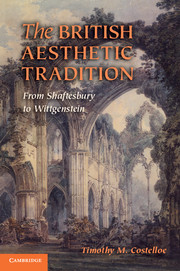
The British Aesthetic Tradition
The British Aesthetic Tradition: From Shaftesbury to Wittgenstein is the first single volume to offer readers a comprehensive and systematic history of aesthetics in Britain from its inception in the early eighteenth century to major developments in Britain and beyond in the late twentieth century. The book consists of an introduction and eight chapters, and is divided into three parts. The first part, The Age of Taste, covers the eighteenth-century approaches of internal sense theorists, imagination theorists and associationists. The second, The Age of Romanticism, takes readers from debates over the picturesque through British Romanticism to late Victorian criticism. The third, The Age of Analysis, covers early twentieth-century theories of Formalism and Expressionism to conclude with Wittgenstein and a number of views inspired by his thought.
eBook

The sublime : from antiquity to the present
\"This volume offers readers a unique and comprehensive overview of theoretical perspectives on \"the sublime,\" the singular aesthetic response elicited by phenomena that move viewers by transcending and overwhelming them. The book consists of an editor's introduction and fifteen chapters written from a variety of disciplinary perspectives. Part One examines philosophical approaches advanced historically to account for the phenomenon, beginning with Longinus, moving through eighteenth and nineteenth century writers in Britain, France, and Germany, and concluding with developments in contemporary continental philosophy. Part Two explores the sublime with respect to particular disciplines and areas of study, including Dutch literature, early modern America, the environment, religion, British Romanticism, the fine arts, and architecture. Each chapter is both accessible for nonspecialists and offers an original contribution to its respective field of inquiry\"-- Provided by publisher.
Book

“SHINING BITS OF METAL”: MONEY, PROPERTY, AND THE IMAGINATION IN HUME’S POLITICAL ECONOMY
This essay examines Hume’s treatment of money in light of his view of the imagination. It begins with his claim that money is distinct from wealth, the latter arising, according to vulgar reasoning, from the power of acquisition that it represents, or, understood philosophically, from the labor that produces it. The salient features that Hume identifies with the imagination are then put forth, namely its power to combine ideas creatively and the principle of easy transition that characterizes its movement among them. Two issues that these features explain are then discussed: first, why people take value to lie in the material of which money is made, and, second, why they assign value to what they take money to represent, namely, wealth. In both cases, the imagination creates a new relation, an illusion or fiction, that cannot be traced directly to experience. In the case of money, the faculty conjoins what is intangible (the power of acquisition) with the physical qualities of specie; in the case of property it produces a causal relation that connects persons with objects to constitute stable possession that constitutes ownership. Hume also appeals to the imagination to explain the rules of property that subsequently develop (present possession, occupation, prescription, and transference). The essay concludes by emphasizing that being based on the imagination is not in itself indicative of any instability in either money or property and the practices they enshrine, a feature they share with other phenomena (such as the self and continued existence) that Hume also traces to the same faculty.
Journal Article


Hume, Kant, and the 'Antinomy of Taste'
This paper traces the systematic connections between the structure of Hume's argument in \"Of the Standard of Taste\" and the way Kant presents the Antinomy of Taste in his Critique of Judgment. It is argued, however, that although there are striking parallels between the way Hume and Kant formulate their respective antinomies, there are significant differences in the way the two philosophers solve them. For while Hume's approach reflects his scepticism about the place of philosophy in common life, Kant's solution confirms his view that philosophy can effectively correct the errors into which human reason naturally falls.
Journal Article

'In Every Civilized Community': Hume on Belief and the Demise of Religion
This paper considers the claim that Hume was hostile to religion and religious belief, and hoped for their demise. Part one examines his approach to belief, showing how commentators take him to see religious belief as non-natural. Part two challenges this conclusion by arguing, first, that Hume's distinction between natural and artificial virtue allows the term \"natural\" to cover religious belief as well; second, that Hume himself never denies religious belief is natural, and, third, that he takes religion to be a necessary part of any flourishing society. The target of Hume's critical remarks on religion, it is then emphasized, are forms of \"false\" religion, which arise from the corrupting influence of passion, hypocrisy, bigotry, enthusiasm, and superstition. At best, it is concluded, the claim that Hume was hostile to religion requires qualification, while the view that he was in favor of its actual demise is largely unwarranted.
Journal Article

