
Catalogue Search | MBRL


Are you sure you want to remove the book from the shelf?

{{itemTitle}}
155
result(s) for
"Cotton, Hannah"
Sort by:


JUXTAPOSING LITERARY AND DOCUMENTARY EVIDENCE
This article was prompted by the recent discovery of two more copies of the so-called Heliodoros Stele’from Maresha. A second one from Byblos was published in 2015. The third one, re-discovered recently and published here for the first time, also comes from Maresha. The steles bear Seleukos IV’s epistolary prostagma from 178 bc to his vizier Heliodoros, and forwarded to other officials with the instruction to display it in public. It contains an appointment of one Olympiodoros to be high priest in Koele Syria and Phoenicia. Both Seleukos IV and Heliodoros also appear in the story of the plundering of the Temple related in II Maccabees 3. The existence of multiple copies, though hardly surprising, made us suspect the king’s apologetic tone and identify the reform'as an attempt to embellish the withdrawal of previously bestowed privileges on the Jews (so Josephus) as well as on others.
Journal Article


Rome, the Greek World, and the East
This volume completes the three-volume collection of Fergus Millar's essays, which, together with his books, transformed the study of the Roman Empire by shifting the focus of inquiry onto the broader Mediterranean world and beyond. The eighteen essays presented here include Millar's classic contributions to our understanding of the impact of Rome on the peoples, cultures, and religions of the eastern Mediterranean, and the extent to which Graeco-Roman culture acted as a vehicle for the self-expression of the indigenous cultures. In an epilogue written to conclude the collection, Millar argues for rethinking the focus of \"ancient history\" itself and for considering the Levant and the eastern Mediterranean from the first millennium B.C. to the Islamic conquests a valid scholarly framework and an appropriate educational syllabus for the study of antiquity. English translations of extended ancient passages in Greek, Latin, and Semitic languages in all the essays make Millar's most important articles accessible for the first time to specialists and nonspecialists alike.
eBook

South Coast
This third volume of the Corpus Inscriptionum Iudaeae/Palaestinae includes inscriptions from the South Coast from the time of Alexander through the end of Byzantine rule in the 7th century.It includes all the languages used in the inscriptions of this period - Greek, Latin, Hebrew, Aramaic, Samaritan, Christian Palestinian Aramaic, and Nabataean.
eBook

Rome, the Greek World, and the East
Fergus Millar is one of the most influential contemporary historians of the ancient world. His essays and books, above all The Emperor in the Roman World and The Roman Near East, have transformed our understanding of the communal culture and civil government of the Greco-Roman world. This second volume of the three-volume collection of Millar's published essays draws together twenty of his classic pieces on the government, society, and culture of the Roman Empire (some of them published in inaccessible journals). Every article in Volume 2 addresses the themes of how the Roman Empire worked in practice and what it was like to live under Roman rule. As in the first volume of the collection, English translations of the extended Greek and Latin passages in the original articles make Millar's essays accessible to readers who do not read these languages.
eBook
Jerusalem: 1-704
The first volume of the Corpus Inscriptionum Iudaeae/Palaestinae covers the inscriptions of Jerusalem from the time of Alexander to the Arab conquest in all the languages used for inscriptions during those times: Hebrew, Aramaic, Greek, Latin, Syrian, and Armenian. The 1,120 texts have been arranged in categories based on three epochs: up to the destruction of Jerusalem in the year 70, to the beginning of the 4th century, and to the end of Byzantine rule in the 7th century.
eBook
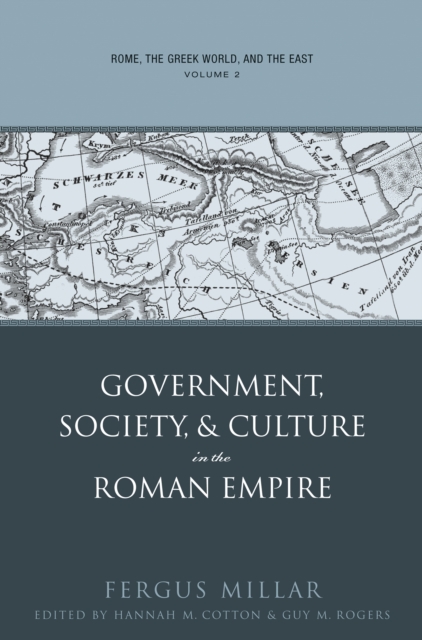
Rome, the Greek world, and the East.: (Government, society, and culture in the Roman Empire)
Fergus Millar is one of the most influential contemporary historians of the ancient world. His essays and books, above all The Emperor in the Roman World and The Roman Near East, have transformed our understanding of the communal culture and civil government of the Greco-Roman world. This second volume of the three-volume collection of Millar's published essays draws together twenty of his classic pieces on the government, society, and culture of the Roman Empire (some of them published in inaccessible journals). Every article in Volume 2 addresses the themes of how the Roman Empire worked in practice and what it was like to live under Roman rule. As in the first volume of the collection, English translations of the extended Greek and Latin passages in the original articles make Millar's essays accessible to readers who do not read these languages.
eBook
