
Catalogue Search | MBRL


Are you sure you want to remove the book from the shelf?

{{itemTitle}}
585
result(s) for
"Council on Foreign Relations"
Sort by:
Foreign affairs
Includes sections \"Recent books on international relations\" and \"Source material.\"
Book

The emerging global health crisis : noncommunicable diseases in low- and middle-income countries
\"Rates of heart disease, cancer, diabetes, and other noncommunicable diseases (NCDs) in low- and middle-income countries are increasing faster, in younger people, and with worse outcomes than in wealthier countries. In 2013 alone, NCDs killed eight million people before their sixtieth birthdays in developing countries. A new CFR-sponsored Independent Task Force report and accompanying interactive look at the factors behind this epidemic and the ways the United States can best fight it\"--Publisher's web site
eBook


Sparks : China's underground historians and their battle for the future
\"A vital account of how some of China's most important writers, filmmakers, and artists have overcome crackdowns and censorship to challenge the Chinese Communist Party on its most sacred ground, its monopoly on history\" -- publisher's description.
Book


Lost decade : the US pivot to Asia and the rise of Chinese power
\"The \"Pivot to Asia\" was first announced by the Obama administration in 2011 with the aim to redirect America's strategic focus to the Indo-Pacific. Not all went according to plan. This book tells the story of Washington's attempted reorientation and the simultaneous rise of Chinese power and assertiveness. It examines the impulse behind the Pivot, analyzes the challenges the policy posed for America's global presence and commitments, and investigates where and how it faltered. It assesses responses to the Pivot and strategic trendlines across countries in Asia, Europe, and the Middle East, and details China's aggressive actions throughout the 2010s. More than ten years after its announcement, a careful examination of the evidence indicates that the United States did not, in fact, pivot to Asia. This \"lost decade\" coincided with a massive expansion of Chinese power and assertiveness, a deepening of America's domestic divisions, and rising doubts in the world about US intentions, staying power, and competence. If the 1965 escalation in Vietnam and the 2003 invasion of Iraq represent America's greatest post-World War II failures of commission, Washington's collective failure to respond adequately to growing Chinese power across the 2010s stands as perhaps the most consequential US policy omission since 1945. The text draws on lessons from the policy's faulty implementation to propose a renewed US pivot to Asia\"-- Provided by publisher.
BOOK
Opening NATO's Door
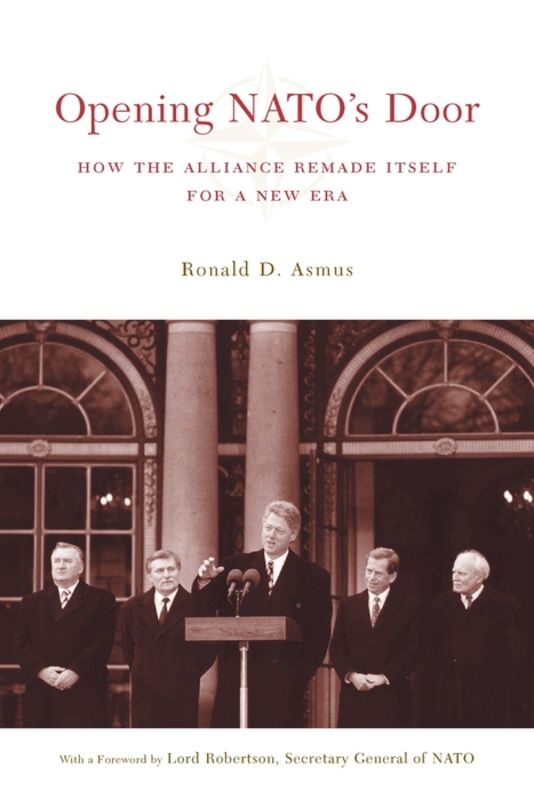
How and why did NATO, a Cold War military alliance created in 1949 to counter Stalin's USSR, become the cornerstone of new security order for post-Cold War Europe? Why, instead of retreating from Europe after communism's collapse, did the U.S. launch the greatest expansion of the American commitment to the old continent in decades? Written by a high-level insider, Opening NATO's Door provides a definitive account of the ideas, politics, and diplomacy that went into the historic decision to expand NATO to Central and Eastern Europe. Drawing on the still-classified archives of the U.S. Department of State, Ronald D. Asmus recounts how and why American policymakers, against formidable odds at home and abroad, expanded NATO as part of a broader strategy to overcome Europe's Cold War divide and to modernize the Alliance for a new era. Asmus was one of the earliest advocates and intellectual architects of NATO enlargement to Central and Eastern Europe after the collapse of communism in the early 1990s and subsequently served as a top aide to Secretary of State Madeleine Albright and Deputy Secretary Strobe Talbott, responsible for European security issues. He was involved in the key negotiations that led to NATO's decision to extend invitations to Poland, Hungary, and the Czech Republic, the signing of the NATO-Russia Founding Act, and finally, the U.S. Senate's ratification of enlargement. Asmus documents how the Clinton Administration sought to develop a rationale for a new NATO that would bind the U.S. and Europe together as closely in the post-Cold War era as they had been during the fight against communism. For the Clinton Administration, NATO enlargement became the centerpiece of a broader agenda to modernize the U.S.-European strategic partnership for the future. That strategy reflected an American commitment to the spread of democracy and Western values, the importance attached to modernizing Washington's key alliances for an increasingly globalized world, and the fact that the Clinton Administration looked to Europe as America's natural partner in addressing the challenges of the twenty-first century. As the Alliance weighs its the future following the September 11 terrorist attacks on the U.S. and prepares for a second round of enlargement, this book is required reading about the first post-Cold War effort to modernize NATO for a new era.
eBook