
Catalogue Search | MBRL


Are you sure you want to remove the book from the shelf?

{{itemTitle}}
30
result(s) for
"Crump, William D"
Sort by:

Happy Holidays--Animated!
Since the early 20th century, animated Christmas cartoons have brightened the holiday season around the world--first in theaters, then on television.From devotional portrayals of the Nativity to Santa battling villains and monsters, this encyclopedia catalogs more than 1,800 international Christmas-themed cartoons and others with year-end themes.
eBook
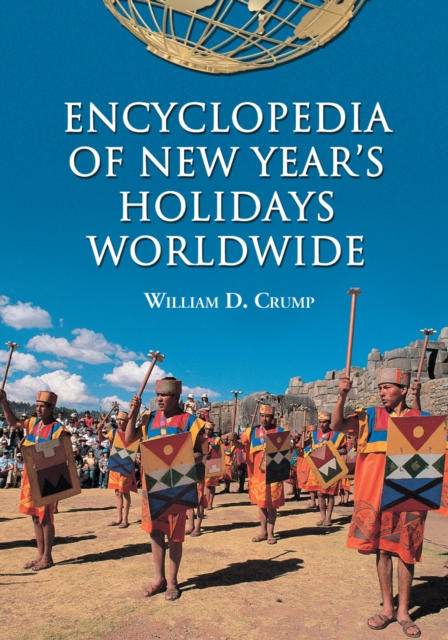
Encyclopedia of New Year's Holidays Worldwide
\"Dedicated\"--Booklist; \"rich...recommended\"--Library Journal; \"well researched...valuable\"--ARBA; \"this reference work stands out...a welcome addition--Reference Reviews. The first encyclopedia devoted exclusively to the New Year, this work includes 320 entries focusing on the New Year from a global perspective. The bulk of the encyclopedia consists of national or regional entries detailing the principal traditions and customs of 130 countries, while 27 entries discuss major calendar systems that are either currently in use, such as the Gregorian and Chinese calendars, or that are of significant historical interest, such as the Aztec, Mayan, and Roman calendars.
eBook

The Christmas Encyclopedia (2nd edition)
Lindsay reviews The Christmas Encyclopedia (2nd edition) by William D. Crump.
Book Review

Etiology of Severe Non-malaria Febrile Illness in Northern Tanzania: A Prospective Cohort Study
The syndrome of fever is a commonly presenting complaint among persons seeking healthcare in low-resource areas, yet the public health community has not approached fever in a comprehensive manner. In many areas, malaria is over-diagnosed, and patients without malaria have poor outcomes.
We prospectively studied a cohort of 870 pediatric and adult febrile admissions to two hospitals in northern Tanzania over the period of one year using conventional standard diagnostic tests to establish fever etiology. Malaria was the clinical diagnosis for 528 (60.7%), but was the actual cause of fever in only 14 (1.6%). By contrast, bacterial, mycobacterial, and fungal bloodstream infections accounted for 85 (9.8%), 14 (1.6%), and 25 (2.9%) febrile admissions, respectively. Acute bacterial zoonoses were identified among 118 (26.2%) of febrile admissions; 16 (13.6%) had brucellosis, 40 (33.9%) leptospirosis, 24 (20.3%) had Q fever, 36 (30.5%) had spotted fever group rickettsioses, and 2 (1.8%) had typhus group rickettsioses. In addition, 55 (7.9%) participants had a confirmed acute arbovirus infection, all due to chikungunya. No patient had a bacterial zoonosis or an arbovirus infection included in the admission differential diagnosis.
Malaria was uncommon and over-diagnosed, whereas invasive infections were underappreciated. Bacterial zoonoses and arbovirus infections were highly prevalent yet overlooked. An integrated approach to the syndrome of fever in resource-limited areas is needed to improve patient outcomes and to rationally target disease control efforts.
Journal Article