
Catalogue Search | MBRL


Are you sure you want to remove the book from the shelf?

{{itemTitle}}
317
result(s) for
"Cuban, Larry"
Sort by:


Why so many structural changes in schools and so little reform in teaching practice?
Purpose - The aim of this paper is to explain how errors in policymaking contribute to the minimal impact that structural, curricular and cultural changes have made on teaching practice in American schools.Design methodology approach - Drawing on the author's research legacy, the paper extends an historical analysis to explore and explain current dilemmas of change in schools and schooling.Findings - Over the last century, educational reforms have most often led to first order classroom change, represented by the development of hybrids of old and new teaching practices. Second order change at the classroom level has proven elusive. Factors at the policymaking level that explain the minimal impact on classroom practice include a misplaced trust in structural reform, an understanding of schools as complicated rather than complex systems, and the tendency not to distinguish teacher quality from the quality of teaching.Originality value - The paper proposes that the lack of impact of reform on classroom practice is explained in large part by errors in assumptions and thinking that policymakers commit, a focus seldom explored in research.
Journal Article

The flight of a butterfly or the path of a bullet? : using technology to transform teaching and learning
Larry Cuban returns with fresh energy and insight to one of his perennial topics: the uses and effects of digital technologies in K-12 classrooms. Cuban has an extensive track record as a skeptic about the educational consequences of those technologies. In this book, he returns to this topic by exploring the uses of these technologies in notably ambitious classrooms, all of them in schools in the heart of Silicon Valley. The book looks carefully at 41 classrooms in all, located in twelve schools in six different districts. All have devoted special attention and resources to integrating digital technologies in their education practices. Cuban observed all of these classrooms and interviewed all of the teachers in an effort to answer several straightforward, if also elusive, questions: has technology integration been fully implemented and put into practice in these classrooms? And has this integration and implementation resulted in altered teaching practices? Ultimately, Cuban asks if the use of digital technologies has resulted in transformed teaching and learning in these classrooms. The answers to these questions reflect both Cuban's nuanced understanding not only of digital technologies and their uses, but of the complex interrelations of policy and practice, and of the many, often unintended, consequences of reforms and initiatives in the education world. Similarly, his answers reflect his subtle understanding of change and continuity in education practice, and of the varying ways in which different actors in the education world--policy makers, school leaders, teachers, and others--understand, and sometimes misinterpret, those changes. -- Provided by publisher.
BOOK
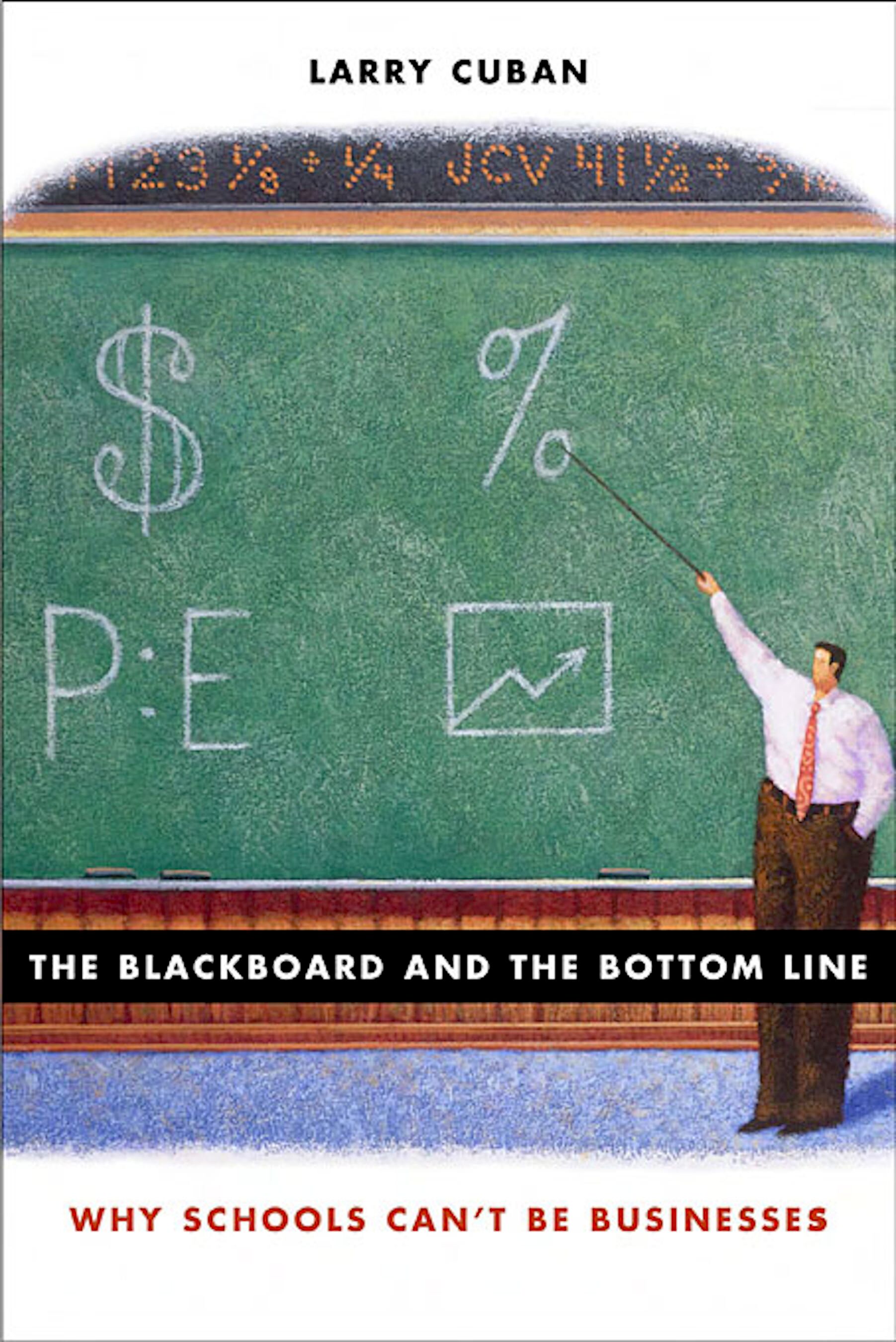
The blackboard and the bottom line
\"Ford Motor Company would not have survived the competition had it not been for an emphasis on results. We must view education the same way,\" the U.S. Secretary of Education declared in 2003. But is he right? In this provocative new book, Larry Cuban takes aim at the alluring cliché that schools should be more businesslike, and shows that in its long history in business-minded America, no one has shown that a business model can be successfully applied to education. In this straight-talking book, one of the most distinguished scholars in education charts the Gilded Age beginnings of the influential view that American schools should be organized to meet the needs of American businesses, and run according to principles of cost-efficiency, bottom-line thinking, and customer satisfaction. Not only are schools by their nature not businesslike, Cuban argues, but the attempt to run them along business lines leads to dangerous over-standardization--of tests, and of goals for our children. Why should we think that there is such a thing as one best school? Is \"college for all\" achievable--or even desirable? Even if it were possible, do we really want schools to operate as bootcamps for a workforce? Cuban suggests that the best business-inspired improvement for American education would be more consistent and sustained on-the-job worker training, tailored for the job to be done, and business leaders' encouragement--and adoption--of an ethic of civic engagement and public service.
eBook


Education Researchers, AERA Presidents, and Reforming the Practice of Schooling, 1916-2016
For a century, AERA has had as its mission using research to improve K–12 and higher education practices. Born in a period of reform, the Association's mission—reformist both in spirit and the letter—has been articulated time and again by its elected presidents. As different reform movements have swept across U.S. schools, as demographics and contexts changed, elected presidents reflecting those shifting reforms, contexts, and demographics have adhered to the founding mission of the Association. Using presidents' addresses across the century, I show that the belief in using research to improve practice has remained stable yet contested in recent decades.
Journal Article

محاولات إصلاحية نحو المدينة الفاضلة : قرن من الإصلاح في التعليم العام
يستعرض هذا الكتاب قرنا من محاولات إصلاح التعليم العام في الولايات المتحدة، مستندا إلى منهج تاريخي يعالج التفاعل بين المؤسسات التعليمية والتغيرات المجتمعية. يطرح الكتاب تساؤلات جوهرية حول طبيعة الإصلاحات التعليمية : كيف غيرت المدارس مسار الإصلاحات ؟ وكيف أثرت هذه الإصلاحات في المدارس ؟ وما الذي يعد \"نجاحا\" في هذا السياق ؟ من خلال دراسات حالة مثل \"مدارس الغد\"، و\"وحدات كارنيجي\"، و\"الصفوف المتدرجة\"، و\"دراسة السنوات الثماني\"، يعرض المؤلفان أسباب مقاومة التغيير داخل المدارس، ويحللان أسباب فشل بعض الإصلاحات ونجاح أخرى. ويخلص الكتاب إلى دعوة لخلق حوار حقيقي بين صناع القرار والمعلمين والمجتمع، لتطوير إصلاحات تعليمية أكثر واقعية وفعالية، تراعي تعقيدات البيئة المدرسية وتحديات التنفيذ.
BOOK

WHAT COUNTS AS A GOOD SCHOOL?
Kappan’s editor talks with education historian Larry Cuban about the various ways Americans have judged the quality of schools and the success of various efforts to improve schools. For much of the 20th century, efficiency was the watchword, as schools adopted scientific management techniques from the business sector. By the mid-1960s, that goal was subsumed by a focus on effectiveness, which required that schools find ways to measure the outcomes of their efforts. At the same time, alternative models have emerged, challenging the idea that there’s only one “best” way of doing school.
Journal Article