
Catalogue Search | MBRL


Are you sure you want to remove the book from the shelf?

{{itemTitle}}
33
result(s) for
"Cummings, Alex Sayf"
Sort by:

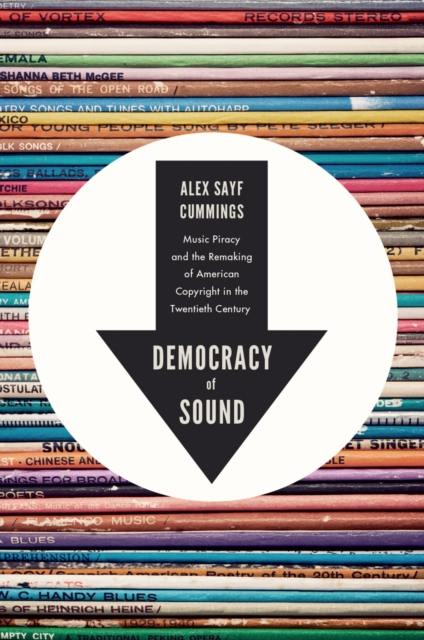
Democracy of Sound
It was a time when music fans copied and traded recordings without permission. An outraged music industry pushed Congress to pass anti-piracy legislation. Yes, that time is now; it was also the era of Napster in the 1990s, of cassette tapes in the 1970s, of reel-to-reel tapes in the 1950s, even the phonograph epoch of the 1930s. Piracy, it turns out, is as old as recorded music itself. This book uncovers the little-known history of music piracy and its sweeping effects on the definition of copyright in the United States. When copyright emerged, only visual material such as books and maps were thought to deserve protection; even musical compositions were not included until 1831. Once a performance could be captured on a wax cylinder or vinyl disc, profound questions arose over the meaning of intellectual property. Is only a written composition defined as a piece of art? If a singer performs a different interpretation of a song, is it a new and distinct work? Such questions have only grown more pressing with the rise of sampling and other forms of musical pastiche. Indeed, music has become the prime battleground between piracy and copyright. It is compact, making it easy to copy. And it is highly social, shared or traded through social networks—often networks that arise around music itself. But such networks also pose a counter-argument: as channels for copying and sharing sounds, they were instrumental in nourishing hip-hop and other new forms of music central to American culture today.
eBook


The Bootleg South
According to historian Mark D. Howell, these bootleggers soon became \"the subjects of regional folklore,\" whose stories embodied themes of \"self-reliance and personal economic survival. [...]it prefigured the challenge to copyright posed by widespread piracy in less developed countries around the world just a few years later.23 Bootlegging, though, represented more than a pirate threat from the periphery.
Journal Article
We Think a Lot
In 1961, a group of professors and businessmen met around a table for what was known as the Cultural Advancement Committee. Their task? To persuade top companies and scientists to come to Research Triangle Park (RTP), a high-tech district between Raleigh and Durham that was founded in 1959 as a center for scientific research. “Educated and cultured people are reluctant to leave large cities,” North Carolina State University professor Howard G. Miller explained, “because of the great opportunities such cities offer for the theater and the arts, for education, and for the intellectual stimulation and excitement they provide.” Universities in
Book Chapter

The Criminalization of Piracy
This chapter focuses on the united front put up by composers, musicians, and record labels against the common foe of rampant piracy. It considers the Supreme Court's endorsement of the new property rights, which arguably impinged on the limitations of copyright set out in the Constitution. The chapter first provides an overview of copyright reforms adopted by Congress between 1955 and 1964 before turning to the Supreme Court's ruling in the 1973 case Goldstein v. California. It then examines Congress's decision to extend copyright to sound recordings before concluding with a discussion of the passage of the Sound Recording Act of 1972 and the Copyright Act of 1976.
Book Chapter