
Catalogue Search | MBRL


Are you sure you want to remove the book from the shelf?

{{itemTitle}}
40
result(s) for
"Cummings, Denise K"
Sort by:


Visualities
In recent years, works by American Indian artists and filmmakers such as Jaune Quick-To-See Smith, Edgar Heap of Birds, Sherman Alexie, Shelley Niro, and Chris Eyre have illustrated the importance of visual culture as a means to mediate identity in contemporary Native America. This insightful collection of essays explores how identity is created and communicated through Native film-, video-, and art-making; what role these practices play in contemporary cultural revitalization; and how indigenous creators revisit media pasts and resignify dominant discourses through their work. Taking an interdisciplinary approach,Visualities: Perspectives on Contemporary American Indian Film and Artdraws on American Indian Studies, American Studies, Film Studies, Cultural Studies, Women's Studies, and Postcolonial Studies. Among the artists examined are Hulleah J. Tsinhnahjinnie, Eric Gansworth, Melanie Printup Hope, Jolene Rickard, and George Longfish. Films analyzed include Imprint, It Starts with a Whisper, Mohawk Girls, Skins, The Business of Fancydancing, and a selection of Native Latin films.
eBook
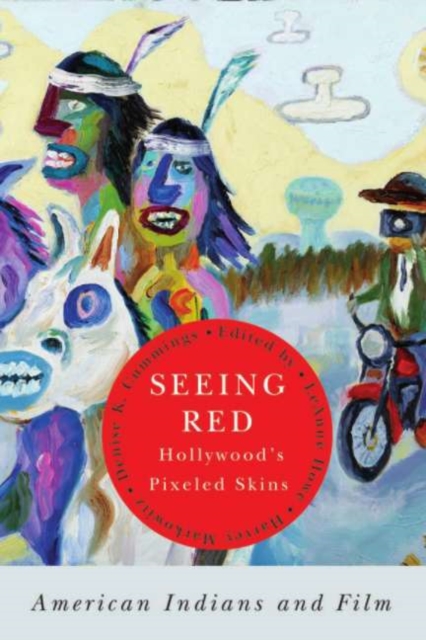
Seeing Red—Hollywood's Pixeled Skins
At once informative, comic, and plaintive,Seeing Red-Hollywood's Pixeled Skinsis an anthology of critical reviews that reexamines the ways in which American Indians have traditionally been portrayed in film. From George B. Seitz's 1925The Vanishing Americanto Rick Schroder's 2004Black Cloud, these 36 reviews by prominent scholars of American Indian Studies are accessible, personal, intimate, and oftentimes autobiographic.Seeing Red-Hollywood's Pixeled Skinsoffers indispensible perspectives from American Indian cultures to foreground the dramatic, frequently ridiculous difference between the experiences of Native peoples and their depiction in film. By pointing out and poking fun at the dominant ideologies and perpetuation of stereotypes of Native Americans in Hollywood, the book gives readers the ability to recognize both good filmmaking and the dangers of misrepresenting aboriginal peoples. The anthology offers a method to historicize and contextualize cinematic representations spanning the blatantly racist, to the well-intentioned, to more recent independent productions.Seeing Redis a unique collaboration by scholars in American Indian Studies that draws on the stereotypical representations of the past to suggest ways of seeing American Indians and indigenous peoples more clearly in the twenty-first century.
eBook

Seeing Red—Hollywood's Pixeled Skins
At once informative, comic, and plaintive, Seeing Red—Hollywood’s Pixeled Skins is an anthology of critical reviews that reexamines the ways in which American Indians have traditionally been portrayed in film. From George B. Seitz’s 1925 The Vanishing American to Rick Schroder’s 2004 Black Cloud , these 36 reviews by prominent scholars of American Indian Studies are accessible, personal, intimate, and oftentimes autobiographic. Seeing Red—Hollywood’s Pixeled Skins offers indispensible perspectives from American Indian cultures to foreground the dramatic, frequently ridiculous difference between the experiences of Native peoples and their depiction in film. By pointing out and poking fun at the dominant ideologies and perpetuation of stereotypes of Native Americans in Hollywood, the book gives readers the ability to recognize both good filmmaking and the dangers of misrepresenting aboriginal peoples. The anthology offers a method to historicize and contextualize cinematic representations spanning the blatantly racist, to the well-intentioned, to more recent independent productions. Seeing Red is a unique collaboration by scholars in American Indian Studies that draws on the stereotypical representations of the past to suggest ways of seeing American Indians and indigenous peoples more clearly in the twenty-first century.
eBook


The spaces of viewing: Film, architecture, exhibition, spectatorship
“The Spaces of Viewing” confronts the relationship between exhibition spaces and those who attend films, an emphasis I approach as an essential supplement to the more obvious and discussed relationship, that between the cinematic apparatus and the audience. This project emphasizes the “movie house” as a particular site for the investigation of American film and cultural history. Within this focus, the project addresses certain related concerns: audience reception, cinema spectatorship, and architectural space. Following the example offered by film historian Miriam Hansen, my project considers the divide between film history and film theory. Surveying various late twentieth-century methodologies that seek to conceptualize the relations between films and viewers as a point of departure, I examine how cinema spectatorship has been considered as implicitly formed by the structures of films on one hand while a competing model starts with the empirical moviegoer in his or her demographic contingency. I mediate between these two positions in order to underscore how aspects of exhibition sites work to subtly construct the viewing experience. In each of my additional chapters, I use the case study as a model for performing local film history derived from such scholars as Robert C. Allen, Kathryn Fuller, Douglas Gomery, and Gregory Waller. I demonstrate new findings regarding a neighborhood Art Deco exhibition space, the Campus Theatre (1941– ), and mid-century movie-going in Lewisburg, Pennsylvania. As the dissertation's centerpiece, I am able to combine historical and material approaches—in looking at an actual viewing space and its practices—with theoretical, speculative work on architecture, public sphere theory, and gendered space. Arguing that the present is a particularly rich period of exhibition, my final chapter relates current film practices to the contemporary practices of historic cinema architectural restoration and preservation and to the recent explosion and proliferation of film exhibition contexts and spaces. I conclude the thesis with an Epilogue, a return to 1920s Florida film history.
Dissertation

Souths: Global and Local
[...]the meaning of \"South\" might be dictated today by American mythological cultural markers: [...]the campsite acts as a communicative metaphor, a rethinking of how cultural codes shift and displace themselves, eventually reconstructing new lines of thought and expression. For Ventura globalized Vegas is a paradox: suburban fringes-with their planned communities and an increasingly mixed-race population-reverse US historical narratives of migration and resemble black migrations \"back South.\" [...]globalization has generally led to decreased living standards. [...]the fusion of qualities that once seemed oppositional has become common practice in Las Vegas.\"
Journal Article