
Catalogue Search | MBRL


Are you sure you want to remove the book from the shelf?

{{itemTitle}}
1,415
result(s) for
"Cummins, Anthony"
Sort by:
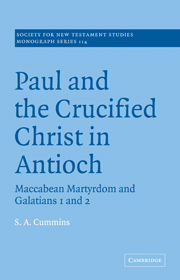
Paul and the Crucified Christ in Antioch
The so-called 'Antioch Incident' - the confrontation between the apostles Peter and Paul in Galatians 2.11-21 - continues to be a source of controversy in both scholarly and popular estimations of the emergence of the early Church and the development of Pauline theology. Paul and the Crucified Christ in Antioch offers an interesting interpretation of Paul's account of and response to this event, creatively combining historical reconstruction, detailed exegesis, and theological reflection. S. A. Cummins argues that the nature and significance of the central issue at stake in Antioch - whether the Torah or Jesus Christ determines who are the people of God - gains great clarity and force when viewed in relation to a Maccabean martyr model of Judaism as now christologically reconfigured and redeployed in the life and ministry of the apostle Paul.
eBook

Émile Zola's Cheap English Dress: The Vizetelly Translations, Late-Victorian Print Culture, and the Crisis of Literary Value
In 1888 and 1889 the publisher Henry Vizetelly was twice convicted of obscenity for issuing two-shilling English translations of Zola's novels. This controversial episode in late-Victorian literary history both emerged from, and deepened, the division between mass and elite readerships that the 1870 Education Act had opened up. Vizetelly's prosecution was the result of pressure from the National Vigilance Association, a social-reform group which argued that the Education Act's beneficiaries needed protection from the explicit descriptions of sex contained in novels like La Terre. The terms of the resulting suppression—Zola was prohibited in English, but not in French—revealed how far literary value was contingent on a work's presumed audience, rather than on its specific content. Forward-looking authors and publishers who championed freedom of expression—including Gissing, Gosse, Hardy, Heinemann, Meredith and Symons—could therefore accommodate the apparent legal threat to their artistic autonomy simply by turning away from post-1870 readers. As such, the debate about the Vizetelly translations established enduring principles of literary regulation, with Zola emerging as a symbol of mass/elite cultural division.
Journal Article

North-south divide in social inequalities in Great Britain: Health inequalities in Wirral: a living Black report?
The healthier west sector, with a lower standardised mortality ratio for coronary heart disease, has a higher rate of referral for coronary angiography, coronary angioplasty, and bypass surgery-and vice versa.
Journal Article

From \L'Assommoir\ to \Let's ha' some more\: Émile Zola's Early Circulation on the Late-Victorian Stage
In lieu of an abstract, here is a brief excerpt of the content: 155 From L’Assommoir to “Let’s ha’ some more”: Émile Zola’s Early Circulation on the Late-Victorian Stage A n thon y Cu mmins • When Émile Zola became famous in France with his controversial novel L’Assommoir (1877), the British literary press kept quiet.1The periodicals that covered noteworthy foreign fiction avoided the slangy tale of working-class alcoholism, and the rare notices that did appear were curt in suggesting why so little had been said about the book. “No words can be strong enough to paint [its] filthiness,” warned the Athenaeum (“Novels”). In only one line, the Saturday Review dismissed the entire novel as “six hundred pages of garbage” (“French”). With “M. Zola” hardly known in Britain in 1877, and no translations available of his novels, such terse denunciation gave little away to an audience that was unable to read French.As such, it is commonly believed that “the English reader, ignorant of French, really had no opportunity of forming any personal opinion [of Zola]” until 1884, when Henry Vizetelly (1820–94) translated Nana and L’Assommoir (Vizetelly 242).2WhileVizetelly is the name most closely associated with Zola’s circulation in English—largely because his translations led him to be jailed for publishing obscenity3—the reader who was ignorant of French did not, in fact, have to wait seven years before encountering L’Assommoir. In 1879—within two years of the book’s French publication—London theatregoers flocked to see Drink, a seven-act melodrama that the outspoken novelist and dramatist Charles Reade (1814–84) adapted from a French play that was based on L’Assommoir. Literary surveys of Zola’s transmission in Britain have tended to ignore Reade’s play, and though it is acknowledged in critical studies of Victorian drama, there is little indication of the extent to which it put Zola into mainstream British culture.4 To the dismay of a circumspect literary press that had sought to keep Zola at bay, early British exposure to L’Assommoir was not restricted to London audiences, nor was it limited to Drink.Theatres in more than seventy towns and cities nationwide staged competing dramatizations, ensuring L’Assommoir’s widespread early circulation in Britain.5 As this suggests, the early British dissemination of L’Assommoir owed nothing to enterprising publishers likeVizetelly, nor did it owe to an aspiring “English Zola” like the Anglo-Irish novelist George Moore (1852–1933), another victorian review • Volume 34 Number 1 156 traditional focus for studies of Zola’s British reception.6 Rather, L’Assommoir achieved its prominence because the business practices of the nineteenthcentury theatre—adaptation, imitation, and touring—served to connect the British provinces with the French capital, via London’sWest End. Furthermore, wherever L’Assommoir was produced, street advertising further extended its remarkable reach, turning passersby into British “readers” of Zola.The story of Zola’s translation in late-Victorian Britain cannot be told, therefore, only by reference to the traditional objects of cross-cultural literary reception study, the prestigious periodical review and the printed translation. These sources tend to give the impression that Zola was little known in Britain until 1884. This article examines wider-circulation media such as plays, newspapers, and posters to argue that, even beforeVizetelly issued his popularizing translations, the early British encounter with Zola was hardly confined to French-reading sophisticates. I The catalyst for this early British encounter with Zola was the French dramatization of L’Assommoir at theAmbiguTheatre in Paris, on 18 January 1879. Though Zola collaborated with the dramatistWilliam Busnach (1832–1907) to adapt his novel for the stage, he did not want his involvement known publicly and refused to identify himself with the play. This was because Zola and Busnach had abridged L’Assommoir’s original story to satisfy moral decorum and theatrical convention. For instance, they excised the ménage à trois, making Gervaise resist the advances of her ex-lover Lantier. More fundamentally, Zola and Busnach attributed the decline of the Coupeau family not to hereditary and environmental determinations but to the malign scheming of Virginie. The story of L’Assommoir thus resembled not only the early conception of the novel that Zola had rejected, but also the productions...
Journal Article
Paul and the Crucified Christ in Antioch: Maccabean Martyrdom and Galatians 1 and 2
The so-called 'Antioch Incident' - the confrontation between the apostles Peter and Paul in Galatians 2.11-21 - continues to be a source of controversy in both scholarly and popular estimations of the emergence of the early Church and the development of Pauline theology. Paul and the Crucified Christ in Antioch offers an interesting interpretation of Paul's account of and response to this event, creatively combining historical reconstruction, detailed exegesis, and theological reflection. S. A. Cummins argues that the nature and significance of the central issue at stake in Antioch - whether the Torah or Jesus Christ determines who are the people of God - gains great clarity and force when viewed in relation to a Maccabean martyr model of Judaism as now christologically reconfigured and redeployed in the life and ministry of the apostle Paul.
eBook

