
Catalogue Search | MBRL


Are you sure you want to remove the book from the shelf?

{{itemTitle}}
76
result(s) for
"Cuomo, Massimo"
Sort by:

Ioannis Canani de Constantinopolitana obsidione relatio : a critical edition, with English translation, introduction, and notes of John Kananos' account of the Siege of Constantinople in 1422
This volume fills the need for a new critical edition and linguistic study of John Kananos' account of the siege of Constantinople in 1422. New research on the manuscriptshas produceda new stemma codicum and shown that the oldest witness of this narrative, Vat. gr. 579 (ff. 355r - 364v), was written in Constantinople and belonged to the prolific scribe Phlamules Kontostephanos, who also provided the copy with atitle in which the name of John Kananos is mentioned for the first time. The philological approach adopted hereexplains contradictionsamong the manuscripts and Kananos' peculiar vernacularisms andreveals a surprisingly realistic and elaborate Greek. The accompanyingEnglish translation, a chapter on the language of Kananos, and a complete thesaurus make this volume a valuable contribution to the study of late Byzantine literature.0.
Book

Continuum damage model for strain gradient materials with applications to 1D examples
In complex materials there exist different, often independent, mechanisms for the evolution of anelastic phenomena at the micro- and at the macroscale. Consequently, gradient plasticity has been introduced for a large variety of non-local materials. In a similar way, continuum damage has been extended to micromorphic and other non-local models, introducing internal damage variables and their gradient. In the paper is proposed a new continuum damage model for strain gradient materials characterized by two independent damage internal variables, each evolving with its own law. In this way, no additional field equation for the damage variable is needed. The model is intended to be used for metamaterials. Some important characteristics of the model are analysed with numerical analyses of a 1D example. In particular, the ability of the model to prevent strain localization is discussed.
Journal Article
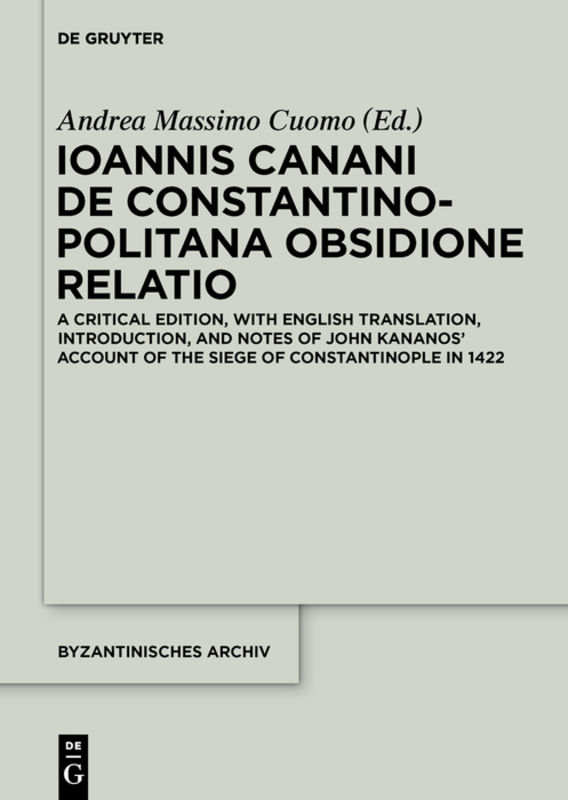
Ioannis Canani de Constantinopolitana obsidione relatio : a critical edition, with English translation, introduction, and notes of John Kananos' account of the Siege of Constantinople in 1422
This volume fills the need for a new critical edition and linguistic study of John Kananos' account of the siege of Constantinople in 1422. New research on the manuscripts has produced a new stemma codicum and shown that the oldest witness of this narrative, Vat. gr. 579 (ff. 355r - 364v), was written in Constantinople and belonged to the prolific scribe Phlamules Kontostephanos, who also provided the copy with a title in which the name of John Kananos is mentioned for the first time. The philological approach adopted here explains contradictions among the manuscripts and Kananos' peculiar vernacularisms and reveals a surprisingly realistic and elaborate Greek. The accompanying English translation, a chapter on the language of Kananos, and a complete thesaurus make this volume a valuable contribution to the study of late Byzantine literature.
eBook

Engineering Geological and Geophysical Studies Supporting Finite Element Analysis of Historical Buildings after Dynamic Identification
Resonance frequencies of a masonry bell tower were estimated by means of ambient noise measurements and compared with those computed by using fixed base, Winkler, and FE numerical, including subsoil. Given the geological complexity that characterizes the subsurface of the analyzed area, despite the presence of massive volcanic outcrops near the bell tower, we carried out a geophysical characterization of the subsoil by using active and passive seismic surveys. These surveys have identified a soft substrate underneath the construction; for this reason, the dynamic identification of the tower was performed, including the interaction with the soil. The resonance frequencies of the masonry bell tower computed by the models are very similar to those obtained using ambient noise. Results suggest that building resonance frequencies, estimated by ambient noise surveys, can be used because of their reliability especially when quick analyses are required at historical buildings located in seismically active areas needing plan actions to reduce their vulnerability. Moreover, such analyses, being performed on samplings acquired within the structure, allow for estimating its dynamic response, taking into account the effect of subsurface characteristics as well.
Journal Article

Large Deformation Behavior of Plane Periodic Truss Networks. Part 1. Closed-Form Solution for Single Node Cells
This article focuses on the derivation of explicit descriptions of networks in large deformation through the homogenization method of discrete media. Analytical models are established for the in-plane behavior of a planar periodic truss, whose cell contains a single node, as frequently encountered in practice. The cell is composed of bars that support only axial forces and are connected by perfect hinges. For the considered type of trusses, (given that the equilibrium conditions of the node and of the cell coincide) closed-form expressions for the local behaviour in the case of large deformations can be derived. This case makes it possible to combine the non-linearities arising from large deformations on the one hand and rheological characteristics on the other, and to compare their respective effects as a function of cell morphology. The results are illustrated by the shear and extension responses of specific trusses. The analysis is carried out for bars with stiffening, linear or softening behavior. The combination of the effects of geometrical non-linearities, rheological non-linearities and anisotropy results in particularly rich behaviors of the network.
Journal Article

Prototyping of a Novel Rammed Earth Technology
Buildings of the future are called to meet increasingly high-performance requirements and to ensure adequate environmental sustainability of the production and construction chain. This issue has stimulated a keen interest in the use of natural materials in construction. Among these, raw earth has proved to be particularly interesting for its intrinsic availability, sustainability, and recyclability. In Europe, the spread of raw earth building technologies has often been hindered by the lack of specific legislation regulating its use for load-bearing structures, even if in many countries, it can be noticed a widespread and well-established constructive tradition. Some transoceanic research experiences attest that unfired earth can be used, together with different types of reinforcements, to create seismic-resistant buildings. After presenting a review of the main raw earth reinforced technologies, the present study focuses on a novel reinforced and modular rammed earth construction made with natural or recycled materials, developing a technology with low energy consumption and low environmental impact, specifically designed for areas with high seismic risk. In particular, the work presents the results of a prototyping procedure aiming at developing a new seismic-resistant construction system that combines rammed earth with timber reinforcement elements and nylon/polyester ropes. These elements have a dual function: (1) they are fundamental components of the construction process (as they integrate the formwork system), and (2) they act as seismic-resistant devices once the structure is completed. In line with the performance-based approach required by the construction sector, the study aims at defining a controlled and standardised supply chain for rammed earth construction.
Journal Article

An enriched finite element for crack opening and rebar slip in reinforced concrete members
Object of the paper is the simulation of reinforced concrete bars behaviour, accounting for crack opening and concrete-rebar slippage. A macro beam element with a single uniform reinforcement is studied in details in the uniaxial case. Distinct constitutive hypotheses are formulated for the materials. The CEB-FIP Model Code 90 rules the behaviour of the materials interface that is assumed to be fully dissipative. Steel is supposed to behave elastoplastically with hardening. Crack opening in the concrete matrix is introduced by means of a strong discontinuity approach (SDA). All the relevant equations of the problem are variationally derived from a mixed energy functional. Two enhancements of the enriched kinematics, based on polynomial or exponential shape functions, respectively, are compared with the usual SDA enhancement. As an alternative approach, high-order interpolation of the displacement field based on B-splines, both for steel and concrete, is proposed. These functions appear to be adequate in reproducing rapidly varying fields, like the stress gradients occurring in the shear lag problem near the boundaries or where slips and/or cracks occur. Their use allow to use few macro-element instead of the very dense meshing required in those areas by the traditional FE interpolations.
Journal Article
Pantographic metamaterials: an example of mathematically driven design and of its technological challenges
In this paper, we account for the research efforts that have been started, for some among us, already since 2003, and aimed to the design of a class of exotic architectured, optimized (meta) materials. At the first stage of these efforts, as it often happens, the research was based on the results of mathematical investigations. The problem to be solved was stated as follows: determine the material (micro)structure governed by those equations that specify a desired behavior. Addressing this problem has led to the synthesis of second gradient materials. In the second stage, it has been necessary to develop numerical integration schemes and the corresponding codes for solving, in physically relevant cases, the chosen equations. Finally, it has been necessary to physically construct the theoretically synthesized microstructures. This has been possible by means of the recent developments in rapid prototyping technologies, which allow for the fabrication of some complex (micro)structures considered, up to now, to be simply some mathematical dreams. We show here a panorama of the results of our efforts (1) in designing pantographic metamaterials, (2) in exploiting the modern technology of rapid prototyping, and (3) in the mechanical testing of many real prototypes. Among the key findings that have been obtained, there are the following ones: pantographic metamaterials (1) undergo very large deformations while remaining in the elastic regime, (2) are very tough in resisting to damage phenomena, (3) exhibit robust macroscopic mechanical behavior with respect to minor changes in their microstructure and micromechanical properties, (4) have superior strength to weight ratio, (5) have predictable damage behavior, and (6) possess physical properties that are critically dictated by their geometry at the microlevel.
Journal Article
Advances in pantographic structures: design, manufacturing, models, experiments and image analyses
In the last decade, the exotic properties of pantographic metamaterials have been investigated and different mathematical models (both discrete or continuous) have been introduced. In a previous publication, a large part of the already existing literature about pantographic metamaterials has been presented. In this paper, we give some details about the next generation of research in this field. We present an organic scheme of the whole process of design, fabrication, experiments, models and image analyses.
Journal Article
Performance Assessment of Giant Reed-Based Building Components
The growing concern for the reduction of energy needs and the environmental impact of the building sector has placed emphasis on the possibilities offered by natural materials. The adoption of agricultural by-products seems to be promising and in line with the circular economy paradigm. Materials such as hemp and straw have been extensively adopted in contemporary construction, but nevertheless, the potential use of giant reed has not been sufficiently investigated despite being a common infesting plant abundantly available all over the planet. This work focuses on the performances assessment of lime/cement–reeds mixtures as base materials to design a new line of building components (bricks, blocks, panels and loose insulation) that can be used both in new bio-based construction and in existing buildings for energy-efficiency retrofit. The main materials used in the experimental campaign are giant reed by-products, lime, cement and local and recycled aggregates. The evaluation of the physical, mechanical and thermal properties of lime–reed and cement–reed composites are presented. The results of thermal conductivities (between 0.245 and 0.191 W/m K) and mechanical properties (compressive strengths between 0.848 and 1.509 MPa, and flexural strengths between 0.483 and 0.829 MPa) allow meeting the requirements for non-bearing and thermal building blocks. The outcomes show how blocks made with the abovementioned lime–reed mixture have good mechanical performance and thermo-physical behavior when compared to conventional building materials such as hollow clay or hemp blocks with the same thickness.
Journal Article