
Catalogue Search | MBRL


Are you sure you want to remove the book from the shelf?

{{itemTitle}}
223
result(s) for
"DONALD L. FIXICO"
Sort by:

Call for Change
For too many years, the academic discipline of history has ignored American Indians or lacked the kind of open-minded thinking necessary to truly understand them. Most historians remain oriented toward the American experience at the expense of the Native experience. As a result, both the status and the quality of Native American history have suffered and remain marginalized within the discipline. In this impassioned work, noted historian Donald L. Fixico challenges academic historians-and everyone else-to change this way of thinking. Fixico argues that the current discipline and practice of American Indian history are insensitive to and inconsistent with Native people's traditions, understandings, and ways of thinking about their own history. InCall for Change, Fixico suggests how the discipline of history can improve by reconsidering its approach to Native peoples.
He offers the \"Medicine Way\" as a paradigm to see both history and the current world through a Native lens. This new approach paves the way for historians to better understand Native peoples and their communities through the eyes and experiences of Indians, thus reflecting an insightful indigenous historical ethos and reality.
eBook

Re-Imagining Race and Ethnicity in the American West in the Twenty-First Century
2018 Presidential Address. Racial violence is a problem in this country, including in the American West. This cancerous condition is persistent and like cancer it changes, adapts, and grows. During the last several years, this nation has experienced a rash of racial protests and shootings. Like a disease, pandemic racism has permeated society and has become a subculture.
Journal Article

Indian Resilience and Rebuilding
Indian Resilience and Rebuildingprovides an Indigenous view of the last one-hundred years of Native history and guides readers through a century of achievements. It examines the progress that Indians have accomplished in rebuilding their nations in the 20th century, revealing how Native communities adapted to the cultural and economic pressures in modern America. Donald Fixico examines issues like land allotment, the Indian New Deal, termination and relocation, Red Power and self-determination, casino gaming, and repatriation. He applies ethnohistorical analysis and political economic theory to provide a multi-layered approach that ultimately shows how Native people reinvented themselves in order to rebuild their nations.Fixico identifies the tools to this empowerment such as education, navigation within cultural systems, modern Indian leadership, and indigenized political economy. He explains how these tools helped Indian communities to rebuild their nations. Fixico constructs an Indigenous paradigm of Native ethos and reality that drives Indian modern political economies heading into the twenty-first century.This illuminating and comprehensive analysis of Native nation's resilience in the twentieth century demonstrates how Native Americans reinvented themselves, rebuilt their nations, and ultimately became major forces in the United States.Indian Resilience and Rebuilding, redefines how modern American history can and should be told.
eBook
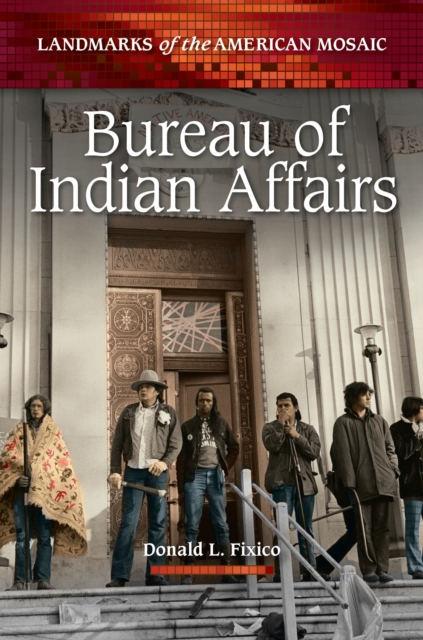
Bureau of Indian Affairs
From 19th-century trade agreements and treatments to 21st-century reparations, this volume tells the story of the federal agency that shapes and enforces U.S. policy toward Native Americans. Bureau of Indian Affairs tells the fascinating and important story of an agency that currently oversees U.S. policies affecting over 584 recognized tribes, over 326 federally reserved lands, and over 5 million Native American residents. Written by one of our foremost Native American scholars, this insider's view of the Bureau of Indian Affairs looks at the policies and the personalities that shaped its history, and by extension, nearly two centuries of government-tribal relations. Coverage includes the agency's forerunners and founding, the years of relocation and outright war, the movement to encourage Indian urbanization and assimilation, and the civil rights era surge of Indian activism. A concluding chapter looks at the modern BIA and its role in everything from land allotments and Indian boarding schools to tribal self-government, mineral rights, and the rise of the Indian gaming industry.
eBook

American Indian History and Writing from Home: Constructing an Indian Perspective
If the typical premise of American Indian history is actually the history of Indian-white relations, then the \"other\" side of the coin must be turned over for understanding an Indian point of view and what is called \"writing from home.\" Conceptually, \"writing from home\" is the challenge of historians who are American Indian and who write history based on their cultural perceptions and home place as Native people who have been trained in the mainstream academy. Indian history is perceived differently by Indians close to their traditions as opposed to academic historians. While this essay focuses on the latter and writing from home, Indian history of the former is conveyed in the oral tradition via stories where \"experiences\" are more important than \"events.\" Furthermore, Indian history in the form of \"experiences\" is actually moments of time where time is perceived differently from the American mainstream. The difference in perception underscores the point that Indians who write history \"see\" the world differently than non-Indian historians who write Indian history. This particular difference has not been so evident, since there are only about a dozen American Indian historians who actively write from a Native perspective. This ability is what the author calls \"real\" Indian history and writing from \"home.\" How they do this is the main argument of this essay. (Contains 7 notes.)
Journal Article

The Invasion of Indian Country in the Twentieth Century
The Invasion of Indian Country in the Twentieth Century, Second Edition is updated through the first decade of the twenty-first century and contains a new chapter challenging Americans--Indian and non-Indian--to begin healing the earth. This analysis of the struggle to protect not only natural resources but also a way of life serves as an indispensable tool for students or anyone interested in Native American history and current government policy with regard to Indian lands or the environment.
eBook
The Second Dimension of Interacting Indian-White Relations
More than two hundred years ago two brothers stood at a place near what is presently Battle Ground, Indiana. Along the Wabash River, lined by towering oaks, maples, tulip trees, hackberries, sycamores, and elms, they discussed their troubled fate. Their decision became their stand against the encroaching white settlers. The younger brother Tenskwatawa, the Shawnee Prophet, stood nearby. Here, at what the Indians called Prophetstown, Tecumseh, the older of the two brothers, said:
It is true I am Shawnee. My forefathers were warriors. Their son is a warrior. From them I only take my existence; from my tribe I take
Book Chapter
Oral Tradition and Language
Originally from the Southeast, the Muscogee Creeks tell a creation story of the people coming out of or emerging from Mother Earth (Ekv nv). According to the story, the Muscogee Creeks were within the earth or underground in the dark and cold. They wandered blindly, hearing only their own voices. They were lost and confused because they had no light, for it had not yet been created. They were cold, for the sacred fire had not yet been given to them. The Muscogee people huddled together for warmth and to console one another as the darkness imprisoned them under the
Book Chapter
Power of Earth and Woman
The “sense of place” is integral to American Indians for it represents homeland and the people who are a part of it. As the earth bonds all things together in kinship, then all things are related, according to many tribal beliefs. That is, we are related to the earth, meaning all things of the earth—the sky, rivers, mountains, a piñon tree, and a blade of grass—and we are related to one another. All things are a part of each other. Native people are connected to the earth. The earth is the mother to Indians and to all humans,
Book Chapter
A Cross-Cultural Bridge of Understanding
Many days later, the Twins heard a voice from the ground. It was from the little man with the red head. “Do not scorn me because I am so small,” he said. “I can and want to help you. Put your hands down on the ground and spit into them four times. Now close your fists, saving the spit until you come to the Big Water. There you can wash off the spit.” The Twins did exactly as they were told, and after thanking the little man with the red head, they again began their travel. Soon the canyon walls
Book Chapter