
Catalogue Search | MBRL


Are you sure you want to remove the book from the shelf?

{{itemTitle}}
240
result(s) for
"DOROTHY BARRESI"
Sort by:

Rouge Pulp
Rouge Pulp explores notions of body and beauty, birth and death, in a contemporary America driven by its contradictions: material plenty and spiritual lack. Dorothy Barresi writes about strippers, hair salons, cancer, good credit ratings, cockfights, childbirth, maternal love, war. Her poems take the world's brutal vitality as their music, and they refuse to despair.
eBook

What We Did While We Made More Guns
The poems inWhat We Did While We Made More Gunsinvestigate the place where economic failure meets a widening acculturation of violence-a kind of Great Acceleration of soul extinction set in this spectacularly uneasy moment in American history. Cutting, comic, sorrowful, at times terrified, at times resolute, the poems tilt along the high cliff's edge of identity anxiety and American moral uncertainty, where each of us plays our part in the business of dispossession or resistance. Building themselves out of jazzed-up verbal velocities and wounded (in)sincerity, the poems counsel resilience against all forms of battery, mortal, spiritual, financial. They are pattern-makers in the dark. They talk back to God. They take into themselves what cannot be taken back: the news that forty-six million Americans have \"slipped\" below the poverty line; that guns discharge monstrously banal virility; that a black woman pulled over for a routine traffic violation dies by strangulation in her jail cell; that we buy and sell the myth of the American Dream as though our lives depended on it.
eBook

American Fanatics
A book of contemporary poetry exploring the fine, shifting line between faith—secular and spiritual faith—and fanaticism in an insecure age, American Fanatics is a lyrical, pop-culture inflected meditation on democracy, morality, beauty, commerce, and the cost of falling dreams.
eBook
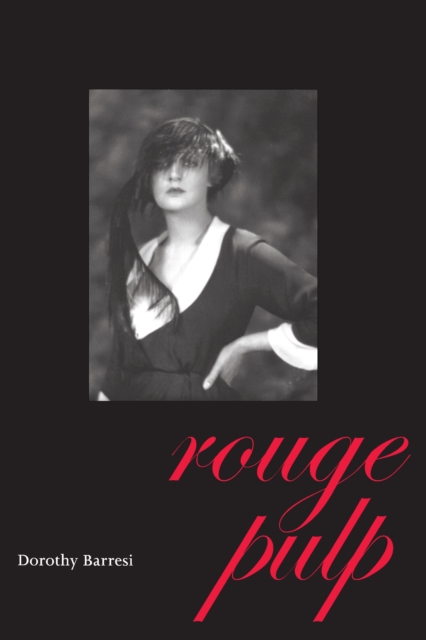
Rouge Pulp
Rouge Pulpexplores notions of body and beauty, birth and death, in a contemporary America driven by its contradictions: material plenty and spiritual lack. Dorothy Barresi writes about strippers, hair salons, cancer, good credit ratings, cockfights, childbirth, maternal love, war. Her poems take the world's brutal vitality as their music, and they refuse to despair.
eBook

The Post-Rapture Diner
\"[In The Post-Rapture Diner] the brashness and sadness of our polyglot nation is given voice. Dorothy Barresi speaks in tongues - of 'undetonated cherubs,' sitcoms, and agents provocateurs. Her toughminded, eloquent poems articulate family tangles, unintentional cruelties, innocenc and sophistication. . . . The Post-Rapture Diner creates a language commensurate to the ethical complexities of this particular American moment and to the ongoing human dilemma.\" --Alice Fulton \"[This] new book of poetry imagines southern California as a vast, hot, flat desert wasteland that revises T. S. Eliot's epic locale, finding redemption in lyrical strains of ice-cream trucks and sit-com romance. . . . Barresi's tone is wise and gullible, her cravings material and mystical, metaphorical and theatrical. . . . . I found myself entranced by Barresi's magical specter of the real, the full-bodied images provided by Nureyev or Ralph Kramden-who, after all, has his own ideas about the moon.\" --Voices in Italian Americana \"Barresi's poetry has wit and pathos. . . . Her metaphors are a delight.\" --Library Journal \"What a pleasure to find a poet whose sense of risk and honesty drives her to complicate the emotions and attitudes of her poems--so that sorrow might be suddenly hijacked by bravado, or delight by anger and humor-rather than to wrap us up a neat little parcel of agreeable 'sensitivities'. . . .Deeply imagined, full of toughness and great heart, Dorothy Barresi's poems come from the places where we all live now, in America, in the 1990s. I'd pay to read or hear her anytime, I'd stand in line.\" --Ploughshares Dorothy Barresi's poems have been published widely in literary journals, including Poetry, Parnassus, the Harvard Review, the Antioch Review and the Kenyon Review, and her essay-reviews appear semi-regularly in the Gettysburg Review. She has been the recipient of Fellowships from the National Endowment for the Arts, the Fine Arts Work Center in Provincetown, and the North Carolina Arts Council. Her poetry has been awarded a Pushcart Prize and the Hart Crane Memorial Poetry Prize. She is a Professor of English at California State University, Northridge, where she is Chair of the Creative Writing program. She lives in Los Angeles, California.
eBook

American Fanatics
A book of contemporary poetry exploring the fine, shifting line between faith—secular and spiritual faith—and fanaticism in an insecure age, American Fanatics is a lyrical, pop-culture inflected meditation on democracy, morality, beauty, commerce, and the cost of falling dreams.
eBook

Rouge Pulp
Rouge Pulp explores notions of body and beauty, birth and death, in a contemporary America driven by its contradictions: material plenty and spiritual lack. Dorothy Barresi writes about strippers, hair salons, cancer, good credit ratings, cockfights, childbirth, maternal love, war. Her poems take the world’s brutal vitality as their music, and they refuse to despair.
eBook


Lost and Found
Jean Valentine is one of American poetry’s great domestic fabulists, writing powerful, enigmatic poems about the darkly enchanted relationship between mother and child. While modernist pathfinder Sylvia Plath sends up postwar motherhood with the outrageous and outraged humor of “Lesbos” (“Viciousness in the kitchen! . . . And I, love, am a pathological liar, /And my child—look at her, face down on the floor, / Little unstrung puppet, kicking to disappear”), Jean Valentine kicks over the traces of Victorian sentimentality more quietly, though the effect is no less dramatic. Her portrayals of motherhood and childhood have the existential force
Book Chapter
