
Catalogue Search | MBRL


Are you sure you want to remove the book from the shelf?

{{itemTitle}}
25
result(s) for
"Dahlquist, Marina"
Sort by:

Exporting perilous Pauline : Pearl White and the serial film craze
The American action film serials of the 1910s featured exciting stunts, film tricks, and effects set against the background of modern technology, often starring resourceful female heroines who displayed traditionally male qualities such as endurance, strength, and authority. The most renowned of these \"serial queens\" was Pearl White, whose career as the adventurous character Pauline developed during a transitional phase in the medium. This collection of essays explores the serial genre and its narrative patterns, marketing, and cultural reception, and historiographic importance.
Book
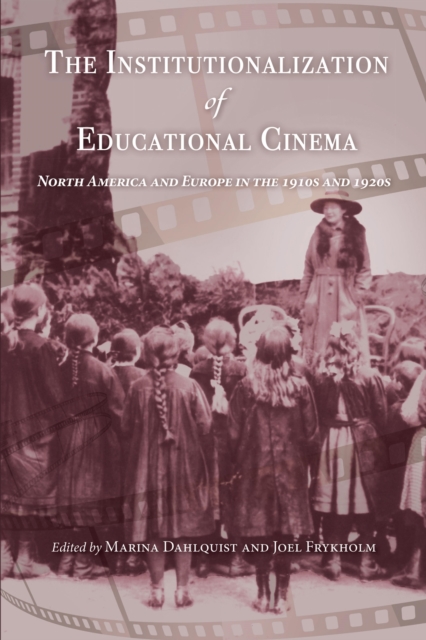
The Institutionalization of Educational Cinema
The potential of films to educate has been crucial for the development of cinema intended to influence culture, and is as important as conceptions of film as a form of art, science, industry, or entertainment. Using the concept of institutionalization as a heuristic for generating new approaches to the history of educational cinema, contributors to this volume study the co-evolving discourses, cultural practices, technical standards, and institutional frameworks that transformed educational cinema from a convincing idea into an enduring genre.The Institutionalization of Educational Cinema examines the methods of production, distribution, and exhibition established for the use of educational filmswithin institutions-such as schools, libraries, and industrial settings in various national and international contexts and takes a close look at the networks of organizations, individuals, and government agencies that were created as a result of these films' circulation. Through case studies of educational cinemas in different North American and European countries that explore various modes of institutionalization of educational film, this book highlights the wide range of vested interests that framed the birth of educational and nontheatrical cinema.
eBook

Exporting Perilous Pauline
Exceptionally popular during their time, the spectacular American action film serials of the 1910s featured exciting stunts, film tricks, and effects set against the background of modern technology, often starring resourceful female heroines who displayed traditionally male qualities such as endurance, strength, and authority. The most renowned of these serial queens was Pearl White, whose career as the adventurous character Pauline developed during a transitional phase in the medium's evolving production strategies, distribution and advertising patterns, and fan culture. In this volume, an international group of scholars explores how American serials starring Pearl White and other female stars impacted the emerging cinemas in the United States and abroad. Contributors investigate the serial genre and its narrative patterns, marketing, and cultural reception, and historiographic importance, with essays on Pearl White's life on and off the screen as well as the serial queen genre in Western and Eastern Europe, India, and China. Contributors are Weihong Bao, Rudmer Canjels, Marina Dahlquist, Monica Dall'Asta, Kevin B. Johnson, Christina Petersen, and Rosie Thomas.
eBook

Films on Ice
The first book to address the vast diversity of Northern circumpolar cinemas from a transnational perspective, Films on Ice: Cinemas of the Arctic presents the region as one of great and previously overlooked cinematic diversity.
eBook

Health on Display
This triumphant belief in hygienic efforts is part of the discourse that promoted the upcoming Panama Pacific International Exposition in San Francisco in 1915 – and as this example, from 1913, makes evident – years in advance of the actual event. As it turned out, sanitation, health, reform and education became prominent themes at the Exposition together with industrial inventions and explorations of national and cultural diversities.
The early twentieth century teemed with initiatives aimed at improving and modernising American everyday life. These uplift campaigns, initiated in topdown fashion, zoomed in on sanitation, working conditions, childcare, education, and recreation. The strive for
Book Chapter
The Best-Known Woman in the World
When Pearl White arrived in Paris in April 1921, she was awarded massive attention by the press. Hervé Lauwick’s article in the French newspaper Figaro bespeaks her fame: “Qui, en France, ne connaît Pearl White?” (Who, in France, doesn’t know Pearl White?)¹ This question would not have been posed in such a rhetorical fashion in Sweden—a country often cited in connection with Pearl White and her serials’ international success. Sweden is, of course, only mentioned to illustrate the extent of her stardom reaching even the most remote places imaginable—from an American perspective, that is. Despite all the hype
Book Chapter

Health Instruction on Screen
As cinema became a medium for social activism, public health discourses adopted films as a means to achieve the wider aim of Americanisation. In Progressive era New York City, didactic initiatives on the part of the Department of Health between 1909 and 1917 brought together a cross-section of civic movements and organisations at a time before government leadership in health and quality of life was assumed either at the federal or municipal level. In New York City, moving pictures were used to raise awareness about the link between sanitary and civic conduct in efforts to reshape both types of behaviours.
Book Chapter


Partners in Screen Education
During the 1910s and 1920s, the momentous and far-reaching social work done by philanthropic organizations can be illustrated by the health slogans used by the Rockefeller Foundation in Lee County, North Carolina, where exclamations such as “Ill health retards social progress,” “Better milk, better babies, better citizens,” “Every home a healthy home,” and “Join in the fight against tuberculosis” were used in campaigns intertwining health and societal concerns.¹ Social uplift and improved health were pivotal aspects of the Progressive project peaking in the United States during the first decades of the twentieth century. The objective for numerous nonprofit organizations emerging
Book Chapter