
Catalogue Search | MBRL


Are you sure you want to remove the book from the shelf?

{{itemTitle}}
275
result(s) for
"Dale, Colin"
Sort by:

The Qur'an revealed : a critical analysis of Said Nursi's epistles of light
\"The Qur'an Revealed is a landmark publication in the history of Islamic studies, providing for the first time a comprehensive critical analysis of Bedizuzzaman Said Nursi's 6000-page work of Quranic exegesis, The Epistles of Light. In discussing a wide range of themes, from Divine unity to causation, from love to spirituality, from prophethood to civilization and politics, Colin Turner invites the reader into Nursi's conceptual universe, presenting the teachings of arguably the Muslim world's most understudied theologian in a language that is accessible to both expert and interested layperson alike.\"--The publisher.
BOOK

Microbiome stability and structure is governed by host phylogeny over diet and geography in woodrats (Neotoma spp.)
The microbiome is critical for host survival and fitness, but gaps remain in our understanding of how this symbiotic community is structured. Despite evidence that related hosts often harbor similar bacterial communities, it is unclear whether this pattern is due to genetic similarities between hosts or to common ecological selection pressures. Here, using herbivorous rodents in the genus Neotoma, we quantify how geography, diet, and host genetics, alongside neutral processes, influence microbiome structure and stability under natural and captive conditions. Using bacterial and plant metabarcoding, we first characterized dietary and microbiome compositions for animals from 25 populations, representing seven species from 19 sites across the southwestern United States. We then brought wild animals into captivity, reducing the influence of environmental variation. In nature, geography, diet, and phylogeny collectively explained ∼50% of observed microbiome variation. Diet and microbiome diversity were correlated, with different toxin-enriched diets selecting for distinct microbial symbionts. Although diet and geography influenced natural microbiome structure, the effects of host phylogeny were stronger for both wild and captive animals. In captivity, gut microbiomes were altered; however, responses were species specific, indicating again that host genetic background is the most significant predictor of microbiome composition and stability. In captivity, diet effects declined and the effects of host genetic similarity increased. By bridging a critical divide between studies in wild and captive animals, this work underscores the extent to which genetics shape microbiome structure and stability in closely related hosts.
Journal Article
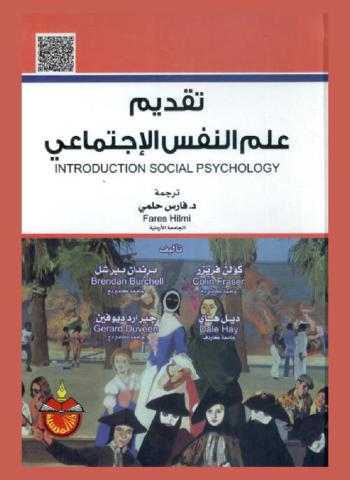
تقديم علم النفس الاجتماعي
أصبح علم النفس الاجتماعي علما لبناء المجتمع والدولة أي لصياغة التفاعل بين أبناء المجتمع بطريقة تؤهلهم للفوز في معركة سباق المجتمعات. وهكذا يساعد هذا العلم مثل غيره من سائر العلوم على التوصل إلى الغايات. ويعود اختيار هذا الكتاب لما يتضمنه من معلومات غزيرة وحديثة في مجالات شتى، يحتاجها طلبة جامعاتنا العربية، وكذلك المشتغلين في المجالات التطبيقية المختلفة. فهذا الكتاب يفتقر إلى فصول تتناول بطريقة مباشرة موضوعات الإعلام والسياسة والاقتصاد.
Book

Stochasticity, determinism, and contingency shape genome evolution of endosymbiotic bacteria
Evolution results from the interaction of stochastic and deterministic processes that create a web of historical contingency, shaping gene content and organismal function. To understand the scope of this interaction, we examine the relative contributions of stochasticity, determinism, and contingency in shaping gene inactivation in 34 lineages of endosymbiotic bacteria,
Sodalis
, found in parasitic lice,
Columbicola
, that are independently undergoing genome degeneration. Here we show that the process of genome degeneration in this system is largely deterministic: genes involved in amino acid biosynthesis are lost while those involved in providing B-vitamins to the host are retained. In contrast, many genes encoding redundant functions, including components of the respiratory chain and DNA repair pathways, are subject to stochastic loss, yielding historical contingencies that constrain subsequent losses. Thus, while selection results in functional convergence between symbiont lineages, stochastic mutations initiate distinct evolutionary trajectories, generating diverse gene inventories that lack the functional redundancy typically found in free-living relatives.
Endosymbionts often have small genomes that maintain minimal functions required to serve their hosts. This study examines cases of new endosymbiont acquisition and finds genome degeneration involves both stochastic and deterministic processes that shape gene content and organismal function.
Journal Article
Experimental Sodalis infection eliminates ancient insect symbiont
Many insects benefit from ancient nutrient-supplementing endosymbionts. While symbiont losses and replacements occur on evolutionary timescales, their dynamics remain enigmatic due to the lack of experimentally tractable systems. Here, we report on the experimental establishment of the culturable bacterium
Sodalis praecaptivus
in a grain pest beetle (
Oryzaephilus surinamensis
) and its effect on the native symbiont
Shikimatogenerans silvanidophilus
, which produces the tyrosine precursor prephenate. Injection of
Sodalis
into female beetles led to systemic intracellular infection and efficient transovarial vertical transmission but reduced host survival and reproduction. Interestingly,
Sodalis
also invaded the host’s bacteriomes, causing irregular morphology and rapid loss of
Shikimatogenerans
within three beetle generations. Transcriptomics revealed a strong upregulation of host immune effectors upon
Sodalis
infection, but little reaction from
Shikimatogenerans
, indicating that the ancient symbiont is incapable of responding adaptively to the introduced competitor. The rapid elimination of the native symbiont in
O. surinamensis
showcases the fragility of ancient beneficial symbioses and experimentally recapitulates a crucial step towards a functional symbiont replacement.
Many insects harbour bacterial endosymbionts that provide them with essential nutrients. Here, Krüsemer et al. show that introduction of a tractable bacterium into a beetle host leads to efficient vertical transmission of the bacterium and rapid elimination of the host’s native symbiont, thus establishing a model system to study symbiont loss and replacement.
Journal Article

Emergent s -Wave Interactions between Identical Fermions in Quasi-One-Dimensional Geometries
Orbital degrees of freedom play an essential role in metals, semiconductors, and strongly confined electronic systems. Experiments with ultracold atoms have used highly anisotropic confinement to explore low-dimensional physics, but they typically eliminate orbital degrees of freedom by preparing atoms in the motional ground states of the strongly confined directions. Here, we prepare multiband systems of spin-polarized fermionic potassium (K40) in the quasi-one-dimensional (q1D) regime and quantify the strength of atom-atom correlations using radio-frequency spectroscopy. The activation of orbital degrees of freedom leads to a new phenomenon: a low-energy scattering channel that has even particle-exchange parity along the q1D axis, as if the underlying interactions weres-wave. This emergent exchange symmetry is enabled by orbital singlet wave functions in the strongly confined directions, which also confer high-momentum components to low-energy q1D collisions. We measure both the q1D odd-wave and even-wave “contact” parameters for the first time and compare them to theoretical predictions of one-dimensional many-body models. The strength and spatial symmetry of interactions are tuned by ap-wave Feshbach resonance and by transverse confinement strength. Near resonance, the even-wave contact approaches its theoretical unitary value, whereas the maximum observed odd-wave contact remains several orders of magnitude below its unitary limit. Low-energy scattering channels of multi-orbital systems, such as those found here, may provide new routes for the exploration of universal many-body phenomena.
Journal Article

Quorum sensing sets the stage for the establishment and vertical transmission of Sodalis praecaptivus in tsetse flies
Bacterial virulence factors facilitate host colonization and set the stage for the evolution of parasitic and mutualistic interactions. The Sodalis-allied clade of bacteria exhibit striking diversity in the range of both plant and animal feeding insects they inhabit, suggesting the appropriation of universal molecular mechanisms that facilitate establishment. Here, we report on the infection of the tsetse fly by free-living Sodalis praecaptivus, a close relative of many Sodalis-allied symbionts. Key genes involved in quorum sensing, including the homoserine lactone synthase (ypeI) and response regulators (yenR and ypeR) are integral for the benign colonization of S. praecaptivus. Mutants lacking ypeI, yenR and ypeR compromised tsetse survival as a consequence of their inability to repress virulence. Genes under quorum sensing, including homologs of the binary insecticidal toxin PirAB and a putative symbiosis-promoting factor CpmAJ, demonstrated negative and positive impacts, respectively, on tsetse survival. Taken together with results obtained from experiments involving weevils, this work shows that quorum sensing virulence suppression plays an integral role in facilitating the establishment of Sodalis-allied symbionts in diverse insect hosts. This knowledge contributes to the understanding of the early evolutionary steps involved in the formation of insect-bacterial symbiosis. Further, despite having no established history of interaction with tsetse, S. praecaptivus can infect reproductive tissues, enabling vertical transmission through adenotrophic viviparity within a single host generation. This creates an option for the use of S. praecaptivus in the biocontrol of insect disease vectors via paratransgenesis.
Journal Article
A Novel Human-Infection-Derived Bacterium Provides Insights into the Evolutionary Origins of Mutualistic Insect–Bacterial Symbioses
Despite extensive study, little is known about the origins of the mutualistic bacterial endosymbionts that inhabit approximately 10% of the world's insects. In this study, we characterized a novel opportunistic human pathogen, designated \"strain HS,\" and found that it is a close relative of the insect endosymbiont Sodalis glossinidius. Our results indicate that ancestral relatives of strain HS have served as progenitors for the independent descent of Sodalis-allied endosymbionts found in several insect hosts. Comparative analyses indicate that the gene inventories of the insect endosymbionts were independently derived from a common ancestral template through a combination of irreversible degenerative changes. Our results provide compelling support for the notion that mutualists evolve from pathogenic progenitors. They also elucidate the role of degenerative evolutionary processes in shaping the gene inventories of symbiotic bacteria at a very early stage in these mutualistic associations.
Journal Article

Independent and repeated acquisition of Sodalis endosymbiotic bacteria across the diversification of feather lice
Many parasitic insects, including lice, form close relationships with endosymbiotic bacteria that are crucial for their survival. In this study, we used genomic sequencing to investigate the distribution and evolutionary history of the bacterial genus Sodalis across a broad range of feather louse species spanning 140 genera. Phylogenomic analysis revealed significant diversity among Sodalis lineages in feather lice and robust evidence for their independent and repeated acquisition by different louse clades throughout their radiation. Among the 1020 louse genomes analysed, at least 22% contained Sodalis, distributed across 57 louse genera. Cophylogenetic analyses between the Sodalis and feather louse phylogenies indicated considerable mismatch. This phylogenetic incongruence between lice and Sodalis, along with the presence of distantly related Sodalis lineages in otherwise closely related louse species, strongly indicates repeated independent acquisition of this endosymbiont. Additionally, evidence of cospeciation among a few closely related louse species, coupled with frequent acquisition of these endosymbionts from free-living bacteria, further highlights the diverse evolutionary processes shaping Sodalis endosymbiosis in feather lice.
Journal Article

Adaptation by Deletogenic Replication Slippage in a Nascent Symbiont
As a consequence of population level constraints in the obligate, host-associated lifestyle, intracellular symbiotic bacteria typically exhibit high rates of molecular sequence evolution and extensive genome degeneration over the course of their host association. While the rationale for genome degeneration is well understood, little is known about the molecular mechanisms driving this change. To understand these mechanisms we compared the genome of Sodalis praecaptivus, a nonhost associated bacterium that is closely related to members of the Sodalis-allied clade of insect endosymbionts, with the very recently derived insect symbiont Candidatus Sodalis pierantonius. The characterization of indel mutations in the genome of Ca. Sodalis pierantonius shows that the replication system in this organism is highly prone to deletions resulting from polymerase slippage events in regions encoding G+C-rich repetitive sequences. This slippage-prone phenotype is mechanistically associated with the loss of certain components of the bacterial DNA recombination machinery at an early stage in symbiotic life and is expected to facilitate rapid adaptation to the novel host environment. This is analogous to the emergence of mutator strains in both natural and laboratory populations of bacteria, which tend to reach high frequencies in clonal populations due to linkage between the mutator allele and the resulting adaptive mutations.
Journal Article