
Catalogue Search | MBRL


Are you sure you want to remove the book from the shelf?

{{itemTitle}}
95
result(s) for
"Damaren, Christopher"
Sort by:

Nuclear microtubule filaments mediate non-linear directional motion of chromatin and promote DNA repair
Damaged DNA shows increased mobility, which can promote interactions with repair-conducive nuclear pore complexes (NPCs). This apparently random mobility is paradoxically abrogated upon disruption of microtubules or kinesins, factors that typically cooperate to mediate the directional movement of macromolecules. Here, we resolve this paradox by uncovering DNA damage-inducible intranuclear microtubule filaments (DIMs) that mobilize damaged DNA and promote repair. Upon DNA damage, relief of centromeric constraint induces DIMs that cooperate with the Rad9 DNA damage response mediator and Kar3 kinesin motor to capture DNA lesions, which then linearly move along dynamic DIMs. Decreasing and hyper-inducing DIMs respectively abrogates and hyper-activates repair. Accounting for DIM dynamics across cell populations by measuring directional changes of damaged DNA reveals that it exhibits increased non-linear directional behavior in nuclear space. Abrogation of DIM-dependent processes or repair-promoting factors decreases directional behavior. Thus, inducible and dynamic nuclear microtubule filaments directionally mobilize damaged DNA and promote repair.
Following DNA damage, different processes come to action to aid repair. The authors here find that microtubule filaments within the cell nucleus capture and non-randomly mobilize damaged chromatin to mediate DNA repair.
Journal Article

Nonlinear Optimal Approach to Spacecraft Formation Flying Using Lorentz and Impulsive Actuation
This paper proposes an optimal control design framework for hybrid nonlinear time-dependent dynamical systems involving an interacting mixture of continuous-time and discrete-time dynamics. Aiming to extend hybrid linear optimal control synthesis to nonlinear non-quadratic formulation, a hybrid version of the Hamilton–Jacobi–Bellman (HJB) equation with time-dependency is first presented. A hybrid computational framework, which alternates between continuous-time and discrete-time subsystems at an appropriate sequence of time instants, is then developed to solve the resultant set of the HJB equations in an interacting manner. The proposed control scheme is subsequently applied to spacecraft formation flying establishment with a hybrid source of actuation, namely Lorentz force and impulsive thrusting. By optimal combination of the Lorentz force and impulsive thrusting proposed in this paper, not only are the uncontrollability issues pertinent inherently to the Lorentz-actuated control systems effectively resolved, but use of both Lorentz and impulsive control inputs is also optimized. As a consequence, the expendable chemical fuels required to actuate thrusters are significantly reduced, thereby extending the duration of such space missions.
Journal Article

Trajectory Planning with Collision Avoidance for Multiple Quadrotor UAVs Using DMPC
Trajectory planning with collision avoidance plays an important role for the safe application of multi-UAV systems in low altitude airspace. Although the synchronous DMPC algorithm had been widely applied in multi-agent systems due to its lower communication and computing cost, it generally suffers from the strict requirements. For example, the additional terminal conditions significantly reduce the maneuverability of the UAV in the fleet, whereas which ensure the stability of the algorithm and the feasibility of recursion. To remedy the raised issues, in this paper, a novel set of terminal conditions is proposed, which effectively reduces the conservativeness of the collision-free trajectories and satisfies the requirements of collision avoidance algorithms simultaneously. In this research, we also leverage the theoretical qualitative analysis, and thus providing initial guesses and related parameter settings for the algorithm. Finally, sufficient numerical simulations are proposed to verify the effectiveness and superiority of the proposed algorithm.
Journal Article

Evaluation of Precise Microwave Ranging Technology for Low Earth Orbit Formation Missions with Beidou Time-Synchronize Receiver
In this study, submillimeter level accuracy K-band microwave ranging (MWR) equipment is demonstrated, aiming to verify the detection of the Earth’s gravity field (EGF) and digital elevation models (DEM), through spacecraft formation flying (SFF) in low Earth orbit (LEO). In particular, this paper introduces in detail an integrated BeiDou III B1C/B2a dual frequency receiver we designed and developed, including signal processing scheme, gain allocation, and frequency planning. The receiver matched the 0.1 ns precise synchronize time-frequency benchmark for the MWR system, verified by a static and dynamic test, compared with a time interval counter synchronization solution. Moreover, MWR equipment ranging accuracy is explored in-depth by using different ranging techniques. The test results show that MWR achieved 40 μm and 1.6 μm/s accuracy for ranging and range rate during tests, using synchronous dual one-way ranging (DOWR) microwave phase accumulation frame, and 6 μm/s range rate accuracy obtained through a one-way ranging experiment. The ranging error sources of the whole MWR system in-orbit are analyzed, while the relative orbit dynamic models, for formation scenes, and adaptive Kalman filter algorithms, for SFF relative navigation designs, are introduced. The performance of SFF relative navigation using MWR are tested in a hardware in loop (HIL) simulation system within a high precision six degree of freedom (6-DOF) moving platform. The final estimation error from adaptive relative navigation system using MWR are about 0.42 mm (range/RMS) and 0.87 μm/s (range rate/RMS), which demonstrated the promising accuracy for future applications of EGF and DEM formation missions in space.
Journal Article

On-Orbit Verification of RL-Based APC Calibrations for Micrometre Level Microwave Ranging System
Micrometre level ranging accuracy between satellites on-orbit relies on the high-precision calibration of the antenna phase center (APC), which is accomplished through properly designed calibration maneuvers batch estimation algorithms currently. However, the unmodeled perturbations of the space dynamic and sensor-induced uncertainty complicated the situation in reality; ranging accuracy especially deteriorated outside the antenna main-lobe when maneuvers performed. This paper proposes an on-orbit APC calibration method that uses a reinforcement learning (RL) process, aiming to provide the high accuracy ranging datum for onboard instruments with micrometre level. The RL process used here is an improved Temporal Difference advantage actor critic algorithm (TDAAC), which mainly focuses on two neural networks (NN) for critic and actor function. The output of the TDAAC algorithm will autonomously balance the APC calibration maneuvers amplitude and APC-observed sensitivity with an object of maximal APC estimation accuracy. The RL-based APC calibration method proposed here is fully tested in software and on-ground experiments, with an APC calibration accuracy of less than 2 mrad, and the on-orbit maneuver data from 11–12 April 2022, which achieved 1–1.5 mrad calibration accuracy after RL training. The proposed RL-based APC algorithm may extend to prove mass calibration scenes with actions feedback to attitude determination and control system (ADCS), showing flexibility of spacecraft payload applications in the future.
Journal Article
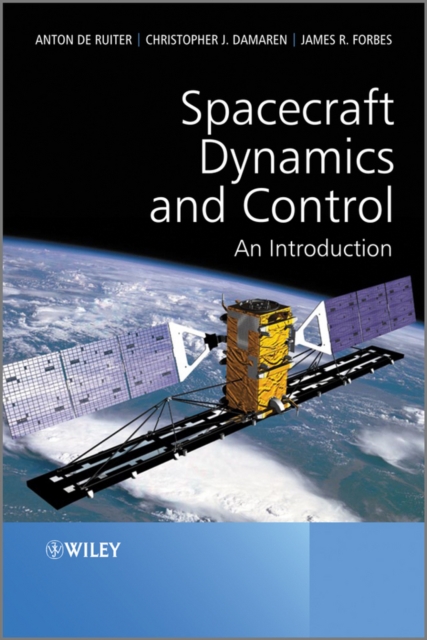
Spacecraft dynamics and control
Provides the basics of spacecraft orbital dynamics plus attitude dynamics and control, using vectrix notation Spacecraft Dynamics and Control: An Introduction presents the fundamentals of classical control in the context of spacecraft attitude control. This approach is particularly beneficial for the training of students in both of the subjects of classical control as well as its application to spacecraft attitude control. By using a physical system (a spacecraft) that the reader can visualize (rather than arbitrary transfer functions), it is easier to grasp the motivation for why topics in control theory are important, as well as the theory behind them. The entire treatment of both orbital and attitude dynamics makes use of vectrix notation, which is a tool that allows the user to write down any vector equation of motion without consideration of a reference frame. This is particularly suited to the treatment of multiple reference frames. Vectrix notation also makes a very clear distinction between a physical vector and its coordinate representation in a reference frame. This is very important in spacecraft dynamics and control problems, where often multiple coordinate representations are used (in different reference frames) for the same physical vector. Provides an accessible, practical aid for teaching and self-study with a layout enabling a fundamental understanding of the subject Fills a gap in the existing literature by providing an analytical toolbox offering the reader a lasting, rigorous methodology for approaching vector mechanics, a key element vital to new graduates and practicing engineers alike Delivers an outstanding resource for aerospace engineering students, and all those involved in the technical aspects of design and engineering in the space sector Contains numerous illustrations to accompany the written text. Problems are
included to apply and extend the material in each chapter Essential reading for graduate level aerospace engineering students, aerospace professionals, researchers and engineers.
eBook

Terminal Airspace Capacity Evaluation Model under Weather Condition from Perspective of a Controller
A route network lays in the terminal airspace. The route network can be divided into multiple subnetworks according to sectors. When severe weather conditions occur, a controller takes measures to obtain safe operation of flights, such as navigation guidance or changing the availability of routes. In such circumstances, the route structure of a subnetwork is changed, and the controller’s attention paid to each route is also changed as well as the unit workload on it. As the subnetwork is handled by one controller, capacities of routes in it are associated. We find the way to determine the “related capacity” of a route in the conditions that whether topological structure of the terminal route network is changed or not. The capacity of the terminal route network calculated by network flow theory represents the capacity of terminal airspace. According to the analysis results, the weather factor reduces capacity of terminal airspace directly by reducing the capacities of routes blocked. Indirectly, it diverts controller’s attention to change capacities of other routes in the subnetwork.
Journal Article
Experimental Analysis of a Small-Scale Rotor at Various Inflow Angles
The performance characteristics of a rotor that is typically used for small unmanned aircraft were analyzed in a series of wind-tunnel experiments. Wind-tunnel measurements were conducted with the rotor at various inflow angles in order to investigate the effects on the rotor performance of partially or fully edgewise flow as they are typically encountered with small multirotor vehicles. Rotor tests were also performed under static and fully axial flow conditions in order to investigate the aerodynamic performance during hover as well as vertical climb and descent. The wind-tunnel data were corrected to account for the interference of wind-tunnel walls with the rotor wake and the blockage due to the presence of the rotor test stand in the wind-tunnel test section. The results are presented in terms of thrust, power, and roll moment coefficients under different rotor rotational speeds for a T-motor 18x6.1. Additionally, the measured thrust and power coefficients of Master Airscrew Electric 11x7 are compared with available propeller data under static and axial flow conditions for verification purposes. It is shown that the rotor performance characteristics are strongly affected by the freestream advance ratio and the freestream inflow angles. For example, at inflow angles that are typical for multirotor vehicles between about 15° and 0° with respect to the rotor disc, thrust coefficients stay constant or grow with increasing advance ratio, whereas power coefficients remain relatively constant with changing advance ratio.
Journal Article
On the Effects of Modeling As-Manufactured Geometry: Toward Digital Twin
A simple, nonstandardized material test specimen, which fails along one of two different likely crack paths, is considered herein. The result of deviations in geometry on the order of tenths of a millimeter, this ambiguity in crack path motivates the consideration of as-manufactured component geometry in the design, assessment, and certification of structural systems. Herein, finite element models of as-manufactured specimens are generated and subsequently analyzed to resolve the crack-path ambiguity. The consequence and benefit of such a “personalized” methodology is the prediction of a crack path for each specimen based on its as-manufactured geometry, rather than a distribution of possible specimen geometries or nominal geometry. The consideration of as-manufactured characteristics is central to the Digital Twin concept. Therefore, this work is also intended to motivate its development.
Journal Article
Nonlinear Dynamics of the High-Speed Rotating Plate
High speed rotating blades are crucial components of modern large aircraft engines. The rotating blades under working condition frequently suffer from the aerodynamic, elastic and inertia loads, which may lead to large amplitude nonlinear oscillations. This paper investigates nonlinear dynamic responses of the blade with varying rotating speed in supersonic airflow. The blade is simplified as a pre-twist and presetting cantilever composite plate. Warping effect of the rectangular cross-section of the plate is considered. Based on the first-order shear deformation theory and von-Karman nonlinear geometric relationship, nonlinear partial differential dynamic equations of motion for the plate are derived by using Hamilton’s principle. Galerkin approach is applied to discretize the partial differential governing equations of motion to ordinary differential equations. Asymptotic perturbation method is exploited to derive four-degree-of-freedom averaged equation for the case of 1 : 3 internal resonance-1/2 sub-harmonic resonance. Based on the averaged equation, numerical simulation is used to analyze the influence of the perturbation rotating speed on nonlinear dynamic responses of the blade. Bifurcation diagram, phase portraits, waveforms and power spectrum prove that periodic motion and chaotic motion exist in nonlinear vibration of the rotating cantilever composite plate.
Journal Article