
Catalogue Search | MBRL


Are you sure you want to remove the book from the shelf?

{{itemTitle}}
138
result(s) for
"Dando, Malcolm"
Sort by:
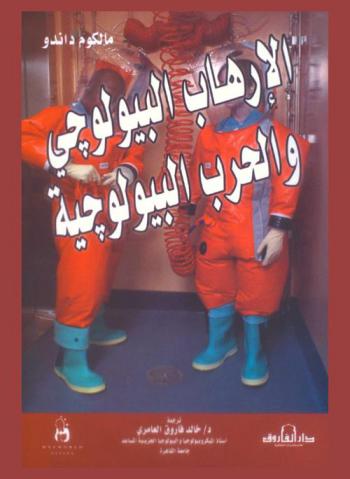
الإرهاب البيولوجي والحرب البيولوجية
في عصر أصبح من السهل فيه إنتاج الجمرة الخبيثة في المعامل وأضحى من الصعب فيه الوصول إلى اتفاقات متعددة الجوانب بين الدول، بات تهديد الحرب البيولوجية وشيكا على الخروج عن نطاق السيطرة. وفي هذا الدليل الموثوق فيه، يفتش الخبير العالمي مالكوم داندو عن السبب الذي طالما صعب على العامة معرفته ويشرح ما يلي : مفهوم الأسلحة البيولوجية، متى بدأت أبحاث الحرب البيولوجية ـ وكيف تطورت ؟، كيف يمكن التقليل من مخاطر الإرهاب البيولوجي ؟ من تاريخ برامج تطور الحرب البيولوجية إلى إمكان حدوث هجمات لحروب بيولوجية، يصف داندو ما يراه ضروريا للحد من الإمكانات المساعدة لشن حرب بيولوجية في المستقبل. ومن خلال إلقاء نظرة وراء كواليس الاتفاقيات الدولية الفاشلة محل النزاع، ستجد أن هذا الدليل المستند إلى حجج وبراهين أكيدة يجمع بين السياسة والتكنولوجيا للكشف عن الحقيقة التي تكمن وراء ما يهدد القرن الحادي والعشرين.
Book

Reconsidering the need for gain-of-function research on enhanced potential pandemic pathogens in the post-COVID-19 era
The dual-use risk of infectious disease research using enhanced potential pandemic pathogens (ePPP), particularly gain-of-function (GOF) research, has been debated since 2011. As of now, research is supported on the condition that the research plan is reviewed and the actual experiment is supervised. However, the kinds of research conducted and what benefits they have brought to our society have not been adequately verified. Nevertheless, due to the COVID-19 pandemic that began at the end of 2019 and caused numerous deaths and wide economic disruption, the importance of infectious disease control from an international perspective has been recognized. Although complete control of the pandemic is still far off, positive signs include generating epidemiological trends based on genome analysis, therapeutic drug and vaccine development, clinical patient management, and public health policy interventions. In this context, the time has come to reconsider the true significance of GOF research on ePPP and the state of research governance in the post-COVID-19 era. In particular, the risks of such research are clearer than before, whereas its benefits seem less apparent. In this paper, we summarize the history of discussions on such GOF research, its significance in the light of the current COVID-19 pandemic, and the direction we shall take in the future.
Journal Article


A transatlantic perspective on 20 emerging issues in biological engineering
Advances in biological engineering are likely to have substantial impacts on global society. To explore these potential impacts we ran a horizon scanning exercise to capture a range of perspectives on the opportunities and risks presented by biological engineering. We first identified 70 potential issues, and then used an iterative process to prioritise 20 issues that we considered to be emerging, to have potential global impact, and to be relatively unknown outside the field of biological engineering. The issues identified may be of interest to researchers, businesses and policy makers in sectors such as health, energy, agriculture and the environment.
Journal Article


The vital importance of a web of prevention for effective biosafety and biosecurity in the twenty-first century
Biological threats are complex and multifaceted, as evidenced by the ongoing COVID-19 pandemic. Their effective prevention and countering require multiple lines of collaborative action and sustained cross-sectorial coordination. This paper reviews the conclusions of Graham Pearson’s 1997
JAMA
article titled ‘The Complementary Role of Environmental and Security Biological Control Regimes in the 21st Century’, taking into account the international policy developments that have occurred over the past two decades. The paper underscores the utility of the concept of a ‘web of prevention’ for elucidating the need for continuous interaction between the international biosafety and international biosecurity regimes, in order to ensure that the life sciences are used only for peaceful purposes. The terms ‘biosafety’ and ‘biosecurity’ are used to denote the primary purpose of the two regimes: the international biosafety regime seeks to prevent the unintentional (accidental) release of pathogens and toxins, including naturally occurring disease, whereas the biosecurity regime seeks to prevent the deliberate release and misuse of pathogens and toxins. The paper concludes by recommending practical steps for strengthening the implementation of all elements of the web of prevention and upholding the norms against the hostile misuse of life sciences.
Journal Article


Find the time to discuss new bioweapons
In Geneva next month, officials will discuss updates to the global treaty that outlaws the use of biological weapons. The 1972 Biological Weapons Convention (BWC) was the first agreement to ban an entire class of weapons, and it remains a crucial instrument to stop scientific research on viruses, bacteria and toxins from being diverted into military programmes.
Journal Article

Preventing a Biochemical Arms Race
Preventing a Biochemical Arms Race responds to a growing concern that changes in the life sciences and the nature of warfare could lead to a resurgent interest in chemical and biological weapons (CBW) capabilities. By bringing together a wide range of historical material and current literature in the field of CBW arms control, the book reveals how these two disparate fields might be integrated to precipitate a biochemical arms race among major powers, rogue states, or even non-state actors.
It seeks to raise awareness among policy practitioners, the academic community, and the media that such an arms race may be looming if developments are left unattended, and to provide policy options on how it-and it's devastating consequences-could be avoided. After identifying weaknesses in the international regime structures revolving around the Biological Weapons and Chemical Weapons Conventions, it provides policy proposals to deal with gaps and shortcomings in each prohibition regime individually, and then addresses the widening gap between them.
eBook