
Catalogue Search | MBRL


Are you sure you want to remove the book from the shelf?

{{itemTitle}}
408
result(s) for
"Darnton, Robert"
Sort by:


First Steps Toward a History of Reading
The \"First Steps\" toward a history of reading that I described in 'AJFS' twenty-eight years ago have now turned into something of a stampede. They lead in many directions-so many that I cannot map them here. The excellent anthology edited by Guglielmo Cavallo and Roger Chartier, 'A History of Reading in the West' (English edition, Polity Press, 1999) surveys much of the ground covered by the end of the century. But the twentieth century already looks like the distant past.
Journal Article

The case for books : past, present, and future
\"The era of the printed book is at a crossroad. E-readers are flooding the market, books are available to read on cell phones, and companies such as Google, Amazon, and Apple are competing to command near monopolistic positions as sellers and dispensers of digital information. Is the printed book resilient enough to survive the digital revolution, or will it become obsolete? In this lasting collection of essays, Robert Darnton--an intellectual pioneer in the field of this history of the book--lends unique authority to the life, role, and legacy of the book in society.\"--P. 4 of cover.
Book

Poetry and the Police
Darnton has ably mined the available evidence surrounding the 1749 investigation and string of arrests for sedition known as the \"Affair of the Fourteen\" and produced a remarkable analysis of a subversive Parisian public discourse that openly attacked the king, his mistress, new taxes, and an unpopular peace treaty. Darnton lucidly reconstructs a world where information traveled through poems and songs set to familiar melodies; he reminds us that our world of instant communication, tweets, and 24-hour news cycles is not as distinctive as we may believe. With rich end matter that includes the lyrics of poems and songs as well as a link to a superb recording of some of the songs by cabaret artist Helene Delavault, this interdisciplinary piece is highly recommended for serious students across the humanities as well as readers with an interest in 18th-century French culture and politics.
eBook

A literary tour de France : the world of books on the eve of the French Revolution
\"The publishing industry in France in the years before the Revolution was a lively and sometimes rough-and-tumble affair, as publishers and printers scrambled to deal with (and if possible evade) shifting censorship laws and tax regulations, in order to cater to a reading public's appetite for books of all kinds, from the famous Encyclopâedie, repository of reason and knowledge, to scandal-mongering libel and pornography. Historian and librarian Robert Darnton uses his exclusive access to a trove of documents-letters and documents from authors, publishers, printers, paper millers, type founders, ink manufacturers, smugglers, wagon drivers, warehousemen, and accountants-involving a publishing house in the Swiss town of Neuchatel to bring this world to life. Like other places on the periphery of France, Switzerland was a hotbed of piracy, carefully monitoring the demand for certain kinds of books and finding ways of fulfilling it. Focusing in particular on the diary of Jean-Franًcois Favarger, a traveling sales rep for a Swiss firm whose 1778 voyage, on horseback and on foot, around France to visit bookstores and renew accounts forms the spine of this story, Darnton reveals not only how the industry worked and which titles were in greatest demand, but the human scale of its operations. A Literary Tour de France is literally that. Darnton captures the hustle, picaresque comedy, and occasional risk of Favarger's travels in the service of books, and in the process offers an engaging, immersive, and unforgettable narrative of book culture at a critical moment in France's history\"-- Provided by publisher.
Book

“WHAT IS THE HISTORY OF BOOKS?” REVISITED
Having accepted the invitation to revisit my essay of 1982, “What Is the History of Books?”, I find that I can do it only in the first person singular and therefore must ask to be excused for indulging in some autobiographical detail. I would also like to make a disclaimer: in proposing a model for studying the history of books twenty-four years ago, I did not mean to tell book historians how they ought to do their jobs. I hoped that the model might be useful in a heuristic way and never thought of it as comparable to the models favored by economists, the kind in which you insert data, work it over, and arrive at a bottom line. (I do not believe that bottom lines exist in history.) It seemed to me in 1982 that the history of books was suffering from fissiparousness: experts were pursuing such specialized studies that they were losing contact with one another. The esoteric elements of book history needed to be integrated into an overview that would show how the parts could connect to form a whole—or what I characterized as a communications circuit. The tendency toward fragmentation and specialization still exists.
Journal Article

The revolutionary temper : Paris, 1748-1789
\"When a Parisian crowd stormed the Bastille in July 1789, it triggered an event of global consequence: the overthrow of the monarchy and the birth of a new society. Most historians account for the French Revolution by viewing it in retrospect as the outcome of underlying conditions such as a faltering economy, social tensions, or the influence of Enlightenment thought. But what did Parisians themselves think they were doing--how did they understand their world? What were the motivations and aspirations that guided their actions? In this dazzling history, Robert Darnton addresses these questions by drawing on decades of close study to conjure a past as vivid as today's news. He explores eighteenth-century Paris as an information society much like our own, its news circuits centered in cafes, on park benches, and under the Palais-Royal's Tree of Cracow. Through pamphlets, gossip, underground newsletters, and public performances, the events of some forty years-from disastrous treaties, official corruption, and royal debauchery to thrilling hot-air balloon ascents and new understandings of the nation--all entered the churning collective consciousness of ordinary Parisians. As public trust in royal authority eroded and new horizons opened for them, Parisians prepared themselves for revolution. Darnton's authority and sure judgment enable readers to confidently navigate the passions and complexities of controversies over court politics, Church doctrine, and the economy. And his compact, luminous prose creates an immersive reading experience. Here is a riveting narrative that succeeds in making the past a living presence\"-- Provided by publisher.
Book

Poetry and the police : communication networks in eighteenth-century Paris
\"We are given a vivid sense of how songs were circulated and performed on the streets of Paris…Darnton has opened up another rich vein of research in the eighteenth century.\" —Times Literary Supplement In spring 1749, François Bonis, a medical student in Paris, found himself unexpectedly hauled off to the Bastille for distributing an \"abominable poem about the king.\" So began the Affair of the Fourteen, a police crackdown on ordinary citizens for unauthorized poetry recitals. Why was the official response to these poems so intense? In this captivating book, Robert Darnton follows the poems as they passed through several media: copied on scraps of paper, dictated from one person to another, memorized and declaimed to an audience. But the most effective dispersal occurred through music, when poems were sung to familiar tunes. Lyrics often referred to current events or revealed popular attitudes toward the royal court. The songs provided a running commentary on public affairs, and Darnton brilliantly traces how the lyrics fit into song cycles that carried messages through the streets of Paris during a period of rising discontent. He uncovers a complex communication network, illuminating the way information circulated in a semi-literate society. This lucid and entertaining book reminds us of both the importance of oral exchanges in the history of communication and the power of \"viral\" networks long before our internet age.
eBook

الكتاب بين الأمس واليوم والغد
في هذا الكتاب يحاول روبرت دارنتون التأكيد على أهمية وموقع الكتاب في عالم البيئة الرقمية التي تحولت اليوم إلى شكل من أشكال المعرفة الأكثر تطورا والأسرع استخداما في حياة ملايين من البشر. سوف نكتشف عبر صفحات هذا الكتاب العوامل المشتركة التي تجمع ما بين الكتاب التقليدي والكتاب الإلكتروني، فضلا عن أهم المزايا التي تجمع بين المكتبات والإنترنت.
Book
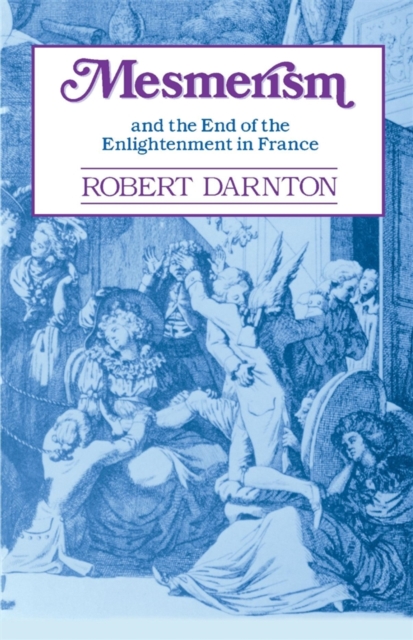
Mesmerism and the end of the Enlightenment in France
Early in 1788, Franz Anton Mesmer arrived in Paris and began to promulgate an exotic theory of healing that almost immediately seized the imagination of the general populace. Robert Darnton's lively study provides a useful contribution to the study of popular culture and the manner in which ideas are diffused down through various social levels.
eBook