
Catalogue Search | MBRL


Are you sure you want to remove the book from the shelf?

{{itemTitle}}
19,405
result(s) for
"Davidson, Neil"
Sort by:

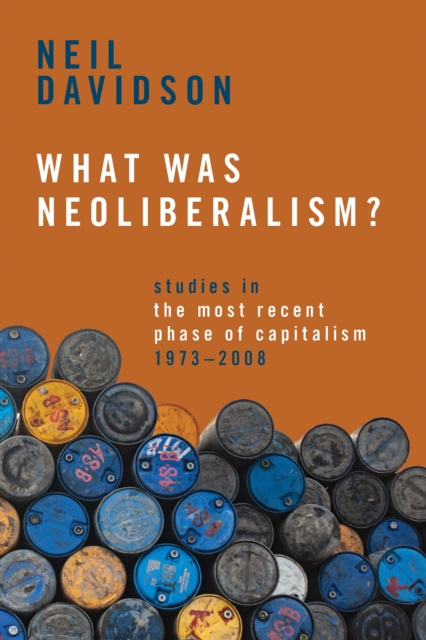
What Was Neoliberalism?
Eminent scholar-activist Neil Davidson's brilliance is on full display in this posthumous work, a timely and prescient introduction to the neoliberal era.
While it is widely agreed that neoliberalism arose in the wake of the global economic crisis of the 1970s, there remains much debate about how to understand its significance and even how to define it. Is it best seen as an ideology of free market fundamentalism, a series of policy decisions gutting the public sector and breaking unions, or as an era of capitalist development with its own logic
Bringing his considerable intellectual breadth and characteristic generosity to bear on this question, Neil Davidson shows that to truly appreciate what is unique about neoliberalism, and what marks it out as a continuation of capitalism more generally, it is necessary to examine its social dimensions. What Was Neoliberalism? holds fast to Davidson's conviction that thoroughly understanding the past means being better prepared for the struggles of the future.
eBook

Cardiovascular effects of marine omega-3 fatty acids
Much evidence shows that the marine omega-3 fatty acids eicosapentaenoic acid and docosahexaenoic acid have beneficial effects in various cardiac disorders, and their use is recommended in guidelines for management of patients after myocardial infarction. However, questions have been raised about their usefulness alongside optimum medical therapies with agents proven to reduce risk of cardiac events in high-risk patients. Additionally, there is some evidence for a possible pro-arrhythmic effect in subsets of cardiac patients. Some uncertainly exists about the optimum dose needed to obtain beneficial effects and the relative merit of dietary intake of omega-3 polyunsaturated fatty acids versus supplements. We review evidence for the effects of omega-3 polyunsaturated fatty acids on various cardiac disorders and the risk factors for cardiac disease. We also assess areas of uncertainty needing further research.
Journal Article

Urban Mind
Existing evidence on the beneficial effects of nature on mental health comes from studies using cross-sectional designs. We developed a smartphone-based tool (Urban Mind; www.urbanmind.info) to examine how exposure to natural features within the built environment affects mental well-being in real time. The tool was used to monitor 108 individuals who completed 3013 assessments over a 1-week period. Significant immediate and lagged associations with mental well-being were found for several natural features. These associations were stronger in people with higher trait impulsivity, a psychological measure of one’s tendency to behave with little forethought or consideration of the consequences, which is indicative of a higher risk of developing mental-health issues. Our investigation suggests that the benefits of nature on mental well-being are time-lasting and interact with an individual’s vulnerability to mental illness. These findings have potential implications from the perspectives of global mental health as well as urban planning and design.
Journal Article

Smartphone-based ecological momentary assessment reveals mental health benefits of birdlife
The mental health benefits of everyday encounters with birdlife for mental health are poorly understood. Previous studies have typically relied on retrospective questionnaires or artificial set-ups with little ecological validity. In the present study, we used the Urban Mind smartphone application to examine the impact of seeing or hearing birds on self-reported mental wellbeing in real-life contexts. A sample of 1292 participants completed a total of 26,856 ecological momentary assessments between April 2018 and October 2021. Everyday encounters with birdlife were associated with time-lasting improvements in mental wellbeing. These improvements were evident not only in healthy people but also in those with a diagnosis of depression, the most common mental illness across the world. These findings have potential implications for both environmental and wildlife protection and mental healthcare policies. Specific measures, aimed at preserving and increasing everyday encounters with birdlife in urban areas, should be implemented.
Journal Article

The mental health benefits of visiting canals and rivers: An ecological momentary assessment study
Existing evidence shows positive effects of being in nature on wellbeing, but we know little about the mental health benefits of spending time near canals and rivers specifically. This study investigates the association between visits to canals and rivers and mental wellbeing. We addressed the following questions: Are visits to canals and rivers associated with higher levels of mental wellbeing? Does this association depend on age and gender? Does this association vary between people with and without a diagnosis on mental illness? We used Urban Mind, a flexible smartphone application for examining the impact of different aspects of the built and social environment on mental wellbeing, a strong predictor of mental health. Participants were invited to complete an ecological momentary assessment three times a day for fourteen days. Each assessment included questions about their surrounding environment and mental wellbeing. A total of 7,975 assessments were completed by 299 participants including 87 with a diagnosis of mental illness. Multilevel regression models were used to analyse the data. We found positive associations between visits to canals and rivers and mental wellbeing (p < .05) when compared to being anywhere else and when compared to being in green spaces. Increases in mental wellbeing were still evident after the visit had taken place. These effects remained significant after adjusting for age, gender, ethnicity and education, and were consistent in people with and without a diagnosis of mental illness. Spending time near canals and rivers is associated with better mental wellbeing. These findings have potential implications for mental health as well as urban planning and policy. Visits to canals and rivers could become part of social prescribing schemes, playing a role in preventing mental health difficulties and complementing more traditional interventions.
Journal Article
Smartphone-based ecological momentary assessment reveals an incremental association between natural diversity and mental wellbeing
Using smartphone-based ecological momentary assessment, this study investigated an association between natural diversity on mental wellbeing. A sample of 1,998 participants completed 41,448 assessments between April 2018 and September 2023. Environments which included a larger range of natural features, such as trees, plants and birdlife (high natural diversity) were associated with greater mental wellbeing than environments including a smaller range of natural features (low natural diversity). There was evidence of a mediating effect of natural diversity on the association between natural environments and mental wellbeing. These results highlight the importance of policies and practices that support richness of biodiversity for public mental health.
Journal Article
Lonely in a crowd: investigating the association between overcrowding and loneliness using smartphone technologies
Loneliness is a major public health concern with links to social and environmental factors. Previous studies have typically investigated loneliness as a stable emotional state using retrospective cross-sectional designs. Yet people experience different levels of loneliness throughout the day depending on their surrounding environment. In the present study, we investigated the associations between loneliness and social and environmental factors (i.e. overcrowding, population density, social inclusivity and contact with nature) in real-time. Ecological momentary assessment data was collected from participants using the Urban Mind smartphone application. Data from 756 participants who completed 16,602 assessments between April 2018 and March 2020 were used in order to investigate associations between momentary feeling of loneliness, the social environment (i.e. overcrowding, social inclusivity, population density) and the built environment (i.e. contact with nature) using multilevel modelling. Increased overcrowding and population density were associated with higher levels of loneliness; in contrast, social inclusivity and contact with nature were associated with lower levels of loneliness. These associations remained significant after adjusting for age, gender, ethnicity, education and occupation. The positive association between social inclusivity and lower levels of loneliness was more pronounced when participants were in contact with nature, indicating an interaction between the social and built environment on loneliness. The feeling of loneliness changes in relation to both social and environmental factors. Our findings have potential implications for public health strategies and interventions aimed at reducing the burden of loneliness on society. Specific measures, which would increase social inclusion and contact with nature while reducing overcrowding, should be implemented, especially in densely populated cities.
Journal Article

From Drones to Phenotype: Using UAV-LiDAR to Detect Species and Provenance Variation in Tree Productivity and Structure
The use of unmanned aerial vehicles (UAVs) for remote sensing of natural environments has increased over the last decade. However, applications of this technology for high-throughput individual tree phenotyping in a quantitative genetic framework are rare. We here demonstrate a two-phased analytical pipeline that rapidly phenotypes and filters for genetic signals in traditional and novel tree productivity and architectural traits derived from ultra-dense light detection and ranging (LiDAR) point clouds. The goal of this study was rapidly phenotype individual trees to understand the genetic basis of ecologically and economically significant traits important for guiding the management of natural resources. Individual tree point clouds were acquired using UAV-LiDAR captured over a multi-provenance common-garden restoration field trial located in Tasmania, Australia, established using two eucalypt species (Eucalyptus pauciflora and Eucalyptus tenuiramis). Twenty-five tree productivity and architectural traits were calculated for each individual tree point cloud. The first phase of the analytical pipeline found significant species differences in 13 of the 25 derived traits, revealing key structural differences in productivity and crown architecture between species. The second phase investigated the within species variation in the same 25 structural traits. Significant provenance variation was detected for 20 structural traits in E. pauciflora and 10 in E. tenuiramis, with signals of divergent selection found for 11 and 7 traits, respectively, putatively driven by the home-site environment shaping the observed variation. Our results highlight the genetic-based diversity within and between species for traits important for forest structure, such as crown density and structural complexity. As species and provenances are being increasingly translocated across the landscape to mitigate the effects of rapid climate change, our results that were achieved through rapid phenotyping using UAV-LiDAR, raise the need to understand the functional value of productivity and architectural traits reflecting species and provenance differences in crown structure and the interplay they have on the dependent biotic communities.
Journal Article

Effects of a single interprofessional simulation session on medical and nursing students’ attitudes toward interprofessional learning and professional identity: a questionnaire study
Background
Participation in simulation-based interprofessional education (sim-IPE) may affect students’ attitudes towards interprofessional learning (through gaining experience with others) and their professional identity (by increasing the ‘fit’ of group membership). We examined this in two questionnaire studies involving students from four universities in two areas of the UK.
Method
Questionnaire data were collected before and after students took part in a sim-IPE session consisting of three acute scenarios. Questionnaires included the Readiness for Interprofessional Learning Scale (RIPLS) and measures of professional identity derived from the social identity theory literature. In Study 1, only identification with Professional Group (doctor or nurse) was measured, while in Study 2 identification with Student Group (medical or nursing student) and the immediate interprofessional Team worked with in the simulation were also measured.
Linear mixed effects regression analysis examined the effect of the simulation session, and differences between medical and nursing students, sites and identity measures.
Results
A total of 194 medical and 266 nursing students completed questionnaires.
A five-item subset of RIPLS (RIPLS
Core
) was used in analysis. In both studies RIPLS
Core
increased for all groups following participation in sim-IPE, although this was larger for nursing students in Study 1. Nursing students had consistently higher RIPLS
Core
scores than medical students at one site.
Effects of the session on identity varied between sites, and dimensions of identity. Notably, while positive emotions associated with group membership (Ingroup Affect) increased for Student Group, Professional Group and Team, the sense of belonging (Ingroup Ties) and importance (Centrality) of the group increased only for Team. Nursing students had consistently higher identification scores than medical students.
Conclusions
Participation in a sim-IPE session can improve attitudes towards interprofessional learning. It can also enhance professional identity, particularly as related to emotional aspects of group membership, with possible benefits for wellbeing. Changes in identification with the immediate Team suggest positive psychological consequences of ad hoc Team formation in the workplace.
Differences between medical and nursing students suggest their differing opportunities to work with other professions during training may change baseline attitudes and identity. However, a single sim-IPE session can still have an additive effect.
Journal Article