
Catalogue Search | MBRL


Are you sure you want to remove the book from the shelf?

{{itemTitle}}
70
result(s) for
"DeMello, Margo"
Sort by:


Faces around the world : a cultural encyclopedia of the human face
\"This book provides a comprehensive examination of the human face, providing fascinating information from biological, cultural, and social perspectives\"-- Provided by publisher.
Book

Speaking for Animals
For thousands of years, in the myths and folktales of people around the world, animals have spoken in human tongues. Western and non-Western literary and folkloric traditions are filled with both speaking animals, some of whom even narrate or write their own autobiographies. Animals speak, famously, in children’s stories and in cartoons and films, and today, social networking sites and blogs are both sites in which animals—primarily pets—write about their daily lives and interests. Speaking for Animals is a compilation of chapters written from a variety of disciplines that attempts to get a handle on this cross cultural and longstanding tradition of animal speaking and writing. It looks at speaking animals in literature, religious texts, poetry, social networking sites, comic books, and in animal welfare materials and even library catalogs, and addresses not just the \"whys\" of speaking animals, but the implications, for the animals and for ourselves.
Introduction Part I: (Mis) Representing Animals: The Limits and Possibilities of Representation 1. What Do We Want from Talking Animals? Reflections on Literary Representations of Animal Voices and Minds Karla Armbruster 2. Our Animals, Ourselves: Representing Animal Minds in Timothy and The White Bone Ryan Hediger 3. Investigations of a Dog, by a Dog: Between Anthropocentrism and Canine-Centrism Naama Harel Part II: Animals in Human Traditions 4. With Dogs and Lions as Witnesses: Speaking Animals in the History of Christianity Laura Hobgood-Oster 5. The Speaking Animal: Non-Human Voices in Comics Lisa Brown 6. Who'll Let the Dogs In? Animals, Authorship, and the Library Catalog Nancy Babb Part III: Animal Self, Human Self 7. Mistresses as Masters: Voicing Female Power Through the Subject Animal in Two Nineteenth-Century Animal Autobiographies Monica Flegel 8. Catster.com: Creating Feline Identities Online Jennifer L. Schally and Stephen R. Couch 9. Identity, Community and Grief: The Role of Bunspace in Human and Rabbit Lives Margo DeMello Part IV: Interspecies Communication and Connection 10. Talking Dogs, Companion Capital, and the Limits of Bio-Political Fitness Merit Anglin 11. If We Could Talk to the Animals: On Changing the (Post) Human Subject Kathy Rudy Part V: Speaking and Knowing: Accessing Animal Subjectivity 13. The Power of Testimony: The Speaking Animal’s Plea for Understanding in a Selection of Eighteenth-Century British Poetry Anne Milne 14. \"Straight from the Horse’s Mouth\": Equine Memoirs and Autobiographies Marion Copeland 14. First Friend, First Words: Speaking of/to Talking Dogs Jill Morstad Part VI: The Ethics and Value of Speaking for Animals 15. Horse Talk: Horses and Human(e) Discourses Natalie Corinne Hansen 16. Speaking For Dogs: The Role of Dog Biographies in Improving Canine Welfare in Bangkok, Thailand Nikki Savvides 17. The Elephant Letters: The Story of Billy and Kani G.A. Bradshaw
Margo DeMello lectures at Central New Mexico Community College, teaching sociology, cultural studies, and anthropology.
eBook

Bodies of Inscription
Since the 1980s, tattooing has emerged anew in the United States as a widely appealing cultural, artistic, and social form. In Bodies of Inscription Margo DeMello explains how elite tattooists, magazine editors, and leaders of tattoo organizations have downplayed the working-class roots of tattooing in order to make it more palatable for middle-class consumption. She shows how a completely new set of meanings derived primarily from non-Western cultures has been created to give tattoos an exotic, primitive flavor.Community publications, tattoo conventions, articles in popular magazines, and DeMello’s numerous interviews illustrate the interplay between class, culture, and history that orchestrated a shift from traditional Americana and biker tattoos to new forms using Celtic, tribal, and Japanese images. DeMello’s extensive interviews reveal the divergent yet overlapping communities formed by this class-based, American-style repackaging of the tattoo. After describing how the tattoo has moved from a mark of patriotism or rebellion to a symbol of exploration and status, the author returns to the predominantly middle-class movement that celebrates its skin art as spiritual, poetic, and self-empowering. Recognizing that the term “community” cannot capture the variations and class conflict that continue to thrive within the larger tattoo culture, DeMello finds in the discourse of tattooed people and their artists a new and particular sense of community and explores the unexpected relationship between this discourse and that of other social movements.This ethnography of tattooing in America makes a substantive contribution to the history of tattooing in addition to relating how communities form around particular traditions and how the traditions themselves change with the introduction of new participants. Bodies of Inscription will have broad appeal and will be enjoyed by readers interested in cultural studies, American studies, sociology, popular culture, and body art.
eBook

Bodies of inscription : a cultural history of the modern tattoo community
Since the 1980s, tattooing has emerged anew in the United States as a widely appealing cultural, artistic, and social form. In Bodies of Inscription Margo DeMello explains how elite tattooists, magazine editors, and leaders of tattoo organizations have downplayed the working-class roots of tattooing in order to make it more palatable for middle-class consumption. She shows how a completely new set of meanings derived primarily from non-Western cultures has been created to give tattoos an exotic, primitive flavor.
Community publications, tattoo conventions, articles in popular magazines, and DeMello's numerous interviews illustrate the interplay between class, culture, and history that orchestrated a shift from traditional Americana and biker tattoos to new forms using Celtic, tribal, and Japanese images. DeMello's extensive interviews reveal the divergent yet overlapping communities formed by this class-based, American-style repackaging of the tattoo. After describing how the tattoo has moved from a mark of patriotism or rebellion to a symbol of exploration and status, the author returns to the predominantly middle-class movement that celebrates its skin art as spiritual, poetic, and self-empowering. Recognizing that the term \"community\" cannot capture the variations and class conflict that continue to thrive within the larger tattoo culture, DeMello finds in the discourse of tattooed people and their artists a new and particular sense of community and explores the unexpected relationship between this discourse and that of other social movements.
This ethnography of tattooing in America makes a substantive contribution to the history of tattooing in addition to relating how communities form around particular traditions and how the traditions themselves change with the introduction of new participants. Bodies of Inscription will have broad appeal and will be enjoyed by readers interested in cultural studies, American studies, sociology, popular culture, and body art.
eBook

Sociology: The illustrated scientist
Margo DeMello is fascinated by the evocative tattoo culture among different 'tribes' of scientists.
Journal Article

Bodies of Inscription
Since the 1980s, tattooing has emerged anew in the United States as a widely appealing cultural, artistic, and social form. In Bodies of Inscription Margo DeMello explains how elite tattooists, magazine editors, and leaders of tattoo organizations have downplayed the working-class roots of tattooing in order to make it more palatable for middle-class consumption. She shows how a completely new set of meanings derived primarily from non-Western cultures has been created to give tattoos an exotic, primitive flavor. Community publications, tattoo conventions, articles in popular magazines, and DeMello's numerous interviews illustrate the interplay between class, culture, and history that orchestrated a shift from traditional Americana and biker tattoos to new forms using Celtic, tribal, and Japanese images. DeMello's extensive interviews reveal the divergent yet overlapping communities formed by this class-based, American-style repackaging of the tattoo. After describing how the tattoo has moved from a mark of patriotism or rebellion to a symbol of exploration and status, the author returns to the predominantly middle-class movement that celebrates its skin art as spiritual, poetic, and self-empowering. Recognizing that the term \"community\" cannot capture the variations and class conflict that continue to thrive within the larger tattoo culture, DeMello finds in the discourse of tattooed people and their artists a new and particular sense of community and explores the unexpected relationship between this discourse and that of other social movements. This ethnography of tattooing in America makes a substantive contribution to the history of tattooing in addition to relating how communities form around particular traditions and how the traditions themselves change with the introduction of new participants. Bodies of Inscription will have broad appeal and will be enjoyed by readers interested in cultural studies, American studies, sociology, popular culture, and body art.
eBook
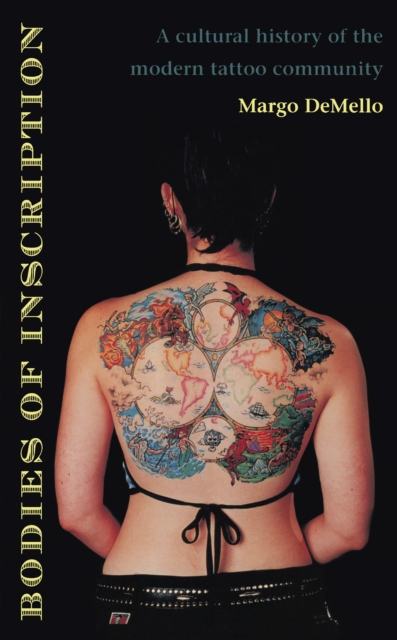
Bodies of inscription: a cultural history of the modern tattoo community
Since the 1980s, tattooing has emerged anew in the United States as a widely appealing cultural, artistic, and social form. In Bodies of Inscription Margo DeMello explains how elite tattooists, magazine editors, and leaders of tattoo organizations have downplayed the working-class roots of tattooing in order to make it more palatable for middle-class consumption. She shows how a completely new set of meanings derived primarily from non-Western cultures has been created to give tattoos an exotic, primitive flavor. Community publications, tattoo conventions, articles in popular magazines, and DeMello's numerous interviews illustrate the interplay between class, culture, and history that orchestrated a shift from traditional Americana and biker tattoos to new forms using Celtic, tribal, and Japanese images. DeMello's extensive interviews reveal the divergent yet overlapping communities formed by this class-based, American-style repackaging of the tattoo. After describing how the tattoo has moved from a mark of patriotism or rebellion to a symbol of exploration and status, the author returns to the predominantly middle-class movement that celebrates its skin art as spiritual, poetic, and self-empowering. Recognizing that the term \"community\" cannot capture the variations and class conflict that continue to thrive within the larger tattoo culture, DeMello finds in the discourse of tattooed people and their artists a new and particular sense of community and explores the unexpected relationship between this discourse and that of other social movements. This ethnography of tattooing in America makes a substantive contribution to the history of tattooing in addition to relating how communities form around particular traditions and how the traditions themselves change with the introduction of new participants. Bodies of Inscription will have broad appeal and will be enjoyed by readers interested in cultural studies, American studies, sociology, popular culture, and body art.
eBook