
Catalogue Search | MBRL


Are you sure you want to remove the book from the shelf?

{{itemTitle}}
9
result(s) for
"Dei, George J. Sefa (George Jerry Sefa), 1954- editor"
Sort by:
Knowledge and decolonial politics : a critical reader
\"Knowledge and decolonial politics: a critical reader offers the perspectives of educators and learners within current developmental settings, highlighting the systemic barriers faced whilst trying to implement decolonial pedagogies and practices. In the hope to challenge the dominance of Western Eurocentric thought in education and international development, the authors of this book offer counter narratives to promote the use of embodied cultural knowledges and histories, along with indigenous perspectives, in order to subvert Western knowledge systems which are inherently colonial in nature. Changing education as we know it today requires creating spaces in which multiple knowledges can co-exist and benefit from one another. These spaces will ensure the continuity of decolonial practices and shape the intellectual politics of future generations\"-- Provided by publisher.
Book


African indigenous knowledge and the disciplines
\"This text explores the multidisciplinary context of African Indigenous Knowledge Systems from scholars and scholar activists committed to the interrogation, production, articulation, dissemination and general development of endogenous and indigenous modes of intellectual activity and praxis. The work reinforces the demand for the decolonization of the academy and makes the case for a paradigmatic shift in content, subject matter and curriculum in institutions in Africa and elsewhere- with a view to challenging and rejecting disinformation and intellectual servitude. Indigenous intellectual discourses related to diverse disciplines take center stage in this volume with a focus on education, mathematics, medicine, chemistry and engineering in their historical and contemporary context\"--Back cover.
Book


Decolonization and anti-colonial praxis : shared lineages
\"Decolonization and Anti-colonial Praxis presents research on contemporary forms of decolonization and anti-colonialism in practice. It pertains to the ways in which individuals, groups, and communities engage with the logic of epistemic colonial power within areas of citizenship, migration, education, Indigeneity, language, land struggle, and social work. The contributions in this edited volume empirically document the conceptual and bodily engagement of racialized and violated individuals and communities as they use anti-colonial principles to disrupt criminalizing institutional discourses and policies within various global imperial contexts. The terms 'Decolonization' and 'Anti-colonialism' are used in diverse and interdisciplinary academic perspectives. They are researched upon and elaborated in necessary ways in the theoretical literature, however, it is rare to see these principles employed in applied forms. Decolonization and Anti-colonial Praxis provides a much needed contemporary and representative reclamation of these concepts from the standpoint of racialized communities. It explores the frameworks and methods rooted in their indigeneity, cultural history and memories to imagine a new future. The research findings and methodological tools presented in this book will be of interdisciplinary interest to teachers, graduate students and researchers. Contributors are: Harriet Akanmori, Ayah Al Oballi, Sevgi Arslan, Jacqueline Benn-John, Lucy El-Sherif, Danielle Freitas, Pablo Isla Monsalve, Dionisio Nyaga, Hoda Samater, Rose Ann Torres, Umar Umangay, and Anila Zainub\"-- Provided by publisher.
Book

Inclusive Education in African Contexts
How do we articulate the possibilities, limitations and challenges of inclusive schooling and education in African contexts? This book insists that inclusive education cannot be taken for granted. Inclusion is neither a natural nor a given educational practice. It must be struggled for. Bringing a critical perspective to inclusive schooling and education is imperative. This book adds to current educational debates with an African lens. It engages inclusive education from multiple lenses of curriculum content, classroom pedagogy and instruction, representation, culture, environment and the socio-organization life of schools, the pursuit of equity and social justice and the search for educational relevance.
eBook

Inclusive education in African contexts : a critical reader
\"How do we articulate the possibilities, limitations and challenges of inclusive schooling and education in African contexts? This book insists that inclusive education cannot be taken for granted. Inclusion is neither a natural nor a given educational practice. It must be struggled for. Bringing a critical perspective to inclusive schooling and education is imperative. This book adds to current educational debates with an African lens. It engages inclusive education from multiple lenses of curriculum content, classroom pedagogy and instruction, representation, culture, environment and the socio-organization life of schools, the pursuit of equity and social justice and the search for educational relevance. It is opined that Africa cannot be left behind in rethinking educational inclusion in ways that evoke critical questions of power, equity and social difference.The question of leaner's identity in terms of class, gender, sexuality, (dis)ability, language, ethnicity and race are equally consequential for African schooling and education. When inclusion is understood as wholeness of education, then how schooling and education engage the complete learner -- her/his body, mind, soul and spirit, as well as the use of local community and Indigenous knowledges in teaching and learning become relevant. Inclusion stands the risk of liberal educational agendas that simply tinker or toy with schooling and education and hardly embrace the challenge of educational change. What we need is a fundamental structural change that ensures schooling and education embraces difference while grappling with the teaching of Indigeneity, decolonization and resistance.\" -- Publisher's description
Book
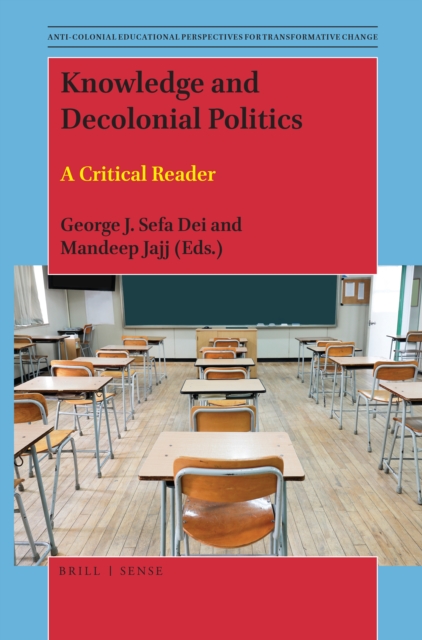
Knowledge and Decolonial Politics
Knowledge and Decolonial Politics: A Critical Reader offers the perspectives of educators and learners within current developmental settings, highlighting the dominance of Western epistemologies in 'academic knowledge making', and the systemic barriers faced whilst trying to implement decolonial practices.
eBook
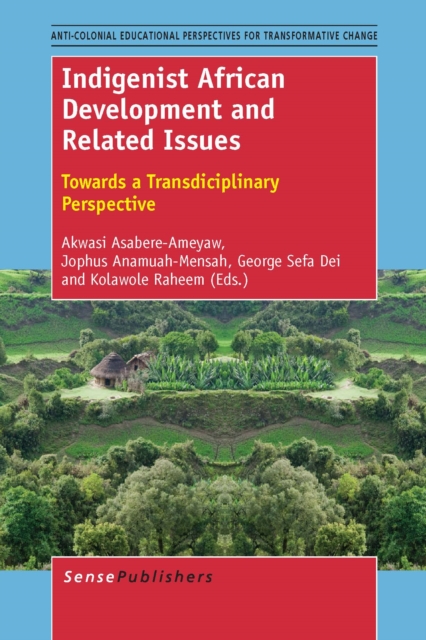
Indigenist African Development and Related Issues
This book brings Indigenous perspectives to African development. It is argued that contrary to development as we know it not working, a greater part of the problem is that conventional development approaches that work have in fact not truly been followed to the letter and hence the quagmire. All this is ironic since everything we do about our world is development.
eBook