
Catalogue Search | MBRL


Are you sure you want to remove the book from the shelf?

{{itemTitle}}
6
result(s) for
"Dennis, Adam, author"
Sort by:

Lean mobile app development : apply Lean startup methodologies to develop successful iOS and Android apps
Lean is the ultimate methodology for creating a startup that succeeds. Sounds great from a theoretical point of view, but what does that mean for you as a technical co-founder or mobile developer / By applying the Lean Start-up methodology to your mobile App development, it will become so much easier to build apps that take Google Play or the App Store by storm. This book shows you how to bring together smarter business processes with technical know-how. It makes no sense to develop a brilliant app for six months or longer only to find out later that nobody is interested in it. Build a Minimum Viable Product (MVP) first. Validate your hypotheses early and often. Discover effective product development strategies that let you put Facebook's famous axiom \"move fast and break things\" into practice. A great app without visibility and marketing clout is nothing, so use this book to market your app, making use of effective metrics that help you track and iterate all aspects of project performance -- page 4 of cover.
Book


On the Rural
A collection of previously untranslated writings by
Henri Lefebvre on rural sociology, situating his research in
relation to wider Marxist work On the Rural is
the first English collection to translate Lefebvre's crucial but
lesser-known writings on rural sociology and political economy,
presenting a wide-ranging approach to understanding the historical
and rural sociology of precapitalist social forms, their endurance
today, and conditions of dispossession and uneven development.
In On the Rural , Stuart Elden and Adam David Morton
present Lefebvre's key works on rural questions, including the
first half of his book Du rural à l'urbain and
supplementary texts, two of which are largely unknown conference
presentations published outside France. On the Rural
offers methodological orientations for addressing questions of
economy, sociology, and geography by deploying insights from
spatial political economy to decipher the rural as a terrain and
stake of capitalist transformation. By doing so, it reveals the
production of the rural as a key site of capitalist development and
as a space of struggle.
This volume delivers a careful translation-supplemented with
extensive notes and a substantive introduction-to cement Lefebvre's
central contribution to the political economy of rural sociology
and geography.
eBook
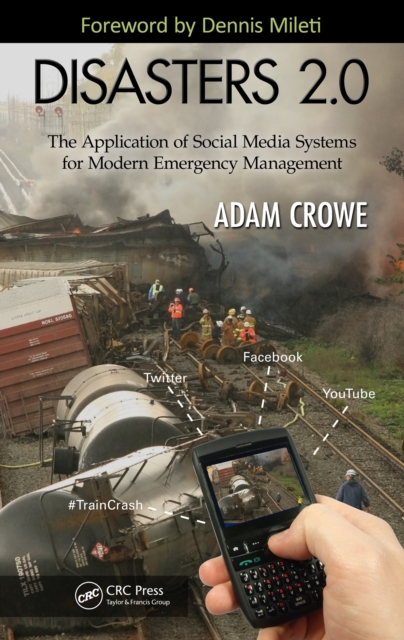
Disasters 2.0
Emerging social media and so-called Web 2.0 technologies will continue to have a great impact on the practice and application of the emergency management function in every public safety sector.Disasters 2.0: The Application of Social Media Systems for Modern Emergency Managementprepares emergency managers and first responders to successfully apply social media principles in the operations, logistics, planning, finance, and administrative aspects of any given disaster. Using real-life examples of domestic and international disasters, the book reveals how social media has quickly become a powerful tool for both providing emergency instruction to the public in real time and allowing responding agencies to communicate among themselves in crisis. A definitive and comprehensive source, the book explores topics such as: Social media basics Citizen journalism Strategic implementation Safety and responsibility Monitoring and analytics Operational implementation Geolocation systems Crowdsourcing Public notification Mobile and other emerging technologies Each chapter begins with a list of objectives and includes a collection of case examples of social media use in past events. Practitioner profiles show real people implementing the technology for real solutions. Demonstrating how to effectively apply social media technology to the next crisis, this is a must-read book for those charged with disaster management and response.
eBook

The Pocket-Size God
Fr. Robert Griffin, C.S.C. (1925–1999), was a beloved member of the Notre Dame community. With his cocker spaniel, Darby O'Gill, he was instantly recognizable on campus. He was well known for his priestly work counseling students as university chaplain for thirty years, his summer ministry to the homeless and parishioners in New York City, and his weekly columns in the student newspaper, The Observer, in which he invited the campus community to reflect with him on the challenges and joys of being Catholic in a time of enormous social and religious change. This collection draws together essays that Griffin wrote for Notre Dame Magazine between 1972 and 1994. In them, he considers many of the challenges that beset church and campus, such as the laicization of priests, premarital sex, the erosion of institutional authority, intolerance toward gay people, and failure of fidelity to the teachings of the church. Griffin also ruminates on the distress that human beings experience in the ordinariness of their lives—the difficulty of communication in families, grief over the loss of family and friends, the agonies of isolation, and the need for forgiveness. Griffin's shrewd insights still ring true for people today. His efforts to temper the winds of institutional rules, cultural change, and personal suffering reveal a mind keenly attuned to the need for understanding human limitations and to the presence of grace in times of change. Griffin quotes from the works of literary modernists, such as Fitzgerald and Hemingway, whose novels and short stories he loved; in these allusions and in his own reflections and experiences, Griffin bridges the spiritual and the secular and offers hope for reconciliation and comfort.
eBook

Love in the time of ethnography
Love in the Time of Ethnography explores love – variously defined – as an important facet of human life and a worthy focus of study. The authors look at love in association with an Alevi and Sunni couple in Turkey, organizers of Mexican American and immigrant youth movements, Christian missionaries in China, an elderly man with dementia, two women “coming home” to queer identity, a White researcher working with Black women in the US, the common ground between Dōgen’s Zen teachings and Habermas's critical theory, an Albanian Sufi community in Michigan and interactions between humans and the natural world. It also includes theoretical writing on the place of love in social analysis, whether this involves relationships between researchers and participants or the nature of human connection itself. The authors argue that social research is an affective process as well as a cognitive one, and that fellow feeling is an essential component of making sense of the world. Along with more traditional scholarly forms, the contributors to this book use auto-ethnography, life stories, archival research and poetry, noting that style itself conveys information and emotion. Writing is always to some extent partisan. While anthropologists and other social researchers have explored this idea over the last few decades, they have more often explored it with an eye to critique than to the ideals underlying that critique. This is a collection of essays about what ethnographers are aiming for as well as the problems they address, and the authors discuss ethical principles like agape, hizmet and cariño as rationales for ethnography and rationales for social change.
eBook