
Catalogue Search | MBRL


Are you sure you want to remove the book from the shelf?

{{itemTitle}}
116
result(s) for
"Derek Krueger"
Sort by:

Liturgical Subjects
Liturgical Subjects examines the history of the self in the Byzantine Empire, challenging narratives of Christian subjectivity that focus only on classical antiquity and the Western Middle Ages. As Derek Krueger demonstrates, Orthodox Christian interior life was profoundly shaped by patterns of worship introduced and disseminated by Byzantine clergy. Hymns, prayers, and sermons transmitted complex emotional responses to biblical stories, particularly during Lent. Religious services and religious art taught congregants who they were in relation to God and each other.Focusing on Christian practice in Constantinople from the sixth to eleventh centuries, Krueger charts the impact of the liturgical calendar, the eucharistic rite, hymns for vigils and festivals, and scenes from the life of Christ on the making of Christian selves. Exploring the verse of great Byzantine liturgical poets, including Romanos the Melodist, Andrew of Crete, Theodore the Stoudite, and Symeon the New Theologian, he demonstrates how their compositions offered templates for Christian self-regard and self-criticism, defining the Christian \"I.\" Cantors, choirs, and congregations sang in the first person singular expressing guilt and repentence, while prayers and sermons defined the collective identity of the Christian community as sinners in need of salvation. By examining the way models of selfhood were formed, performed, and transmitted in the Byzantine Empire, Liturgical Subjects adds a vital dimension to the history of the self in Western culture.
eBook
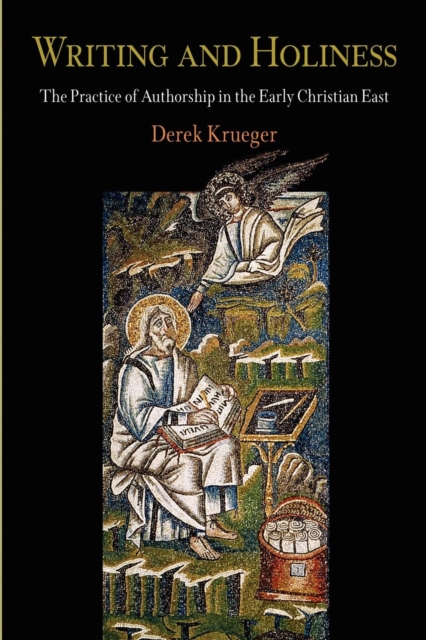
Writing and holiness : the practice of authorship in the early Christian East
Drawing on comparative literature, ritual and performance studies, and the history of asceticism, Derek Krueger explores how early Christian writers came to view writing as salvific, as worship through the production of art.
eBook

Writing and Holiness
Drawing on comparative literature, ritual and performance studies, and the history of asceticism, Derek Krueger explores how early Christian writers came to view writing as salvific, as worship through the production of art. Exploring the emergence of new and distinctly Christian ideas about authorship in late antiquity, Writing and Holiness probes saints' lives and hymns produced in the Greek East to reveal how the ascetic call to imitate Christ's humility rendered artistic and literary creativity problematic. In claiming authority and power, hagiographers appeared to violate the saintly practices that they sought to promote. Christian writers meditated within their texts on these tensions and ultimately developed a new set of answers to the question \"What is an author?\"Each of the texts examined here used writing as a technique for the representation of holiness. Some are narrative representations of saints that facilitate veneration; others are collections of accounts of miracles, composed to publicize a shrine. Rather than viewing an author's piety as a barrier to historical inquiry, Krueger argues that consideration of writing as a form of piety opens windows onto new modes of practice. He interprets Christian authors as participants in the religious system they described, as devotees, monastics, and faithful emulators of the saints, and he shows how their literary practice integrated authorship into other Christian practices, such as asceticism, devotion, pilgrimage, liturgy, and sacrifice. In considering the distinctly literary contributions to the formation of Christian piety in late antiquity, Writing and Holiness uncovers Christian literary theories with implications for both Eastern and Western medieval literatures.
eBook


Between Monks: Tales of Monastic Companionship in Early Byzantium
According to Moschos's introduction, he gathered up the stories like flowers into an anthology, to work the finest flowers of the unmown meadow into a garland to present to his faithful disciple, and through him to the world at large [...] Through the composition and publication of his text, Moschos became another conduit for such visions, dazzling his authence with images of monasticism that both inspired eros and constrained it.5 Only a few decades later, writing in the 640s, Leontios of Neapoiis offered an emotionally charged portrait of monastic companions in his Life ofSymeon the Fool.\\n One viable option for men to practice celibacy together in early Byzantium involved maintaining a primary emotional commitment to one other man.
Journal Article

Long-Term Monitoring of Bat Populations in North Dakota
Throughout the past few decades, North American bat species have experienced population declines due to White-Nose Syndrome, wind energy, climate change, and other factors. In North Dakota, the presence of wind energy, and the recent arrival of White-Nose Syndrome in 2019, pose serious threats to bat populations in the state. The objective of this study was to gather and analyze long term population data on the different bat species in North Dakota. In Summers of 2019–2021, we recorded bat echolocation call sequences at 60 grid cells established across North Dakota. We compared data across years to determine if any species showed changes in activity level. Occupancy modeling was also used to determine any link between occupancy/detectability and some environmental features for four bat species in 2020. Our results suggest a possible decline in regional populations of species in the Myotis genus. We found no link between occupancy and environmental factors.
Dissertation

The Unbounded Body in the Age of Liturgical Reproduction
Miracle stories from the sixth and seventh centuries about irregular, accidental, and inadvertent Eucharists demonstrate God's unbounded and excessive material body. These traditions provide a counterpoint to ascetic emphasis on bodily discipline and limits. As narratives of divine abundance, these tales contain implicit theologies of the Eucharist and theories of ritual efficacy through the recitation of anaphoral prayers.
Journal Article
Romanos the Melodist and the Christian Self
Within his hymns, the sixth-century liturgical poet Romanos the Melodist gave voice to a wide range of biblical characters.¹ He composed dialogues, imaginatively reconstructing the interactions of biblical personae. In his Christological hymns, his audience might witness Christ’s interaction with Mary, Peter, Thomas, or the Harlot who anointed Jesus while at supper.² In hymns on Old Testament themes, his listeners attended the narratives of Abraham and Sarah, Joseph, and Jonah. Keying his hymns to the events of the liturgical calendar, Romanos gave psychological depth to biblical heroes and villains, modeling a whole range of possible interactions both with the sacred
Book Chapter