
Catalogue Search | MBRL


Are you sure you want to remove the book from the shelf?

{{itemTitle}}
24
result(s) for
"Derenowski, Marek"
Sort by:
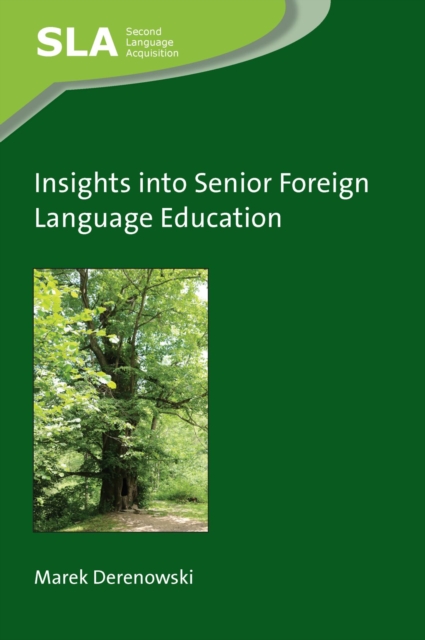
Insights into Senior Foreign Language Education
This book examines the unique characteristics of teaching
foreign languages to senior learners. It discusses the potential
age-related barriers and learning difficulties which may be
encountered in senior foreign language education as well as
solutions to overcome these challenges. The author describes the
processes of human aging from different perspectives and introduces
the concept of lifelong learning. The book proposes classroom
practices, activities and materials that may be adopted when
working with senior learners which will prove useful to teachers
and teacher trainers, as well as to educational policymakers and
planners. Furthermore, it describes potential modifications to
educational programmes that may be introduced in order to eliminate
affective barriers, making the learning material relevant and
motivating, and encouraging the use of adult learning
strategies.
eBook
Interdisciplinary Approach to Aging
When in 1513 Spanish explorer Juan Ponce de Leon travelled to what is now called the state of Florida, he was hoping to find the fabled Fountain of Youth, which, according to the apocryphal combination of New World and Eurasian legends as well as stories told by the local Native Americans, was located in a place called Bimini. Water from the pool could restore youth to anyone who drank from it. According to the legends, there existed a mythical land of prosperity with a pond having mystical healing powers. Of course Ponce de Leon was not the first nor the
Book Chapter
Voices from the Classroom
In recent years we have observed a growing interest in foreign language acquisition and aging as the philosophy of lifelong learning is becoming one of the dominant trends in educational policies all around the world, having its reflection in the official documents of the European Union and other organisations. There is a growing tendency to perceive senior learners as a group with specific characteristics and needs. On the one hand, older learners are faced with negative stereotyping that with time memory, cognitive and physical abilities decline. On the other hand, there is evidence that senior learners can be successful in
Book Chapter
Lifelong Learning in a Contemporary Society
The philosophy of learning throughout the entire life is anything but modern, since ‘ancient societies all over the world have emphasized the need to learn from the cradle to the grave’ (Medel-Añonuevo et al., 2001: a). The concept of lifelong learning was firmly embodied in the works of the ancient philosophers, such as Confucius (551–479 BC), Socrates (469–399 BC), Plato (427–347BC) and Seneca (4BC to 65AD), who described the process of learning which comprised a whole human life. Later, Amos Komensky (1592–1670) and Grundtvig (1783–1872) came back to the concept of learning through the whole
Book Chapter
Senior Language Learning
The first two decades of the 21st century introduced challenges that humanity had to face and deal with. One of them is the constant aging of the world population. Between 2025 and 2050 the elderly population is going to expand from 1.2 to 2 billion people, which constitutes more than 20% of the world population. These predictions may be drastically changed by to Covid-19 epidemic, which has proven to be lethal especially to older members of our societies and is already increasing the death toll dramatically, especially in Europe and both Americas, but also in Asia, Africa and Australia. If
Book Chapter

Conclusions and Modest Suggestions for Further Research
It was Confucius who said that: ‘Old age is a good and pleasant thing. It is true you are gently shouldered off the stage, but then you are given such a comfortable front chair as spectator’ (Goodman, 1976). However, this book is not about those who are willing to sit quietly in comfortable chairs but, rather those elderly members of our societies who decide to transform their third or even fourth age into an active and challenging enterprise as well as those for whom lifelong learning is sometimes the only chance to become full-fledged members of society and to overcome
Book Chapter
Introduction
Albert Einstein wrote that ‘wisdom is not a product of schooling, but the lifelong attempt to acquire it’ (Dukas & Hoffmann, 2013: 44). Before him there was Seneca the Younger (4–65 AD), who said: ‘As long as you live keep learning how to live’ (McGowan, 1931: 27). Curiosity and inquisitive mind have always been engraved in human nature, just as learning has always been an intrinsic characteristic of humanity. In the contemporary world societies are aging and the active life span is being extended significantly. On the one hand, these aging societies must face challenges such as social exclusion or
Book Chapter