
Catalogue Search | MBRL


Are you sure you want to remove the book from the shelf?

{{itemTitle}}
25
result(s) for
"Devercelli, Amanda E"
Sort by:


Early childhood development coming of age: science through the life course
Early childhood development programmes vary in coordination and quality, with inadequate and inequitable access, especially for children younger than 3 years. New estimates, based on proxy measures of stunting and poverty, indicate that 250 million children (43%) younger than 5 years in low-income and middle-income countries are at risk of not reaching their developmental potential. There is therefore an urgent need to increase multisectoral coverage of quality programming that incorporates health, nutrition, security and safety, responsive caregiving, and early learning. Equitable early childhood policies and programmes are crucial for meeting Sustainable Development Goals, and for children to develop the intellectual skills, creativity, and wellbeing required to become healthy and productive adults. In this paper, the first in a three part Series on early childhood development, we examine recent scientific progress and global commitments to early childhood development. Research, programmes, and policies have advanced substantially since 2000, with new neuroscientific evidence linking early adversity and nurturing care with brain development and function throughout the life course.
Journal Article
Measuring and forecasting progress in education: what about early childhood?
A recent Nature article modelled within-country inequalities in primary, secondary, and tertiary education and forecast progress towards Sustainable Development Goal (SDG) targets related to education (SDG 4). However, their paper entirely overlooks inequalities in achieving Target 4.2, which aims to achieve universal access to quality early childhood development, care and preschool education by 2030. This is an important omission because of the substantial brain, cognitive and socioemotional developments that occur in early life and because of increasing evidence of early-life learning’s large impacts on subsequent education and lifetime wellbeing. We provide an overview of this evidence and use new analyses to illustrate medium- and long-term implications of early learning, first by presenting associations between pre-primary programme participation and adolescent mathematics and science test scores in 73 countries and secondly, by estimating the costs of inaction (not making pre-primary programmes universal) in terms of forgone lifetime earnings in 134 countries. We find considerable losses, comparable to or greater than current governmental expenditures on all education (as percentages of GDP), particularly in low- and lower-middle-income countries. In addition to improving primary, secondary and tertiary schooling, we conclude that to attain SDG 4 and reduce inequalities in a post-COVID era, it is essential to prioritize quality early childhood care and education, including adopting policies that support families to promote early learning and their children’s education.
Journal Article
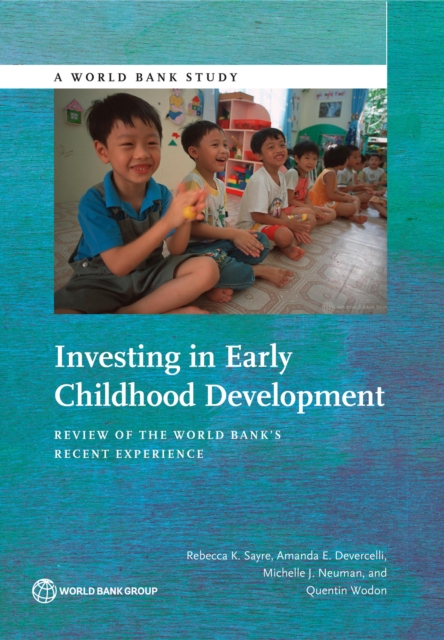
Investing in early childhood development
This study provides an overview of Bank investments in Early Childhood Development (ECD) from 2000-2013 within the Education, Health, Nutrition and Population, and Social Protection and Labor practices. The study summarizes trends in operational and analytical investments in early childhood, including lending and trust funded operations at the country, regional, and global levels. Findings are presented on the overall level of finance during this thirteen-year period, the number of ECD investments, and regional and sectoral trends. A series of case studies are presented to highlight lessons learned to inform future Bank support to ECD and to promote better planning across sectors and regions. Trends in analytical and advisory activities are also discussed, including economic sector work, technical assistance, partnership activities, impact evaluations, programmatic approaches, and knowledge products. Finally, the study discusses recent new approaches to support ECD within the World Bank and in client countries. The study benefited from support from the Children Investment Fund Foundation.
eBook

Early Childhood Policies in Sub-Saharan Africa: Challenges and Opportunities
In recent years, increasing priority has been placed on the development of national intersectoral early childhood development (ECD) policies in Sub-Saharan Africa. This paper reviews the role of national ECD policies to promote young children’s access to key early childhood services. We discuss the proliferation of national ECD policies in Sub-Saharan Africa in the last decade and argue that for most countries, these documents can be useful, but are not sufficient without proper implementation and enforcement. We look specifically at the different ECD policies and institutional arrangements in four countries in East Africa: Ethiopia, Kenya, Tanzania and Uganda and draw out some cross-country lessons for moving from policy development to implementation.
Journal Article
Advancing Early Childhood Development: from Science to Scale 1
Early childhood development programmes vary in coordination and quality, with inadequate and inequitable access, especially for children younger than 3 years. New estimates, based on proxy measures of stunting and poverty, indicate that 250 million children (43%) younger than 5 years in low-income and middle-income countries are at risk of not reaching their developmental potential. There is therefore an urgent need to increase multisectoral coverage of quality programming that incorporates health, nutrition, security and safety, responsive caregiving, and early learning. Equitable early childhood policies and programmes are crucial for meeting Sustainable Development Goals, and for children to develop the intellectual skills, creativity, and wellbeing required to become healthy and productive adults. In this paper, the first in a three part Series on early childhood development, we examine recent scientific progress and global commitments to early childhood development. Research, programmes, and policies have advanced substantially since 2000, with new neuroscientific evidence linking early adversity and nurturing care with brain development and function throughout the life course.
Journal Article

Investing in Early Childhood Development
This study provides an overview of Bank investments in Early Childhood Development (ECD) from 2000-2013 within the Education, Health, Nutrition and Population, and Social Protection and Labor practices. The study summarizes trends in operational and analytical investments in early childhood, including lending and trust funded operations at the country, regional, and global levels. Findings are presented on the overall level of finance during this thirteen-year period, the number of ECD investments, and regional and sectoral trends. A series of case studies are presented to highlight lessons learned to inform future Bank support to ECD and to promote better planning across sectors and regions. Trends in analytical and advisory activities are also discussed, including economic sector work, technical assistance, partnership activities, impact evaluations, programmatic approaches, and knowledge products. Finally, the study discusses recent new approaches to support ECD within the World Bank and in client countries. The study benefited from support from the Children Investment Fund Foundation
Book