
Catalogue Search | MBRL


Are you sure you want to remove the book from the shelf?

{{itemTitle}}
52
result(s) for
"Dew, Nicholas"
Sort by:


What to do next? The case for non-predictive strategy
Two prescriptions dominate the topic of what firms should do next in uncertain situations: planning approaches and adaptive approaches. These differ primarily on the appropriate role of prediction in the decision process. Prediction is a central issue in strategy making owing to the presumption that what can be predicted can be controlled. In this paper we argue for the independence of prediction and control. This implies that the pursuit of successful outcomes can occur through control-oriented approaches that may essentially be non-predictive. We further develop and highlight control-oriented approaches with particular emphasis on the question of what organizations should do next. We also explore how these approaches may impact the costs and risks of firm strategies as well as the firm's continual efforts to innovate.
Journal Article

Shaping entrepreneurship research
Preface1. PrimerPart 1: Motivation1. Introduction: A pluralistic approach to entrepreneurship research2. The Sciences of the Artificial (Herbert A. Simon) 3. Three Varieties of Knowledge (Donald Davidson)4. The Market as a Creative Process (James M. Buchanan and Viktor J. Vanberg)Part 2: Maker5. Introduction: Entrepreneurial Agency6. Bounding Rationality to the World (Peter M. Todd and GerdGigerenzer) 7. Philosophy in the Flesh: The Embodied Mind and Its Challenge to Western Thought (George Lakoff and Mark Johnson)8. The Construction of Preference (Paul Slovic)9. The Technology of Foolishness (James March)10. Great Men, Great Thoughts, and the Environment (William James)Part 3: Making11. Entrepreneurial Process12. Words, Works, Worlds, Ways of Worldmaking (Nelson Goodman)13. Competition as a Discovery Procedure (F.A. Hayek)14. The Transactional Self (Jerome Bruner)15. The Spandrels of San Marco and the Panglossian Paradigm (S. J. Gould and R. C. Lewontin)16. The Coasian and Knightian Theories of the Firm (Donald J. Boudreaux and Randall G. Holcombe)Part 4: Made17. Introduction: Entrepreneurial Outcomes17. The State of Humanity (Julian L. Simon)18. From the Past to the Future (Julian L. Simon)19. The Possibility of Social Choice (Amartya Sen)20. The Mystery of Capital: Why Capitalism Triumphs In The West And Fails Everywhere Else (Hernando De Soto)21. Beyond Markets and States: Polycentric Governance of Complex Economic Systems (Elinor Ostrom)22. Social Attitudes, Entrepreneurship and Economic Development (Alexander Gerschenkron)Part 5: Method23. Studying entrepreneurship as a three-legged artifact 24. Economics as a Historical Science (Herbert A. Simon)25. The Art and Science of Cause and Effect (Judea Pearl)26. Conceptual Metaphor in Everyday Language (George Lakoff and Mark Johnson)27. Contingency, Irony, and Solidarity (Richard Rorty)28. What Pragmatism Means (William James)29. Conclusion: Creative Powers of a Free Civilization (F.A. Hayek)
Book
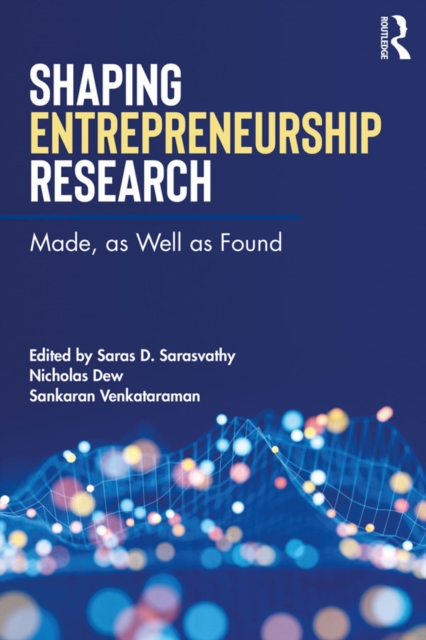
Shaping Entrepreneurship Research
Shaping Entrepreneurship Research: Made, as Well as Found is a collection of readings designed to support entrepreneurship research. Focused on a worldview in which the future is open-ended and shapeable through human action - i.e. \"made\", this collection reframes entrepreneurship as a science of the artificial rather than as a natural or social science. It posits an open-ended universe for the making of human artifacts even if large swathes of nature and society are not within the control of the people making them.
The book explores the notion of \"made\" through 25 foundational readings - classics from the history of ideas. Organized into five sections, each classic is individually introduced by the editors in one of five chapters written to explain its relevance and significance for a \"made\" view of entrepreneurship. Readers will benefit from exposure to these classic ideas and ongoing research in a variety of areas that fall somewhat outside the line-of-sight of traditional entrepreneurship research. Both individually and collectively, the readings suggest opportunities to ask new questions and develop new ways of framing entrepreneurship research that carry the discussion beyond worlds found to worlds made as well as found.
The book is crafted to be valuable to three groups of scholars: young scholars with limited or no access to research infrastructure but with a desire to participate in deep conversations; young scholars with access to research infrastructure who also desire to listen-in on a different kind of conversation; and established entrepreneurship scholars who are contemplating an alternative set of foundational ideas to support their conversations in the discipline.
eBook

Unshackling Imagination: How Philosophical Pragmatism can Liberate Entrepreneurial Decision-Making
Despite the evident importance of imagination in both ethical decision-making and entrepreneurship, significant gaps remain in our understanding of its actual role in these processes. As a result, scholars have called for a deeper understanding of how imagination impacts value creation in society and how this critical human faculty might more profoundly connect our theories of ethics and business decision-making. In this paper, we attempt to fill one of these gaps by scrutinizing the underlying philosophical foundations of imagination and applying them to the challenges facing entrepreneurs attempting to create new value in an increasingly unpredictable and kaleidic world. Accordingly, we apply a view of imagination developed by the pragmatist philosopher John Dewey to the radically subjective economic philosophy of G.L.S Shackle. As a result, we develop a concept of imagination which we believe can be both significant and hopeful for research at the intersection of business ethics and new value creation.
Journal Article

Marketing under Uncertainty: The Logic of an Effectual Approach
How do people approach marketing in the face of uncertainty, when the product, the market, and the traditional details involved in market research are unknowable ex ante? The authors use protocol analysis to evaluate how 27 expert entrepreneurs approach such a problem compared with 37 managers with little entrepreneurial expertise (all 64 participants are asked to think aloud as they make marketing decisions in exactly the same unpredictable situation). The hypotheses are drawn from literature in cognitive science on (1) expertise in general and (2) entrepreneurial expertise in particular. The results show significant differences in heuristics used by the two groups. While those without entrepreneurial expertise rely primarily on predictive techniques, expert entrepreneurs tend to invert these. In particular, they use an effectual or nonpredictive logic to tackle uncertain market elements and to coconstruct novel markets with committed stakeholders.
Journal Article

Abduction: a pre-condition for the intelligent design of strategy
Purpose
– This paper seeks to introduce the concept of abduction to strategists and show how abduction is an important influence on the effective design of strategies.
Design/methodology/approach
– The paper defines what is meant by abduction, and describes why abduction is a pre-condition for intelligent designing. It reviews different characteristics of abduction, and suggests several situations in which abduction is used in strategic thinking. It describes a framework managers can use to get better at abductive thinking.
Findings
– The paper finds that strategists can gain a lot from knowing how to use abduction well. Abduction is making inferences to the best explanation from information that is surprising or anomalous – both very typical in strategic decision making. Abduction is frequently integral to problem defining. Problem defining, in turn, sets the stage for possibility thinking, and choice of the best alternative. Therefore, good abductive thinking is a pre-condition for intelligent designing in strategy.
Originality/value
– The paper shows that abduction is of practical relevance to business strategists, just as much as it is for the practice of law and medicine – two professions that have traditionally put it to effective use.
Journal Article

Scientific travel in the Atlantic world: the French expedition to Gorée and the Antilles, 1681–1683
Although historians have long recognized the importance of long-range scientific expeditions in both the practice and culture of eighteenth- and nineteenth-century science, it is less well understood how this form of scientific organization emerged and became established in the seventeenth and early eighteenth centuries. In the late seventeenth century new European scientific institutions tried to make use of globalized trade networks for their own ends, but to do so proved difficult. This paper offers a case history of one such expedition, the voyage sponsored by the French Académie royale des sciences to Gorée (in modern Senegal) and the Caribbean islands of Guadeloupe and Martinique in 1681–3. The voyage of Varin, Deshayes and de Glos reveals how the process of travel itself caused problems for instruments and observers alike.
Journal Article
Scientific travel in the Atlantic world: the French expedition to Gorée and the Antilles, 1681-1683
Although historians have long recognized the importance of long-range scientific expeditions in both the practice and culture of eighteenth- and nineteenth-century science, it is less well understood how this form of scientific organization emerged and became established in the seventeenth and early eighteenth centuries. In the late seventeenth century new European scientific institutions tried to make use of globalized trade networks for their own ends, but to do so proved difficult. This paper offers a case history of one such expedition, the voyage sponsored by the French Académie royale des sciences to Gorée (in modern Senegal) and the Caribbean islands of Guadeloupe and Martinique in 1681-3. The voyage of Varin, Deshayes and de Glos reveals how the process of travel itself caused problems for instruments and observers alike.
Journal Article
Innovations, Stakeholders & Entrepreneurship
In modern societies entrepreneurship and innovation are widely seen as key sources of economic growth and welfare increases. Yet entrepreneurial innovation has also meant losses and hardships for some members of society: it is destructive of some stakeholders' wellbeing even as it creates new wellbeing among other stakeholders. Both the positive benefits and negative externalities of innovation are problematic because entrepreneurs initiate new ventures before their private profitability and/or social costs can be fully recognized. In this paper we consider three analytical frameworks within which these issues might be examined: pre-commitments, contractarianism, and an entrepreneurial framework. We conclude that the intersection of stakeholder theory and entrepreneurial innovation is a potentially rich arena for research.
Journal Article