
Catalogue Search | MBRL


Are you sure you want to remove the book from the shelf?

{{itemTitle}}
1,555
result(s) for
"Dewey, John"
Sort by:

كيف نفكر ؟
يهتم هذا الكتاب بدور المؤسسات التعليمية من مدارس ومعاهد وجامعات في تعزيز التفكير العلمي الممنهج أو في إعاقته وهنا تكمن معضلة النظم التعليمية من مناهج تدريسية وطرق تلقين وأساليب اختبار ومعايير تقويم وقياس وفي خاتمة المطاف المخرج النهائي المتمثل بالتخرج المتأهل لأداء غاية محددة حسب تعبير ديوي في الوقت الحاضر لا يجب على شغل التعليم تحويل الميول الطبيعية إلى عادات فكر مدربة فحسب بل عليه أيضا أن يحصن العقل ضد النزعات غير العقلانية الشائعة في البيئة الاجتماعية.
Book

Do Implicit and Explicit Measures of the Sense of Agency Measure the Same Thing?
The sense of agency (SoA) refers to perceived causality of the self, i.e. the feeling of causing something to happen. The SoA has been probed using a variety of explicit and implicit measures. Explicit measures include rating scales and questionnaires. Implicit measures, which include sensory attenuation and temporal binding, use perceptual differences between self- and externally generated stimuli as measures of the SoA. In the present study, we investigated whether the different measures tap into the same self-attribution processes by determining whether individual differences on implicit and explicit measures of SoA are correlated. Participants performed tasks in which they triggered tones via key presses (operant condition) or passively listened to tones triggered by a computer (observational condition). We replicated previously reported effects of sensory attenuation and temporal binding. Surprisingly the two implicit measures of SoA were not significantly correlated with each other, nor did they correlate with the explicit measures of SoA. Our results suggest that some explicit and implicit measures of the SoA may tap into different processes.
Journal Article


Orogeny Can Be Very Short
In contrast to continent/continent collision, arc-continent collision generates very short-lived orogeny because the buoyancy-driven impedance of the subduction of continental lithosphere, accompanied by arc/suprasubduction-zone ophiolite obduction, is relieved by subduction polarity reversal (flip). This tectonic principle is illustrated by the early Ordovician Grampian Orogeny in the British and Irish Caledonides, in which a wealth of detailed sedimentologic, heavy mineral, and geochronologic data pin the Orogeny to a very short Arenig/Llanvirn event. The Orogeny, from the initial subduction of continental margin sediments to the end of postflip shortening, lasted $\\approx18$ million years (my). The collisional shortening, prograde-metamorphic phase of the Orogeny lasted 8 my, extensional collapse and exhumation of midcrustal rocks lasted 1.5 my, and postflip shortening lasted 4.5 my. Strain rates were a typical plate-boundary-zone 10-15. Metamorphism, to the second sillimanite isograd, with extensive partial melting, occurred within a few my after initial collision, indicating that conductive models for metamorphic heat transfer in Barrovian terrains are incorrect and must be replaced by advective models in which large volumes of mafic/ultramafic magma are emplaced, syn-tectonically, below and into evolving nappe stacks. Arc/continent collision generates fast and very short orogeny, regional metamorphism, and exhumation.
Journal Article


Storm, rogue wave, or tsunami origin for megaclast deposits in western Ireland and North Island, New Zealand?
The origins of boulderite deposits are investigated with reference to the present-day foreshore of Annagh Head, NW Ireland, and the Lower Miocene Matheson Formation, New Zealand, to resolve disputes on their origin and to contrast and compare the deposits of tsunamis and storms. Field data indicate that the Matheson Formation, which contains boulders in excess of 140 tonnes, was produced by a 12- to 13-m-high tsunami with a period in the order of 1 h. The origin of the boulders at Annagh Head, which exceed 50 tonnes, is disputed. We combine oceanographic, historical, and field data to argue that this is a cliff-top storm deposit (CTSD). A numerical model for CTSDs is developed which indicates that boulder shape in addition to density and dimensions should be taken into account when applying hydrodynamic equations to such deposits. The model also predicts that the NE Atlantic storms are capable of producing boulderites that, when size alone is considered, cannot be distinguished from tsunamites. We review the characteristics that identify the origins of these two deposits.
Journal Article

البحث عن اليقين
كان الإنسان في ظل الفلسفات التقليدية يكتسب المعرفة، فيتغير، لأنه يستنير من حصوله عليها، فيصبح عارفا بعد أن كان جاهلا، ولكنها معرفة أشبه بالحلية التي تضاف إلى الشيء لتكسبه رونقا فيصلح للزينة. أما المعرفة التي يطالب بها ديوي، فهي ذلك الضرب الذي يغير العالم لأنه يتدخل فيه ويوجهه. والمعرفة لا تُطلب لذاتها، ولا لأنها لا تفضي إلى الاستنارة وتبديد الجهل، بل لأنها تحقق الأمن حين ترسى قواعدنا على شاطئ اليقين. إذا بلغ أحدنا اليقين اطمأن، واستقر، وإذا لم يبلغ اليقين، بل الشك أو اللايقين، أو الرجحان، أو الاحتمال، لم يستقر، ولم يطمئن. ومن هذه الزاوية – نعنى زاوية اليقين واللايقين وما يتردد بينهما من درجات مختلفة تقترب من اليقين أو تبتعد عنه – بحث ديوي في هذا الكتاب، فجاء عنوانه \"البحث عن اليقين\".
Book

The sole of an ophiolite; the Ordovician Bay of Islands Complex, Newfoundland
The early Ordovician (c. 485 Ma) Bay of Islands Ophiolite Complex was obducted onto the Laurentian rifted margin as the fore-arc of an oceanic arc that collided with the margin during the mid-Ordovician (c. 470 Ma). The subduction zone was nucleated on an oceanic transform-fracture zone, part of whose remnants occur as the polyphase-deformed and intruded mafic and ultramafic rocks of the Coastal Complex. The ophiolite formed as a suprasubduction-zone fore-arc ophiolite at the spatial and temporal continuation of the ridge normal to the transform-fracture zone-subduction zone system and NE of a trench-trench-ridge triple junction. A two-pyroxene garnet granulite-garnet amphibolite-epidote amphibolite mafic metamorphic sole at the base of the ophiolite was generated, roughly synchronously with the ophiolite, by the metamorphism of mid-ocean ridge basalt mafic rocks in the descending slab at about 10 kbar and quickly attached to the base of the overlying ophiolite during slab flattening, and not by subduction zone extrusion. The metamorphic sole is not a metamorphic aureole at the base of a hot obducting ophiolite. Plate slip vector triangles around the triple junction, before collision and during obduction, are constructed from the orientation of dykes in the sheeted complex and the trends of structures in the high- to lower-temperature parts of the sole and the obducted nappes of oceanic and continental margin rocks beneath the ophiolite. Linear structures in the sole amphibolites trend NNW (the subduction direction); those in the greenschist-facies, obducted, oceanic and continental margin rocks trend WSW (the obduction direction).
Journal Article
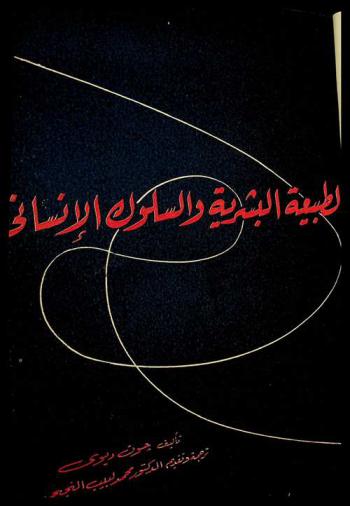
الطبيعة البشرية والسلوك الإنساني
يتناول كتاب (الطبيعة البشرية والسلوك الإنساني) والذي قام بتأليفه (جون ديوي) في حوالي (350) صفحة من القطع المتوسط موضوع (الطبيعة البشرية) مستعرضا المحتويات التالية : الجزء الأول بعنوان مكان العادة من السلوك الإنساني، الفصل الأول العادات كوظائف اجتماعية، الفصل الثاني العادات والإرادة، الفصل الثالث الشخصية والسلوك، الجزء الثاني بعنوان مكان الدافع من السلوك الإنساني، الفصل الأول الدافع وتغيير العادات، الفصل الثاني مطاوعة الدافع، الجزء الثالث بعنوان مكان الذكاء من السلوك الإنساني، الجزء الرابع والأخير بعنوان الخاتمة.
Book

Discussion of Searle, ‘Tectonic evolution of the Caledonian orogeny in Scotland: a review based on the timing of magmatism, metamorphism and deformation’
Searle (2022) argues, based on data from Scotland alone, that the deformation and metamorphism of the Scottish Highlands is continuously diachronous from the early Ordovician (Grampian) in the Dalradian of the Grampian Highlands to the mid-Silurian (Scandian) in the Moine of the Northwest Highlands. Necessarily, he disputes substantial offset along the Great Glen Fault (GGF). He compares the Scottish Caledonides with the Himalayas. We take the different view, which also considers evidence from along-strike in Ireland and Newfoundland, that the Grampian and Scandian orogenies were discrete events. The Grampian Orogeny involved major deformation and metamorphism across the Grampian and Northwest Highlands to the Moine Thrust Zone, whereas the Scandian Orogeny affected only the Northwest Highlands. The early Ordovician Grampian Orogeny was generated by the collision and obduction of an oceanic arc-ophiolite with and onto the Laurentian continent. The mid-Silurian Scandian Orogeny was caused by continental collision between Laurentia and Baltica. Late Silurian – early Devonian sinistral slip along the GGF emplaced the the Moine of the Northwest Highlands from a distant location to the north in the Scandian collision zone, against the Dalradian, which had not been involved in the Scandian collision. We outline several (eight) arguments that we believe contradict evidence for progressive northwestward propagation of a Himalaya-style thrust wedge from the early Ordovician to the mid-Silurian.
Journal Article